Method and apparatus for autonomically moving cache entries to dedicated storage when false cache line sharing is detected

a cache entry and autonomic movement technology, applied in the field of improvement, can solve problems such as interruption, and achieve the effect of avoiding reloading of cache lines

US7114036B2Inactive Publication Date: 2006-09-26IBM CORP
51 Cites 41 Cited by

Patent Information

Authority / Receiving Office
US · United States
Patent Type
Patents(United States)
Current Assignee / Owner
Publication Date
2006-09-26
Estimated Expiration
Not applicable · inactive patent

Smart Images

  • Figure 1
    Figure 1
  • Figure 2
    Figure 2
  • Figure 3
    Figure 3
Patent Text Reader

Abstract

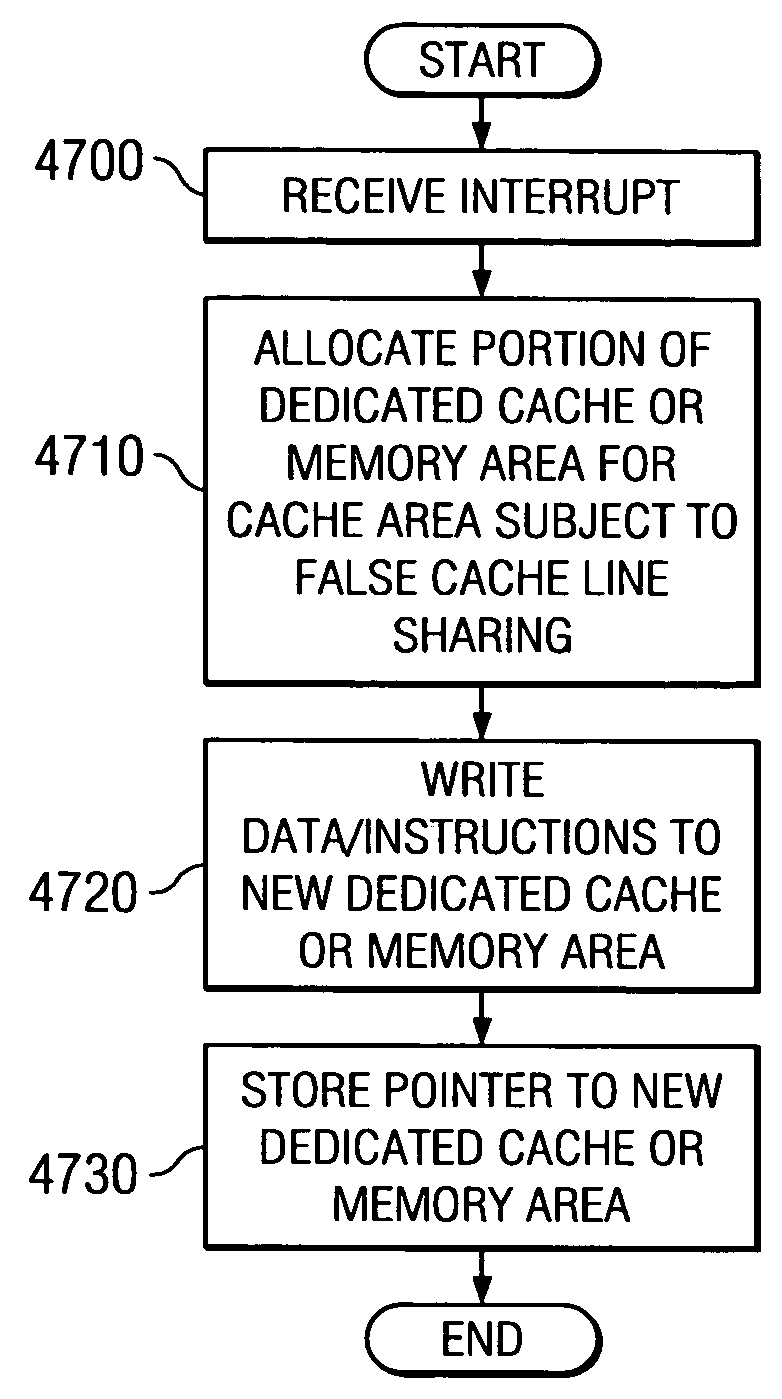
A method, apparatus, and computer instructions in a data processing system for processing instructions are provided. Instructions are received at a processor in the data processing system. If a selected indicator is associated with the instruction, counting of each event associated with the execution of the instruction is enabled. In some embodiments, when it is determined that a cache line is being falsely shared using the performance indicators and counters, an interrupt may be generated and sent to a performance monitoring application. An interrupt handler of the performance monitoring application will recognize this interrupt as indicating false sharing of a cache line. Rather than reloading the cache line in a normal fashion, the data or instructions being accessed may be written to a separate area of cache or memory area dedicated to false cache line sharing data. The code may then be modified by inserting a pointer to this new area of cache or memory. Thus, when the code again attempts to access this area of the cache, the access is redirected to the new cache or memory area rather than to the previous area of the cache that was subject to false sharing. In this way, reloads of the cache line may be avoided.
Need to check novelty before this filing date? Find Prior Art

Description

CROSS REFERENCE TO RELATED APPLICATIONS

[0001] The present invention is related to the following applications entitled “Method and Apparatus for Counting Instruction Execution and Data Accesses”, Ser. No. 10 / 675,777, filed on Sep. 30, 2003; “Method and Apparatus for Selectively Counting Instructions and Data Accesses”, Ser. No. 10 / 674,604, filed on Sep. 30, 2003; “Method and Apparatus for Generating Interrupts Upon Execution of Marked Instructions and Upon Access to Marked Memory Locations”, Ser. No. 10 / 675,831, filed on Sep. 30, 2003; “Method and Apparatus for Counting Data Accesses and Instruction Executions that Exceed a Threshold”, Ser. No. 10 / 675,778, filed on Sep. 30, 2003; “Method and Apparatus for Counting Execution of Specific Instructions and Accesses to Specific Data Locations”, Ser. No. 10 / 675,776, filed on Sep. 30, 2003; “Method and Apparatus for Debug Support for Individual Instructions and Memory Locations”, Ser. No. 10 / 675,751, filed on Sep. 30, 2003; “Method and Appar...

Examples

Embodiment Construction

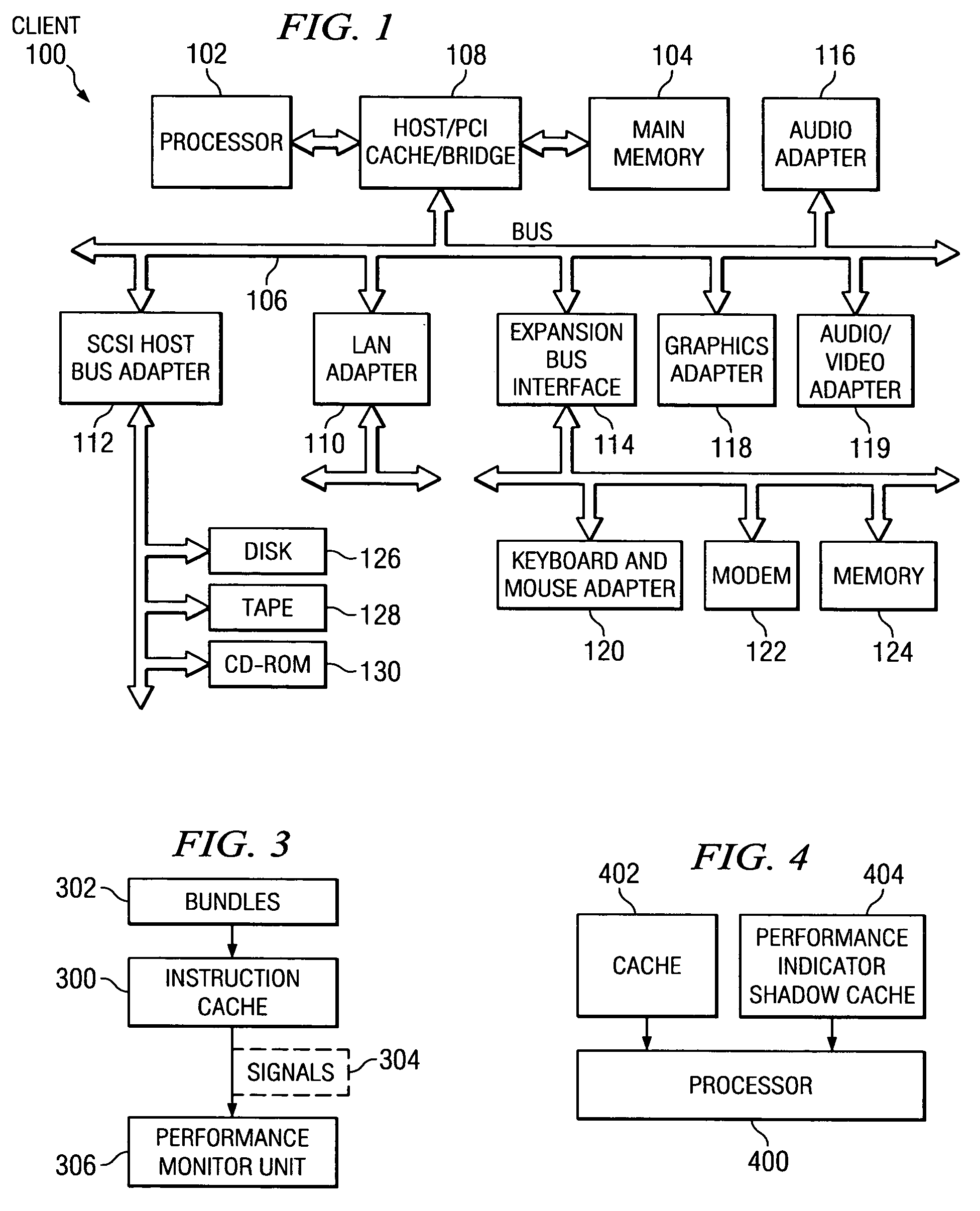
[0082]With reference now to FIG. 1, a block diagram of a data processing system is shown in which the present invention may be implemented. Client 100 is an example of a computer, in which code or instructions implementing the processes of the present invention may be located. Client 100 employs a peripheral component interconnect (PCI) local bus architecture. Although the depicted example employs a PCI bus, other bus architectures such as Accelerated Graphics Port (AGP) and Industry Standard Architecture (ISA) may be used. Processor 102 and main memory 104 are connected to PCI local bus 106 through PCI bridge 108. PCI bridge 108 also may include an integrated memory controller and cache memory for processor 102. Additional connections to PCI local bus 106 may be made through direct component interconnection or through add-in boards.

[0083]In the depicted example, local area network (LAN) adapter 110, small computer system interface SCSI host bus adapter 112, and expansion bus interf...