

Fluorescent polymer superquenching-based bioassays
a bioassay and polymer technology, applied in the field of fluorescent biosensors, can solve problems such as quenching modulation, and achieve the effect of great versatility
- Summary
- Abstract
- Description
- Claims
- Application Information
AI Technical Summary
Benefits of technology
Problems solved by technology
Method used
Image

Examples
example 1
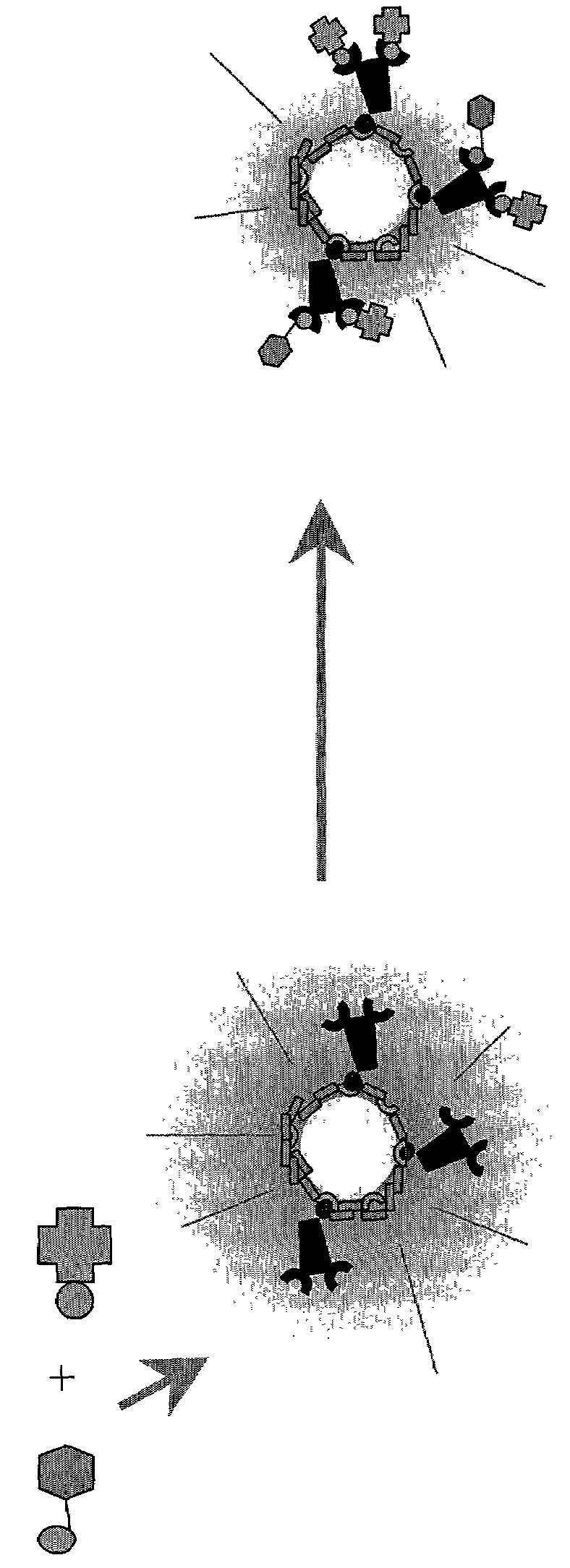
[0086]Commercial polystyrene beads containing streptavidin covalently tethered to the surface(0.53 micron microspheres purchased from Bangs Laboratories, Inc., Fishers, Ind.) were coated with the anionic conjugated polymer 24, a derivative of poly(phenyleneethynylene) (PPE) (structures 24–27 are shown in FIG. 12). The level of loading of 24 on the surface can be controlled depending on the loading of the polymer. The number of biotin binding sites (maximum biotin-FITC binding capacity=1.42 ug / mg of microspheres) is also variable and controllable. For an initial assessment of the ability of the coated microspheres to function in biosensing, a QTL conjugate formed of an energy transfer quencher (Alexafluor 594, purchased from Molecular Probes) was conjugated to the streptavidin ligand biotin. In separate studies it was demonstrated that nonspecific quenching of the polymer fluorescence by non-biotinylated Alexafluor 594 does not occur. Depending on the level of coating, the KSV was fo...
example 2
[0089]A somewhat lower molecular weight PPE oligomer, monofunctionalized with carboxylate 25, was adsorptively coated on quaternary ammonium-derivatized polystyrene microspheres. Following deposition, rabbit anti-goat IgG antibodies were covalently linked to the polymer through the available carboxyl functionality. The fluorescence of the polymer remained strong following the antibody coupling and showed little sensitivity toward photobleaching. However, the fluorescence of the ensemble of oligomers was quenched specifically by the addition of goat anti-rabbit IgG conjugated to the fluorescent energy transfer quencher, Alexafluor 532. Fluorescence quenching could be detected at SV=8×10⁷ M−1 was measured in the sub to few picomoles concentration range.
example 3
[0090]Cyanine dyes exhibit induced J-aggregation on anionic nanoparticles and microspheres. For simple cyanine monomers such as 26, adsorption onto clay or silica particles is reversible and thus individually coated particles coated with different cyanine dyes or cyanine mixtures exhibit exchange among the cyanines. It has been determined that the use of amphiphilic cyanine dyes such as the derivative of 26 where the N-ethyl groups have been replaced by N-octadecyl groups results in molecules that can be irreversibly adsorbed onto silica microspheres. Thus, individual amphiphilic cyanine dyes or mixtures of amphiphilic cyanines may be coated separately onto silica microspheres and then mixed with silica microspheres coated with other formulations of cyanine amphiphiles. The mixtures show no evidence of exchange of cyanines between different particles and thus permit the use of these mixtures for the simultaneous sensing of multiple agents. The use of energy accepting amphiphilic gue...
PUM
| Property | Measurement | Unit |
|---|---|---|
| diameter | aaaaa | aaaaa |
| radius | aaaaa | aaaaa |
| fluorescence | aaaaa | aaaaa |
Abstract
Description
Claims
Application Information
 Login to View More