
Ferroelectric capacitor and semiconductor device having a ferroelectric capacitor
a technology of ferroelectric capacitor and ferroelectric capacitor, which is applied in the direction of capacitors, solid-state devices, transistors, etc., can solve the problems of ferroelectric layer, damaged layer on the side surface, and inability to normal operation of ferroelectric capacitors, so as to reduce the influence of damaged layer
- Summary
- Abstract
- Description
- Claims
- Application Information
AI Technical Summary
Benefits of technology
Problems solved by technology
Method used
Image

Examples
first preferred embodiment
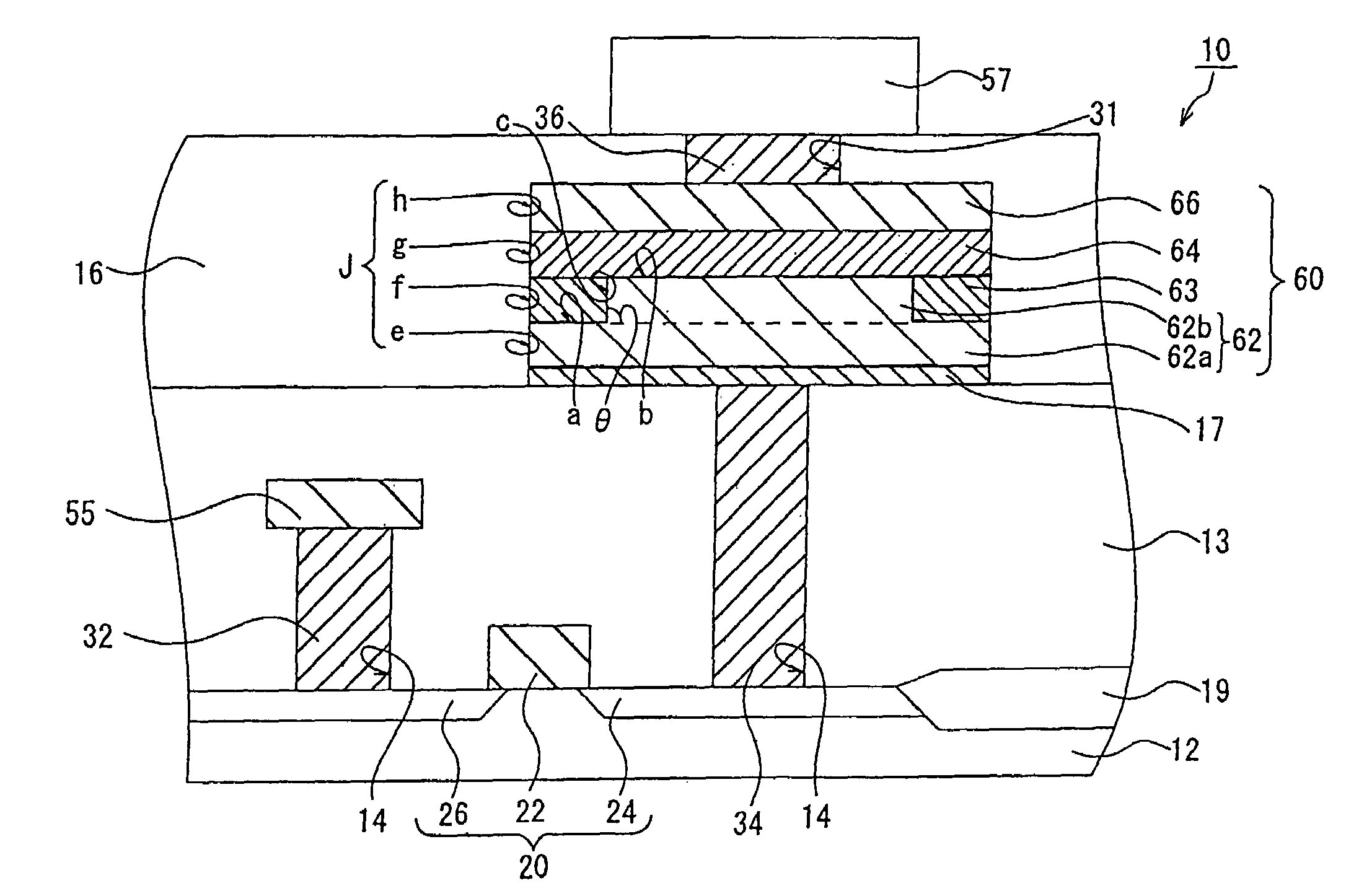
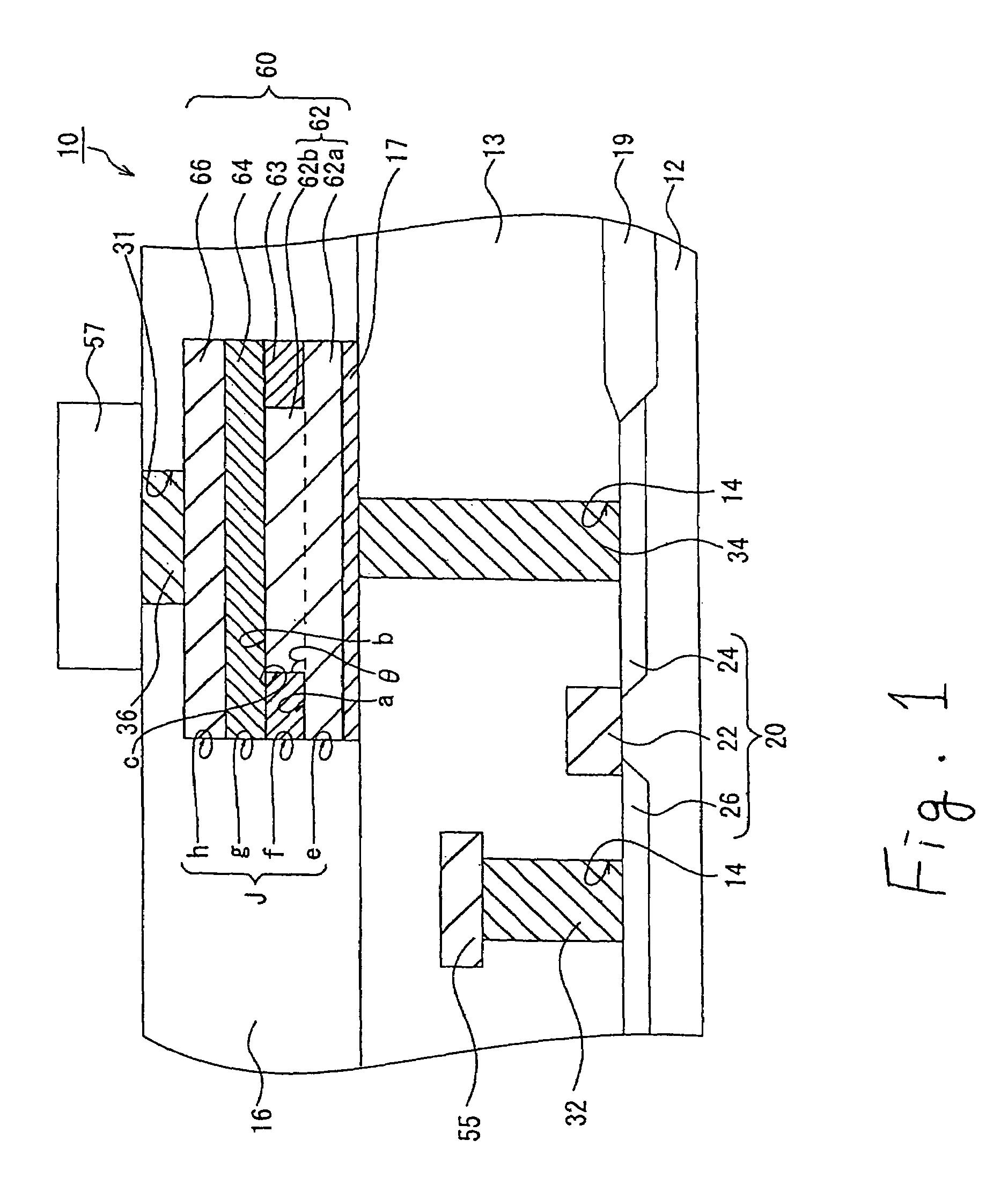
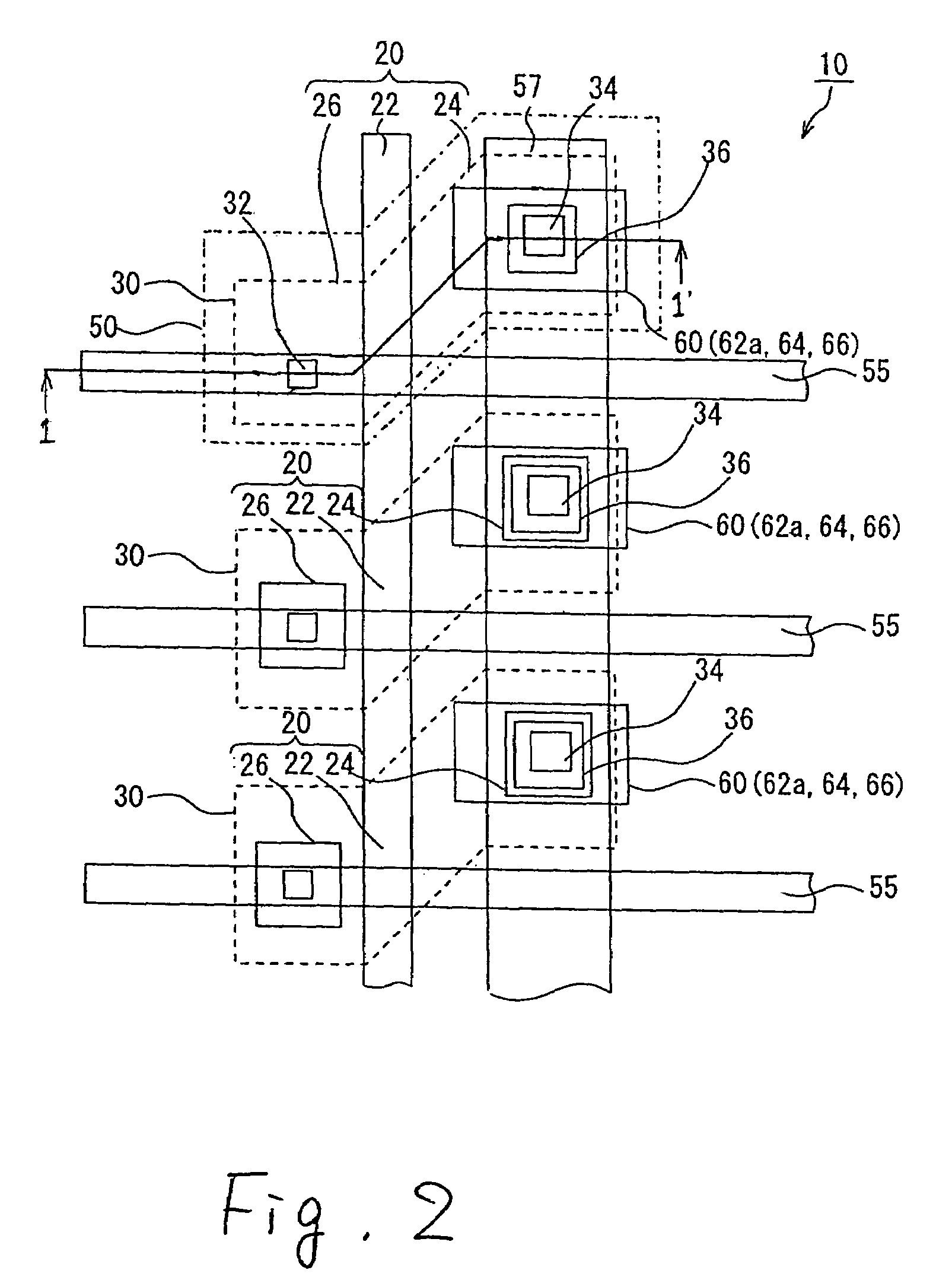
[0028]FIG. 1 is a cross-sectional view showing a semiconductor device 10 of a first embodiment of the present invention. The semiconductor device 10 as shown in FIG. 1 is a cross-sectional view taken along line 1–1′ in FIG. 2. In this embodiment, a stack type FeRAM is described.
[0029]Initially, the semiconductor device 10 is explained in reference to FIG. 2. A memory cell 50 of the semiconductor device 10 includes a MOSFET(Metal Oxide Semiconductor Field Effect Transistor) 20 and a ferroelectric capacitor 60 as shown in FIG. 2. The transistor 20 includes a source region as a first region 24 and a drain region as a second region 26 and a gate electrode as a control electrode 22. The first region 24 and the second region 26 are formed in an active area 30 and the gate electrode 22 is arranged on an area which is located between the first region 24 and the second region 26. The gate electrode 22 is used as a word line in the semiconductor device 10. The drain region 26 is connected to ...
second preferred embodiment
[0065]In the second embodiment, a projection portion 72a of a bottom electrode 72 and a plate portion 72b of the bottom electrode 72 are made of different material as shown in FIG. 6.
[0066]In this embodiment, the bottom electrode 72 of a ferroelectric capacitor 70 includes the plate portion 72a such as iridium and the projection portion 72b such as iridium oxide.
[0067]Next, a method of fabricating a semiconductor device 200 is explained in reference with FIGS. 7(A)–7(C).
[0068]From the step for forming the transistor 20 to the step for forming plug 34 are performed as described in the first embodiment.
[0069]Then, the iridium layer 71 which has 100 nm thickness is formed on the barrier metal 17 by a sputtering technique. Then, the iridium oxide layer 73 which has 100 nm thickness is formed on the iridium layer 71 by a reactive sputtering technique as shown in FIG. 7(A). The iridium layer 71 and the iridium oxide layer 73 form a conductive layer 74 for forming the bottom electrode.
[007...
third preferred embodiment
[0074]FIG. 8 is a cross-sectional view showing a semiconductor device 300 of a third embodiment of the present invention. FIGS. 9(A) to (C) are views showing manufacturing steps for a semiconductor device 300 of the third embodiment of the present invention.
[0075]The bottom electrode 82 includes a stacked plate portion 82a and a projection portion 82b such as platinum formed on the stacked plate portion 82a. The stacked plate portion 82a includes an iridium layer 821 as a lower layer and an iridium oxide layer 822 as an upper layer.
[0076]The iridium oxide layer 822 has good adhesive characteristic for adhering to the platinum projection portion 82b. The iridium layer 821 has a function for resisting oxidation. As a result, an end point of etching for forming the projection portion 82b is found easily, and the platinum projection portion 82b can be used. That is, the platinum projection portion 82b which improves a capacitor characteristic and the iridium layer 821 can be used as the...
PUM
| Property | Measurement | Unit |
|---|---|---|
| angle | aaaaa | aaaaa |
| thickness | aaaaa | aaaaa |
| thickness | aaaaa | aaaaa |
Abstract
Description
Claims
Application Information
 Login to View More