

Finished lubricating comprising lubricating base oil with high monocycloparaffins and low multicycloparaffins
a technology of monocycloparaffin and lubricating base oil, which is applied in the direction of lubricant composition, hydrocarbon oil treatment products, petroleum chemical modification, etc., can solve the problems of small fraction of base oils manufactured today that are able to meet the demanding specifications, decrease the viscosity index, and less desire for multicycloparaffins, etc., to achieve excellent oxidation stability, high viscosity index, and low wear
- Summary
- Abstract
- Description
- Claims
- Application Information
AI Technical Summary
Benefits of technology
Problems solved by technology
Method used
Image

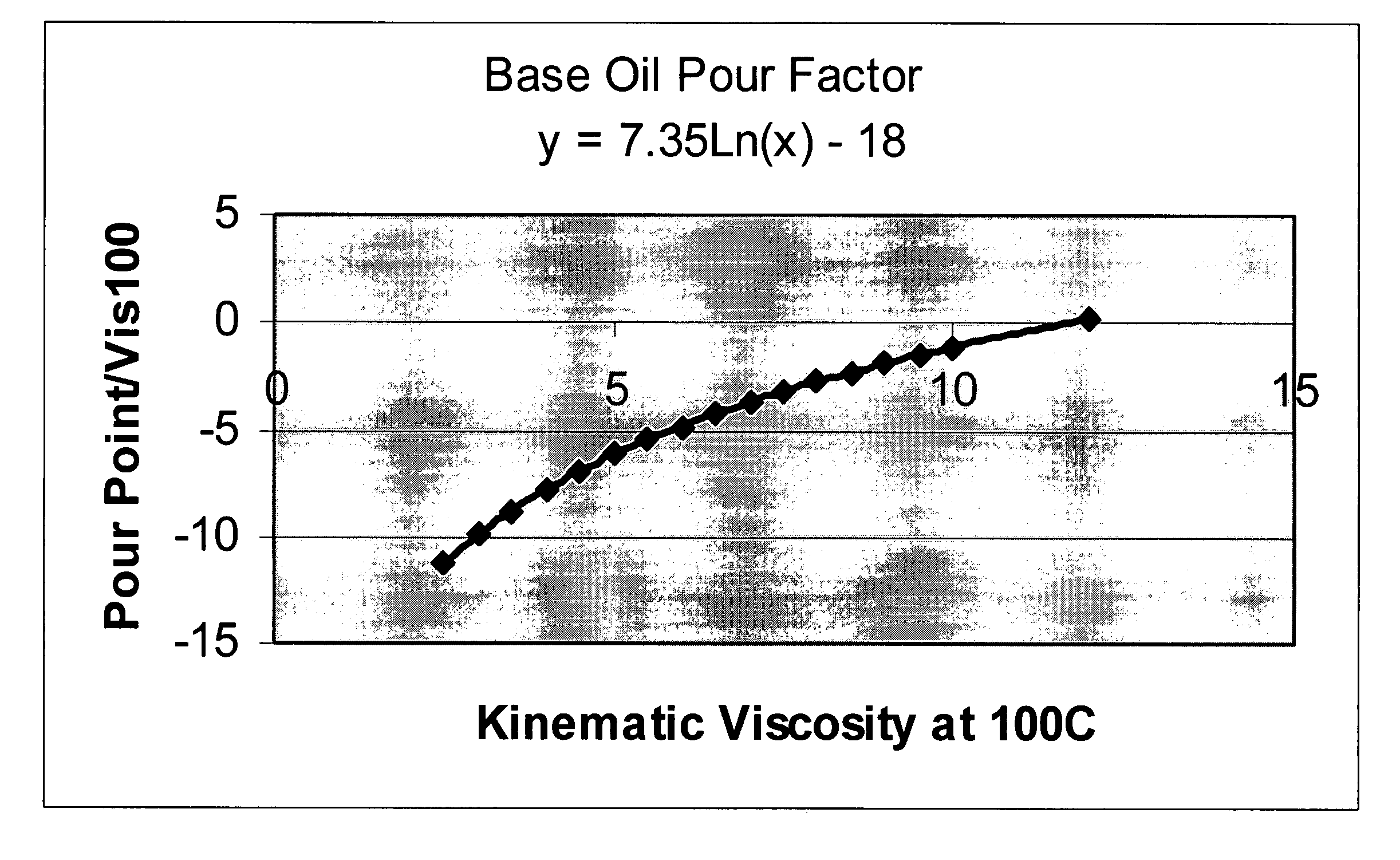
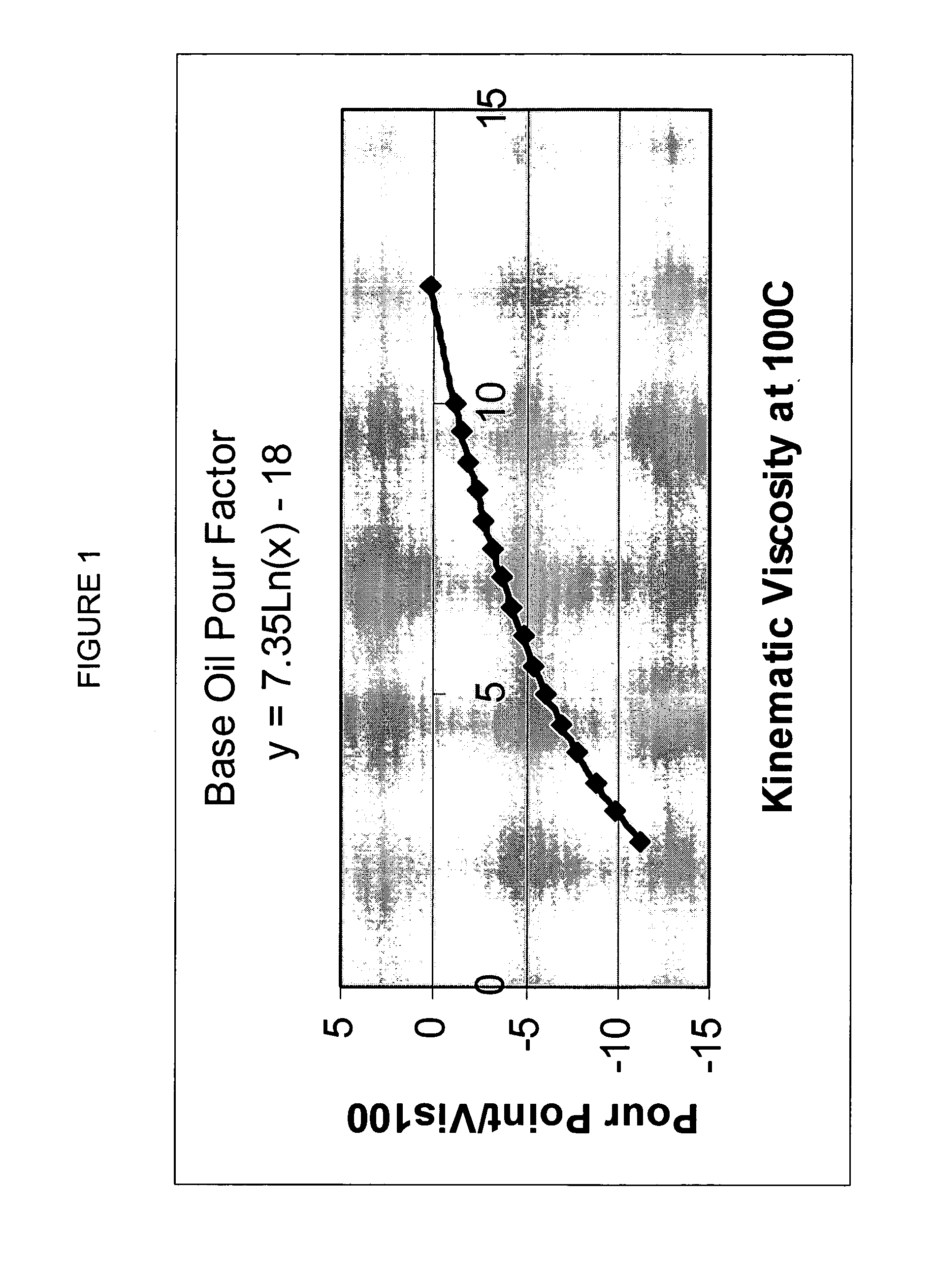
Examples
example 1 , example 2 , and example 3
Example 1, Example 2, and Example 3
[0120]Three lubricating base oils with kinematic viscosities between 3.0 and 5.0 cSt at 100° C. were prepared by hydroisomerization dewaxing Fischer-Tropsch wax as described above. The properties of these two examples are shown in Table II.
[0121]
TABLE IIPropertiesExample 1Example 2Example 3CVX Sample IDNGQ9606PGQ1118NGQ9939Wax FeedWOW9107WOW9237WOW8684Hydroisomerization672652682Temp, ° F.HydroisomerizationPt / SAPO-11Pt / SAPO-11PT / SAPO-11Dewaxing CatalystReactor Pressure,10003001000psigViscosity at 100° C., cSt3.944.3974.524Viscosity Index143158149FIMS, Wt % of MoleculesParaffins89.079.889.4Monocycloparaffins11.021.210.4Multicycloparaffins0.00.00.2Total100.0100.0100.0Pour Point, ° C.−19−31−17Cloud Point, ° C.−9+3−10Ratio of>100>10052Mono / MulticycloparaffinsRatio of Pour−4.82−7.05−3.76Point / Vis100Base Oil Pour Factor−7.92−7.12−6.91Oxidator BN, Hours26.034.92Aniline Point, D 611,253.2° F.Noack Volatility, Wt %17.7612.53CCS Viscosity −35 C, cP16112090
example 4 and example 5
[0122]Two lubricating base oils with kinematic viscosities between 6.0 and 7.0 cSt at 100° C. were prepared by hydroisomerization dewaxing Fischer-Tropsch wax as described above. The properties of these two examples are shown in Table III.
[0123]
TABLE IIIPropertiesExample 4Example 5CVX Sample IDNGQ9941NGQ9988Wax FeedWOW8684WOW8684Hydroisomerization Temp, ° F.690681HydroisomerizationPt / SAPO-11Pt / SAPO-11Dewaxing CatalystReactor Pressure, psig10001000Viscosity at 100° C., cSt6.2976.295Viscosity Index153154FIMS, Wt % of MoleculesParaffins82.576.8Monocycloparaffins17.522.1Multicycloparaffins0.01.1Total100.0100.0API Gravity40.240.2Pour Point, ° C.−23−14Cloud Point, ° C.−6−6Ratio of>10020.1Mono / MulticycloparaffinsRatio of Pour Point / Vis100−3.65−2.22Base Oil Pour Factor−4.48−4.48Aniline Point, D611, ° F.263Noack Volatility, Wt %2.83.19CCS Vis −35 C, cP48685002
example 6 , example 7 , example 8 , example 9 , example 10 , example 11 , and example 12
Example 6, Example 7, Example 8, Example 9, Example 10, Example 11, and Example 12
[0124]Seven engine oils of six different viscosity grades were blended using three of the lubricating base oils of this invention, Example 2, Example 4, and Example 5. They were blended with one of three commercially available passenger car DI additive packages, an OCP viscosity index improver, and a polymethacrylate pour point depressant. Notably, no viscosity index improver was added to the 0W-XX, 5W-XX, and 10W-30 grade samples. None of the examples had ester co-solvent added. Examples 9 and 10 included another GTL base oil, Chevron GTL Base Oil 9.8. Chevron GTL Base Oil 9.8 had a kinematic viscosity at 100° C. of 9.83 cSt, a viscosity index of 163, a pour point of −12° C., a weight percent of total cycloparaffins of 18.7, and a ratio of monocycloparaffins to multicycloparaffins of 7.1. Three of the engine oil samples, Example 7, Example 11, and Example 12, included conventional Group II base oil. T...
PUM
| Property | Measurement | Unit |
|---|---|---|
| weight percent | aaaaa | aaaaa |
| weight ratio | aaaaa | aaaaa |
| temperature | aaaaa | aaaaa |
Abstract
Description
Claims
Application Information
 Login to View More