
Method and apparatus for implement XANES analysis
a technology of xanes analysis and apparatus, applied in the direction of instruments, liquid/fluent solid measurements, nuclear engineering, etc., can solve the problems of insufficient brightness of conventional laboratory x-ray sources, low conversion efficiency of continuum x-ray generation, and only measurement, etc., to achieve low power, high sensitivity, and low cost
- Summary
- Abstract
- Description
- Claims
- Application Information
AI Technical Summary
Benefits of technology
Problems solved by technology
Method used
Image

Examples
Embodiment Construction
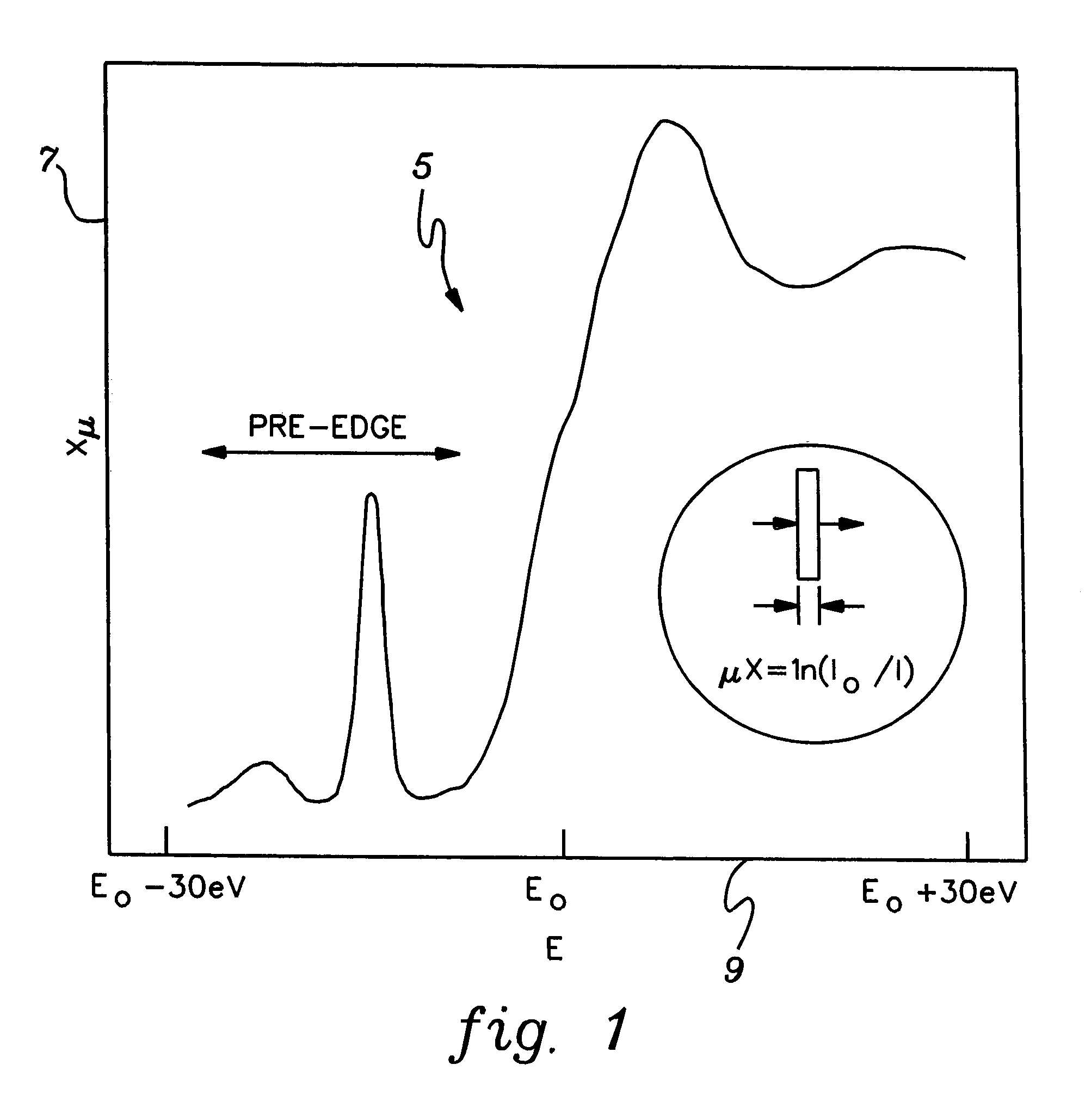
[0031]FIG. 1 illustrates a typical XANES spectrum 5 that can be produced using one aspect of the present invention. The ordinate 7 shown in FIG. 1 represents the intensity of the x-ray fluorescence from a sample. The abscissa 9 of FIG. 1 represents the energy in eV of the corresponding x-ray onto the sample under analysis. EO is the energy of the absorption edge. As shown in FIG. 1, a typical XANES spectrum spans an energy range from about 30 eV below the energy of the absorption edge to about 30 eV above the energy of the absorption edge.
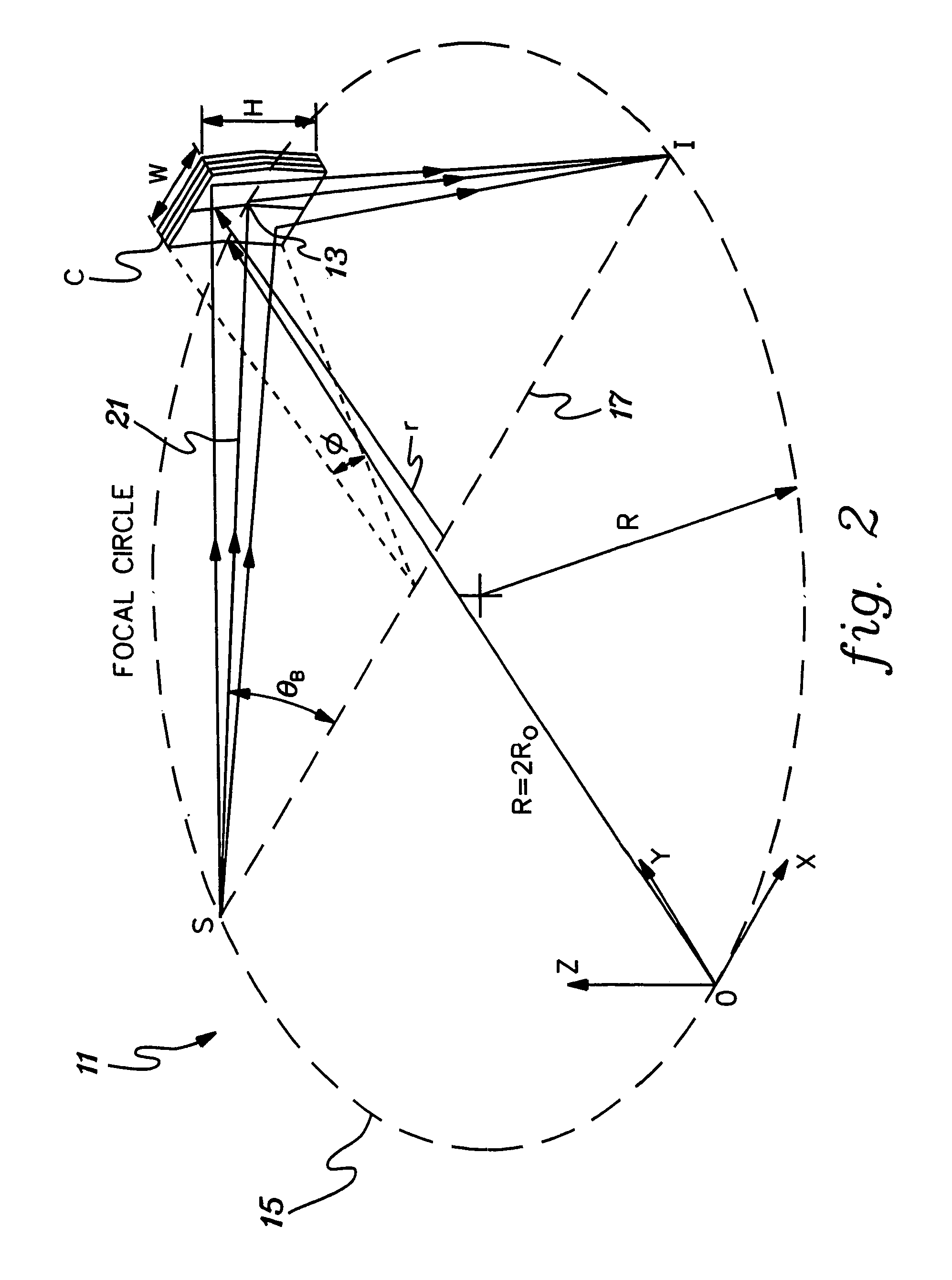
[0032]FIG. 2 is a typical isometric view of a prior art x-ray focusing arrangement 11 having doubly-curved crystal (DCC) optic C, an x-ray source location S, and an x-ray target or image location I, at which the x-ray image is preferably produced. X-rays diverging from a point source S, and striking the surface of crystal C with incident angles within the acceptance rocking curve width of the crystal will be reflected efficiently to target location...
PUM
| Property | Measurement | Unit |
|---|---|---|
| azimuth angle | aaaaa | aaaaa |
| azimuthal angle | aaaaa | aaaaa |
| bending diameter | aaaaa | aaaaa |
Abstract
Description
Claims
Application Information
 Login to View More