[0014]It is an aspect of the present invention to provide a more reliable, quicker and more precise way to measure free fall. One embodiment of the present invention monitors both the accelerometer output and the spindle speed change to detect free fall and / or tumble events. Another embodiment of the present invention employs a free
fall detection algorithm that compares acceleration and the change of acceleration to respective threshold levels to detect a free fall event. These embodiments will detect free falls under different conditions and over shorter distances and thereby protect the disk drive in a wider variety of circumstances. One or more embodiments of the present invention can timely detect falls and complete responsive action to secure the actuator arm within a fall distance of approximately four inches.
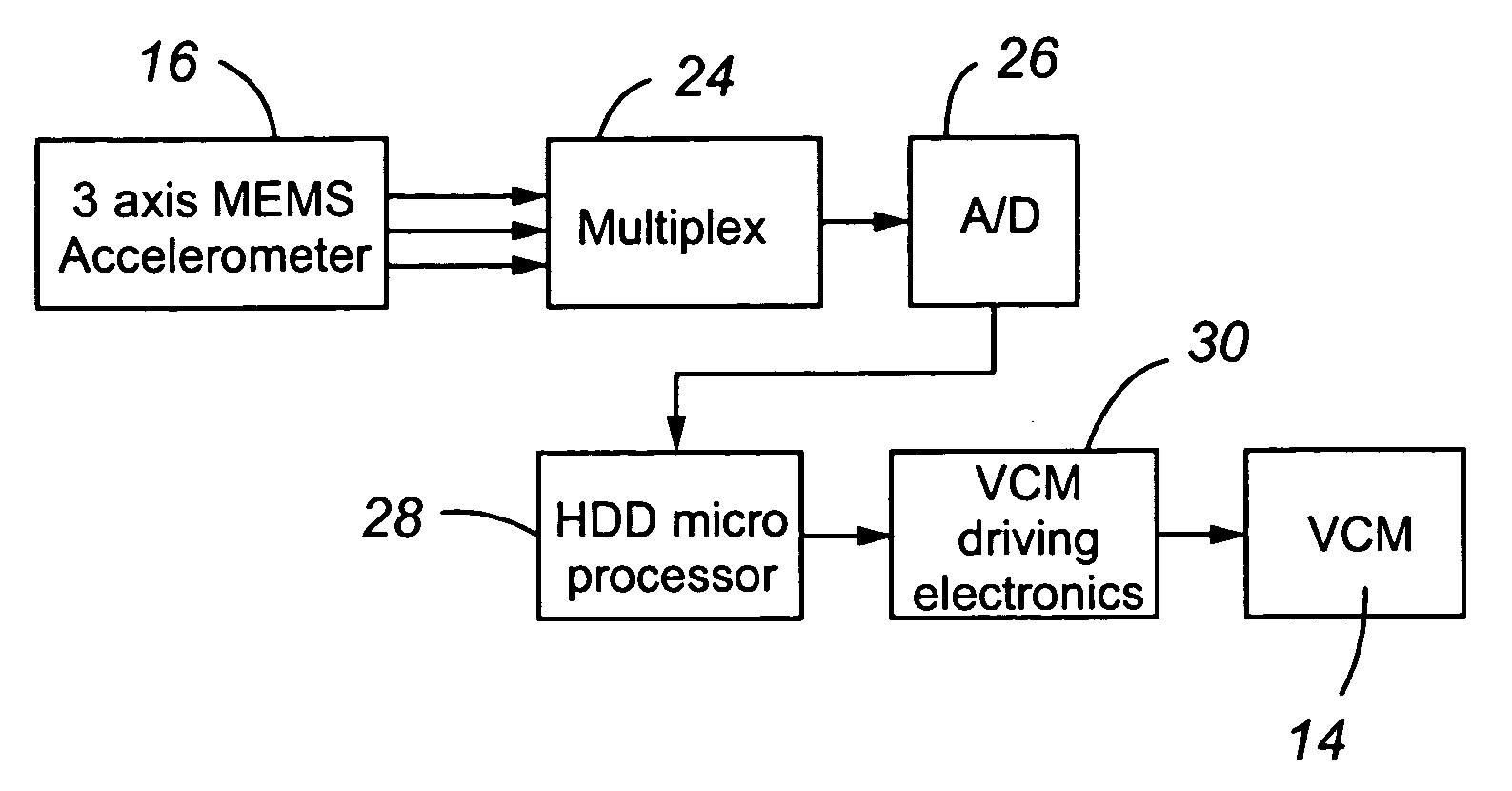
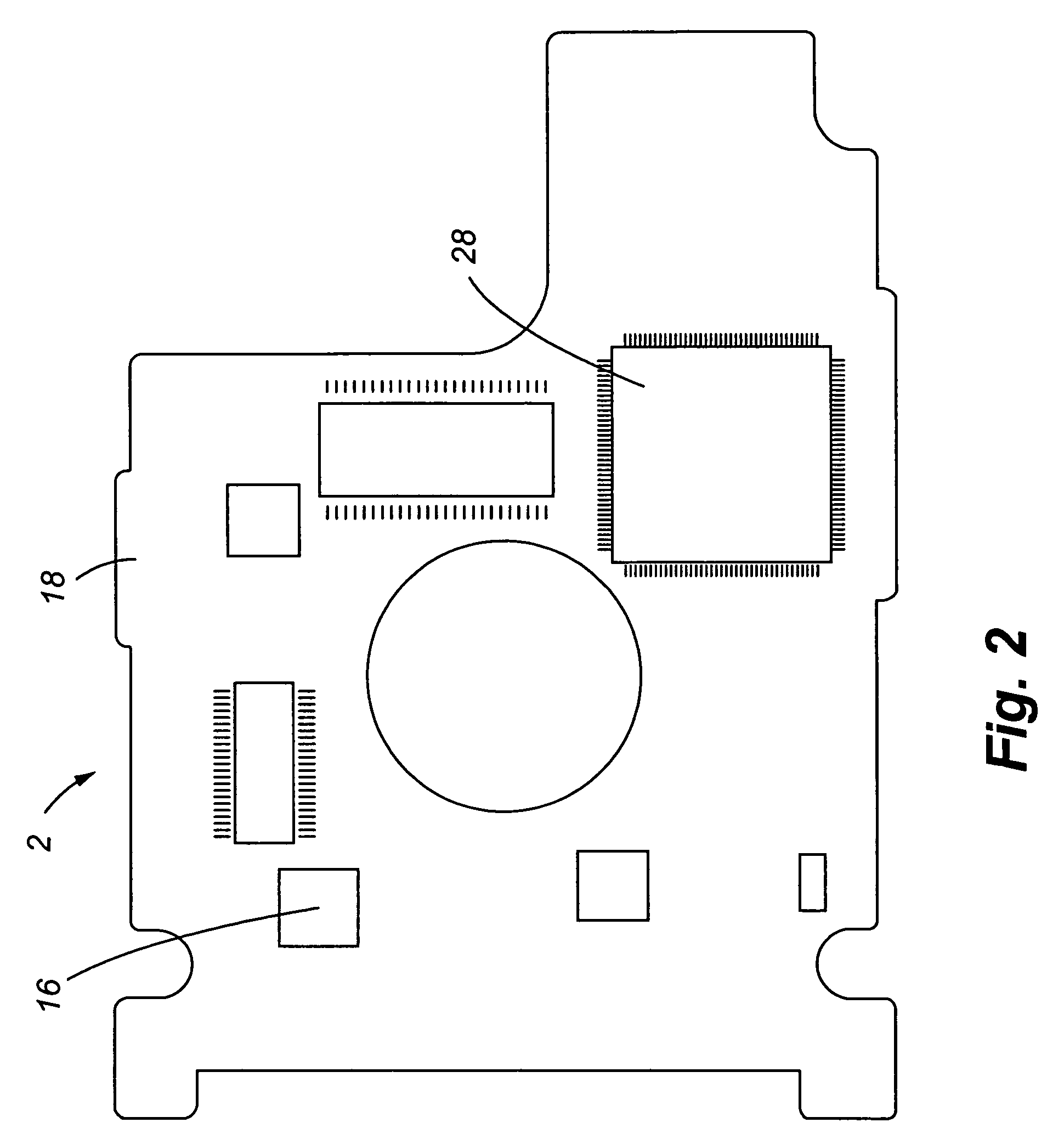
[0016]In another embodiment of the present invention, the accelerometer is interconnected to the
printed circuit board or a substrate of the disk drive rather than a structure outside of the disk drive, such as the mother board of a
laptop computer. When acceleration is detected,
critical time is not lost by transmitting the command through an interface between the computer and the disk drive. This allows detection and protection against falls from lower elevations. Further, if the sensor is placed on the computer mother board or at some location outside of the disk drive regardless if the application is in a computer or some other electronic device, the
signal to secure the actuator arm or park the head may not be able to be received by the
voice coil motor of the disk drive, for example, if the computer is locked up. For this reason, connecting the accelerometer inside the disk drive increases reliability.
[0019]It is yet another aspect of the present invention to reduce the effects of spindle
jitter that may incorrectly cause a tumble detection system to determine a tumble event is occurring. Spindle “
jitter” includes bearing load variations, non-constant loading, seeks, electronic
noise, magnetic couplings, etc. Since
jitter produces an instantaneous change between expected velocity and measured velocity of the disk spindle, jitter may cause the system to believe it is tumbling.
Jitter is typically a problem when spin rates are assessed using analog or hardware controls. As a result, when jitter is present, the threshold that is used to indicate disk drive is tumbling is typically increased to avoid false triggers. Increasing the threshold increases the readings that are required to ensure that the data being collected are not the result of jitter, but are indicative of a tumble condition. Thus, the performance of the system is affected since the detectable drop height of the disk drive must be increased to account for the increased threshold related to filtering out the effects of jitter. To address the problems of jitter caused by analog-based hardware control, one embodiment of the present invention measures spin rate based upon the timing of zero-crossings in the
stator induced by back EMF. Rather than monitoring the timing between successive zero crossings, the system assesses an average spin rate over a number of zero crossings. The average spin rate or spindle speed is then compared to a predicted or expected value over a predetermined time interval. By tracking the average disk spin velocity or spin rate with a
low pass filter, the offset can be removed from the calculation. If the average spin rate exceeds a threshold value for a predetermined time period, the system determines a tumble event is occurring and corrective action is taken. The threshold value is adjusted, usually increased, to account for the presence of jitter, which is treated as a fixed value. More specifically, the
root mean square (RMS) value of spin rate error is calculated and this value is used to adjust the threshold level. As a result, the effects of jitter are accounted for.
[0021]It is yet another aspect of the present invention to provide a disk drive free fall and tumble detection system that may be customized. More specifically, it is contemplated that embodiments of the present invention have the ability to be selectively altered wherein the threshold levels of free fall and / or tumble may be increased, decreased or deactivated and / or the timing windows utilized in association with the threshold levels may be increased or decreased. This aspect has advantages, for example, when the system that embodies the disk drive is used on a
train,
bus,
airplane, etc., where inherent vibrations may falsely indicate a tumbling or free fall condition that would park the head unnecessarily. In other words, the
end user may select the desired sensitivity of the detection system.



 Login to View More
  Login to View More