
Activated protein C variants with normal cytoprotective activity but reduced anticoagulant activity
a technology of activated protein and cytoprotective activity, which is applied in the field of variants (mutants) of recombinant protein c and activated protein c, can solve the problems of limited information about the molecular mechanisms responsible for the direct anti-inflammatory and anti-apoptotic effect of apc on cells, the increased risk of serious bleeding of apc treatment, and the limitation of apc treatment. a major limitation of the risk of bleeding, and the
- Summary
- Abstract
- Description
- Claims
- Application Information
AI Technical Summary
Benefits of technology
Problems solved by technology
Method used
Image

Examples
example 1
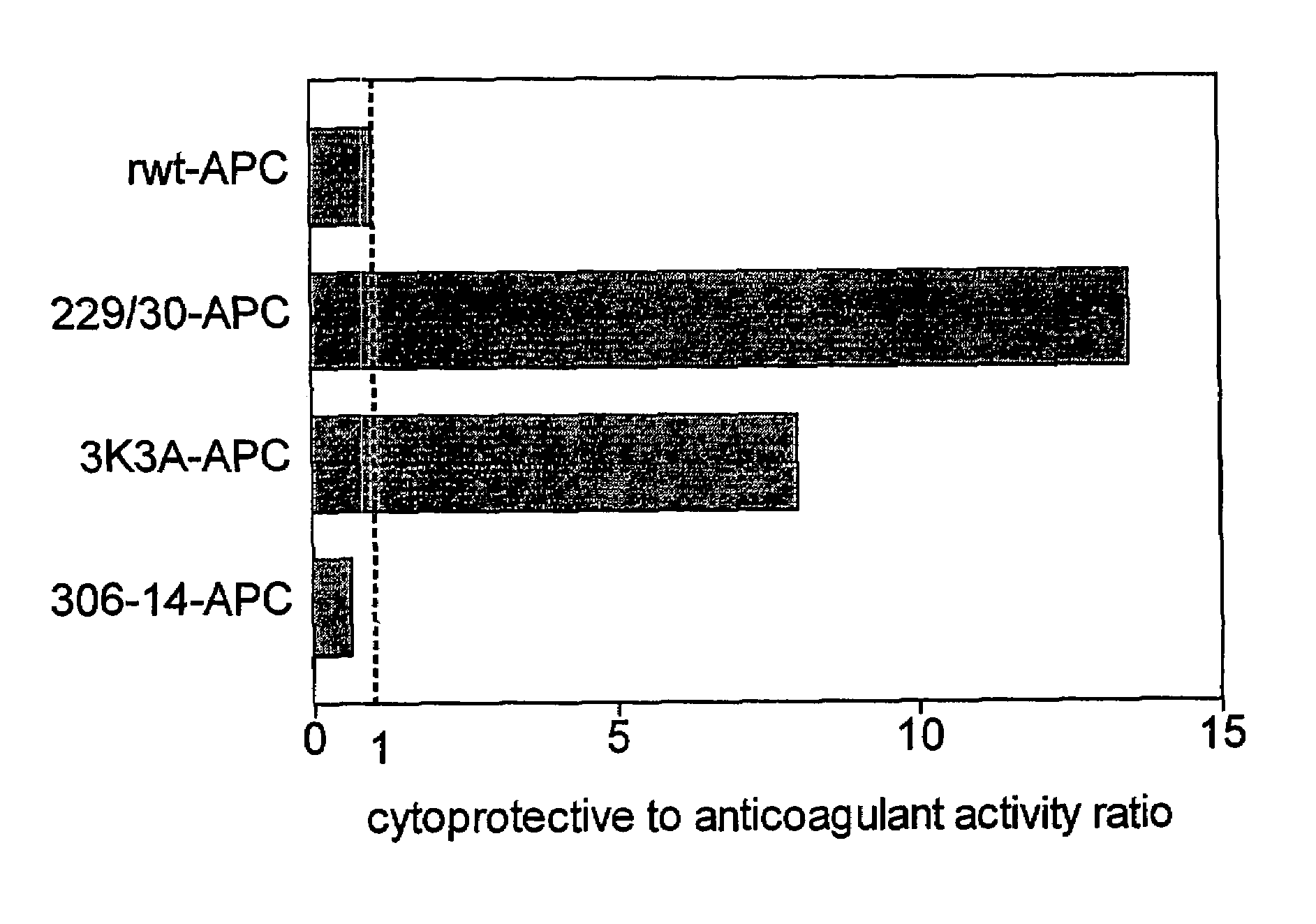
[0043]Replacing the two arginine residues, Arg229 and Arg230, in the calcium-binding loop of APC with alanine residues resulted in a form of APC RR229 / 230AA-APC (229 / 230-APC), see Table 1) with only 6.6% residual anticoagulant activity. This reduction in anticoagulant activity of RR229 / 230AA-APC was primarily due to reduced inactivation of factor Va (FVa) at Arg506 whereas cleavage of factor Va at Arg306 was much less affected.
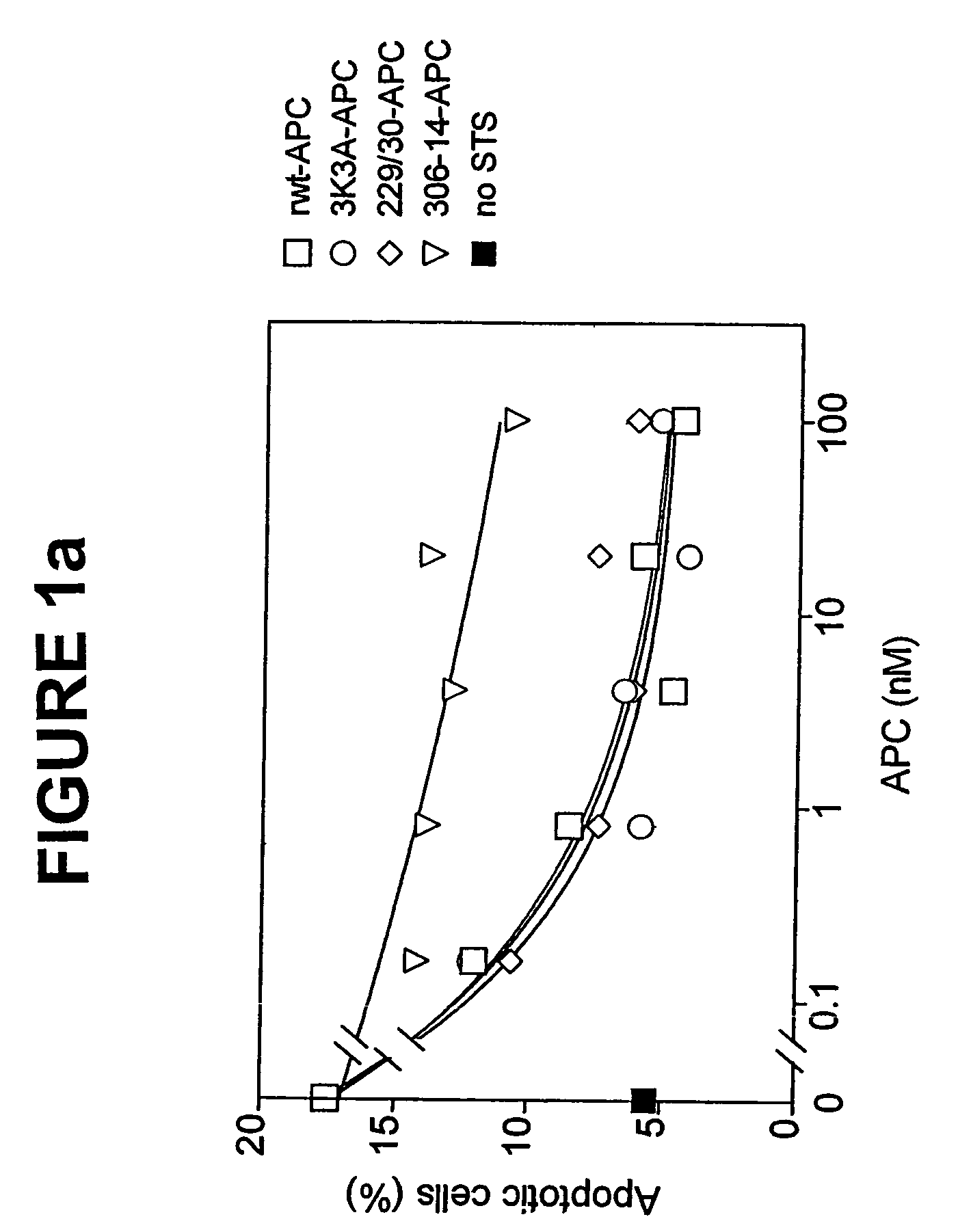
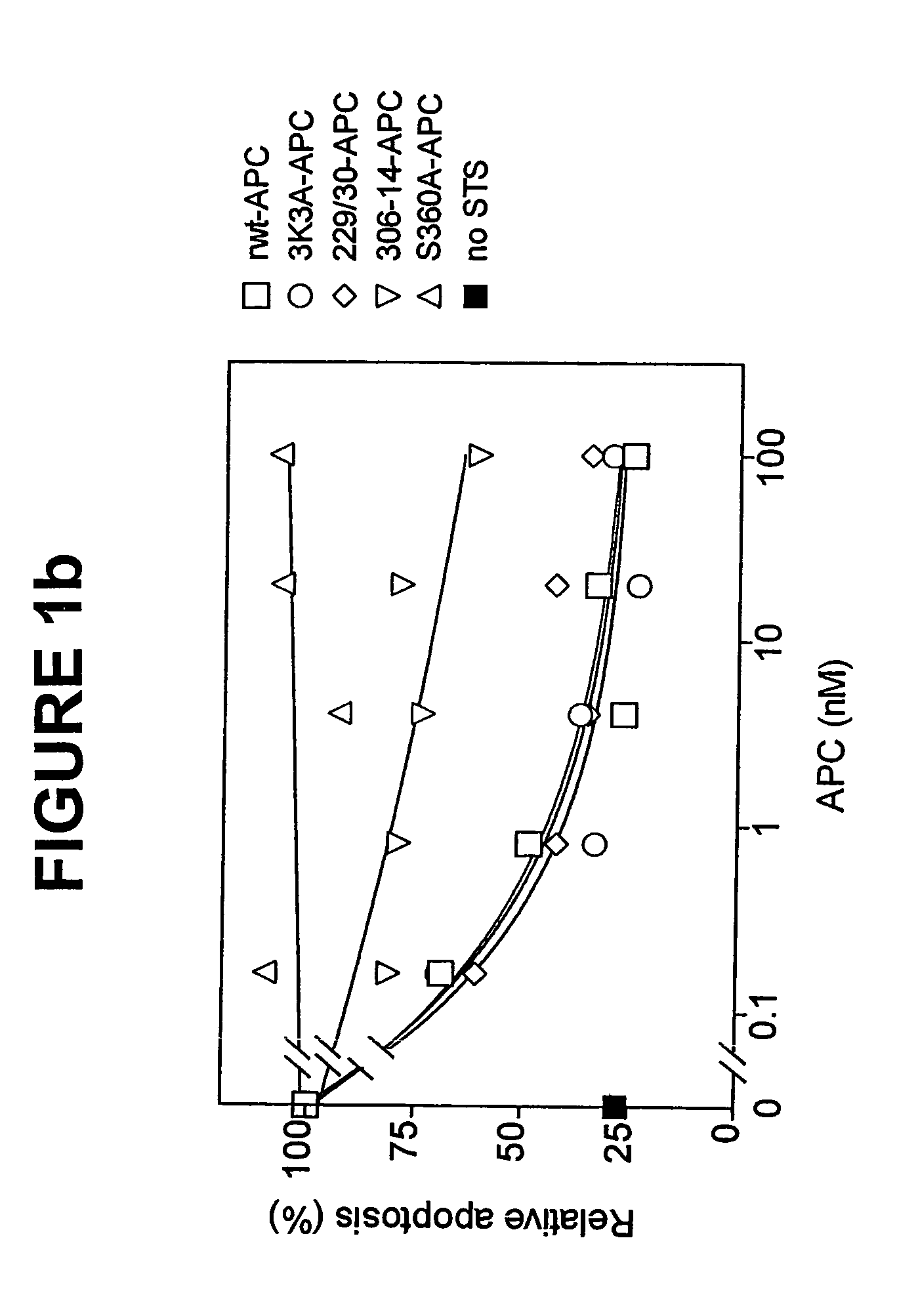
[0044]The dose-dependence for inhibition of apoptosis by RR229 / 230AA-APC (FIGS. 1a and 1b) was similar to that of recombinant wild type (rwt)-APC. Half-maximum inhibition of staurosporine-induced apoptosis by RR229 / 230AA-APC was achieved at 0.27 nM. This example demonstrates that the anticoagulant activity of APC is not required for the cytoprotective (anti-apoptotic) activity of APC.
example 2
[0045]In this example, an APC mutant in which three consecutive lysine residues in loop 37 were replaced with three alanines KKK191-193AAA-APC (3K3A-APC), see Table 1) displayed only 15% residual anticoagulant activity as determined in a dilute prothrombin clotting assay (Gale et al., supra, 2002). The reduction in anticoagulant activity of KKK191-193AAA-APC was due to severely reduced cleavage of factor Va at Arg506 (11% of rwt-APC), whereas inactivation of factor Va at Arg306 was only moderately affected (67% of rwt-APC) (Table 1). Remarkably, as seen in FIGS. 1a and 1b, the anti-apoptotic activity of KKK191-193AAA-APC was similar to that of rwt-APC with half-maximum inhibition of staurosporine-induced apoptosis at 0.20 nM.
example 3
[0046]In this example, four out of the five basic amino acids in the so-called autolysis loop of APC were replaced by alanine residues, resulting in a form of APC R306A / K311A / R312A / R314A-APC (306-314-APC, see Table 1) having only 1.6% residual anticoagulant activity, as determined by the activated partial thromboplastin time (APTT) [765]. The reduction in anticoagulant activity of R306A / K311A / R312A / R314A-APC was due to severely reduced cleavage of factor Va at Arg506 (1.4% of rwt-APC) whereas inactivation of factor Va at Arg306 was only moderately affected (16% of rwt-APC). The R306A / K311A / R312A / R314A-APC mutant was severely deficient in cytoprotective (anti-apoptotic) activity (FIGS. 1a and 1b), with inhibition of staurosporine-induced apoptosis requiring much higher concentrations of this mutant APC compared to rwt-APC or the other two APC mutants, RR-229 / 230AA-APC and KKK191-193AAA-APC.
PUM
| Property | Measurement | Unit |
|---|---|---|
| pH | aaaaa | aaaaa |
| concentration | aaaaa | aaaaa |
| concentration | aaaaa | aaaaa |
Abstract
Description
Claims
Application Information
 Login to View More