

Composite biocidal particles
a biocidal and composite technology, applied in the field of biocidal compositions, can solve the problems of increasing the cost of removal of marine equipment, increasing the cost of removal, so as to reduce the cost of removal and reduce the amount of skin absorption. , the effect of inhibiting the growth of hard
- Summary
- Abstract
- Description
- Claims
- Application Information
AI Technical Summary
Benefits of technology
Problems solved by technology
Method used
Image

Examples
example 1
Preparation of a 1:10 Parts by Weight Copper Pyrithione:Cuprous Oxide Composite Particle Product Made Using Cuprous Oxide Plus Sodium Pyrithione
292.19 grams of a 70% aqueous untreated cuprous oxide slurry was charged into a 1000 ml 3-neck, round-bottom flask reactor, followed by addition of 117.28 grams of 16.1% sodium pyrithione solution. The reaction mixture was stirred continuously, and the pH of the mixture monitored and recorded. The initial pH was 5, and it increased during the reaction to a final pH of 10.5 at room temperature. After approximately 4 hours of mixing, the contents of the flask was assayed for sodium pyrithione content by adding iron chloride and looking for the blue color of iron pyrithione. However, no blue color was found, indicating that the reaction was complete. A small amount (0.5% by weight) of stearic acid was added (to coat the particle) and mixed for 30 minutes.
The resulting copper pyrithione / cuprous oxide product was isolated by filtration. The resul...
example 2
Preparation of a 1:10 Parts by Weight Copper Pyrithione:Cuprous Oxide Composite Particle Product Made Using Cuprous Oxide Plus Sodium Pyrithione
This Example followed the same procedure as in Example 1, except 292.19 grams of a 70% aqueous fatty acid treated cuprous oxide slurry was charged into a 1000 ml 3-neck, round-bottom flask reactor. The cuprous oxide had been treated with 0.5 weight percent of stearic acid. No additional fatty acid was added later to coat the product.
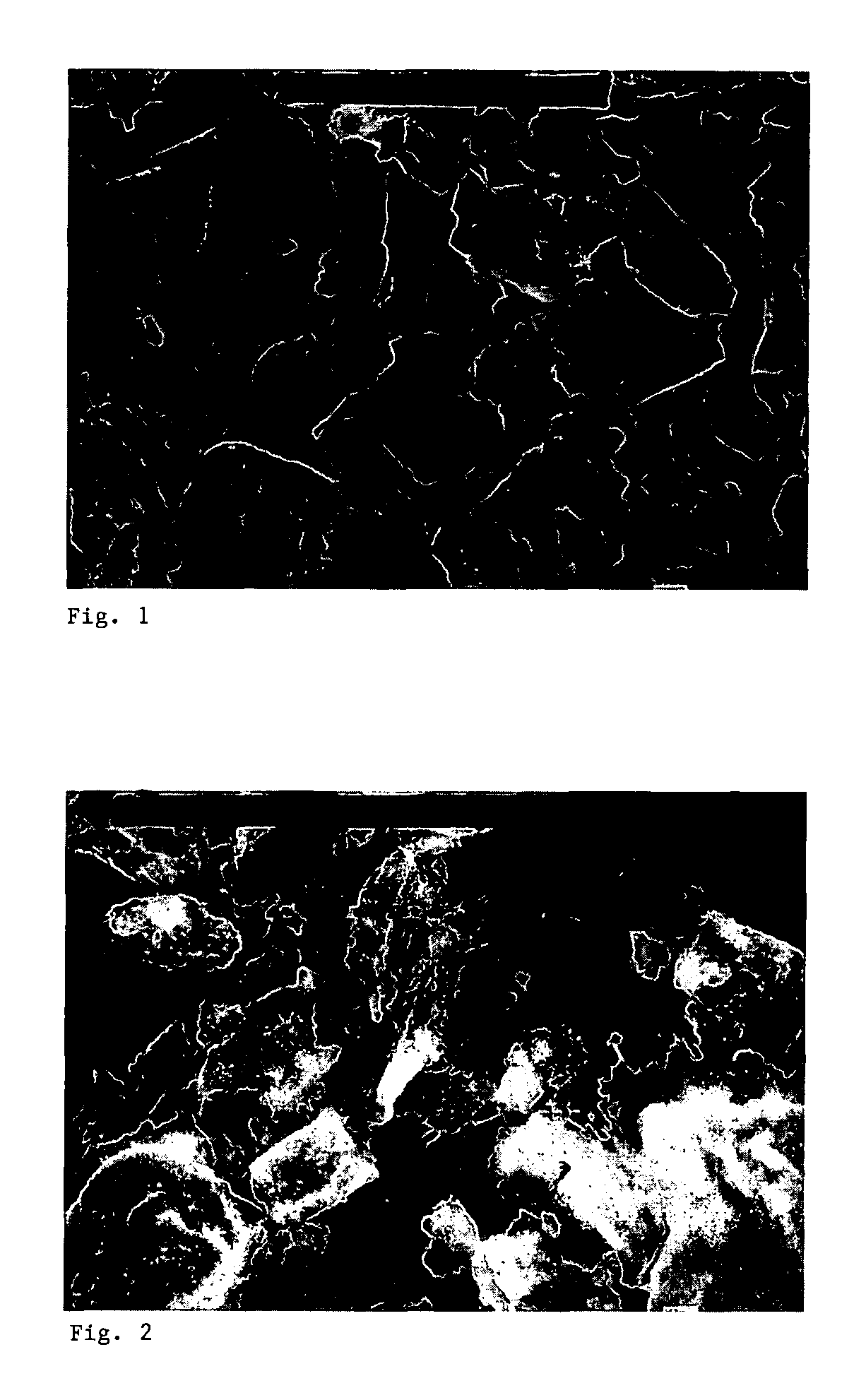
The composite particle product was examined under a microscope consisted of needle-shaped copper pyrithione particles, cuprous oxide particles, and cuprous oxide particles coated with copper pyrithione.
example 3
Preparation of a 1:5 Parts by Weight Copper Pyrithione:Cuprous Oxide Composite Particle Product Made Using Cuprous Oxide Plus Sodium Pyrithione
298.66 grams of a 70% aqueous fatty acid treated cuprous oxide slurry were charged into a 1000 ml 3-neck, round-bottom flask reactor. 234.61 grams of 16.1% crude sodium pyrithione solution were added, and the reaction mixture was continuously stirred as the pH of the mixture was monitored. After 4 hours of mixing the sodium pyrithione in the flask was assayed and found to be 0.0% indicating that the reaction was complete.
The resulting copper pyrithione / cuprous oxide composite product was isolated by filtration. The resulting cake was then washed with water until the filtrate was free of ions as measured by conductivity. The cake was then dried in an vacuum oven at 30° C. overnight.
The microscopic examination result weakens the application as originally stated.
PUM
| Property | Measurement | Unit |
|---|---|---|
| diameter | aaaaa | aaaaa |
| particle size | aaaaa | aaaaa |
| particle size | aaaaa | aaaaa |
Abstract
Description
Claims
Application Information
 Login to View More