
Air conditioner for vehicle
a technology for air conditioners and vehicles, applied in the field of vehicles, can solve the problems of affecting the operation mode of machines, affecting the cooling effect of engines, and determining the temperature of engine coolant, so as to suppress the deterioration of fuel efficiency in engines and ensure heating performan
- Summary
- Abstract
- Description
- Claims
- Application Information
AI Technical Summary
Benefits of technology
Problems solved by technology
Method used
Image

Examples
first embodiment
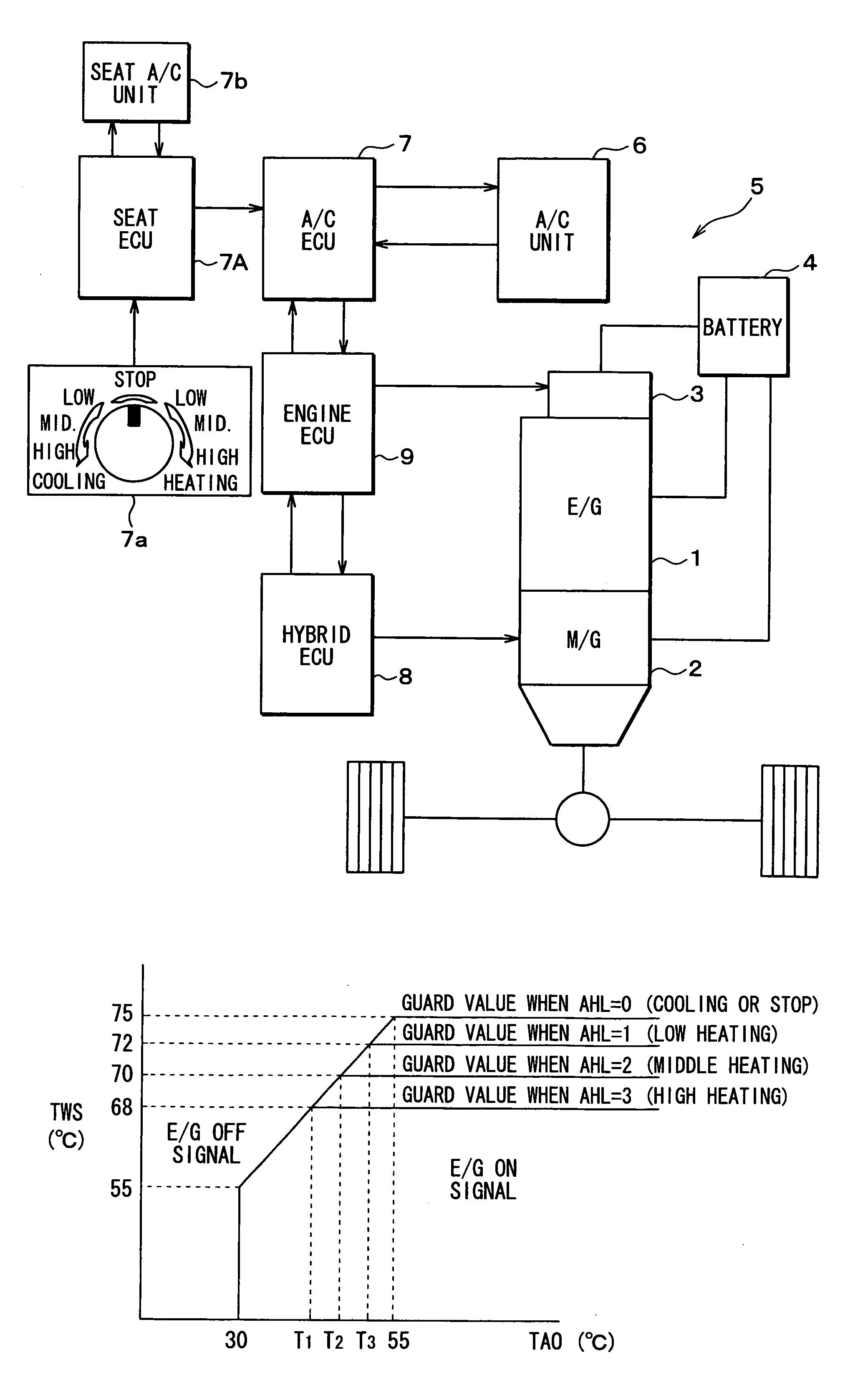
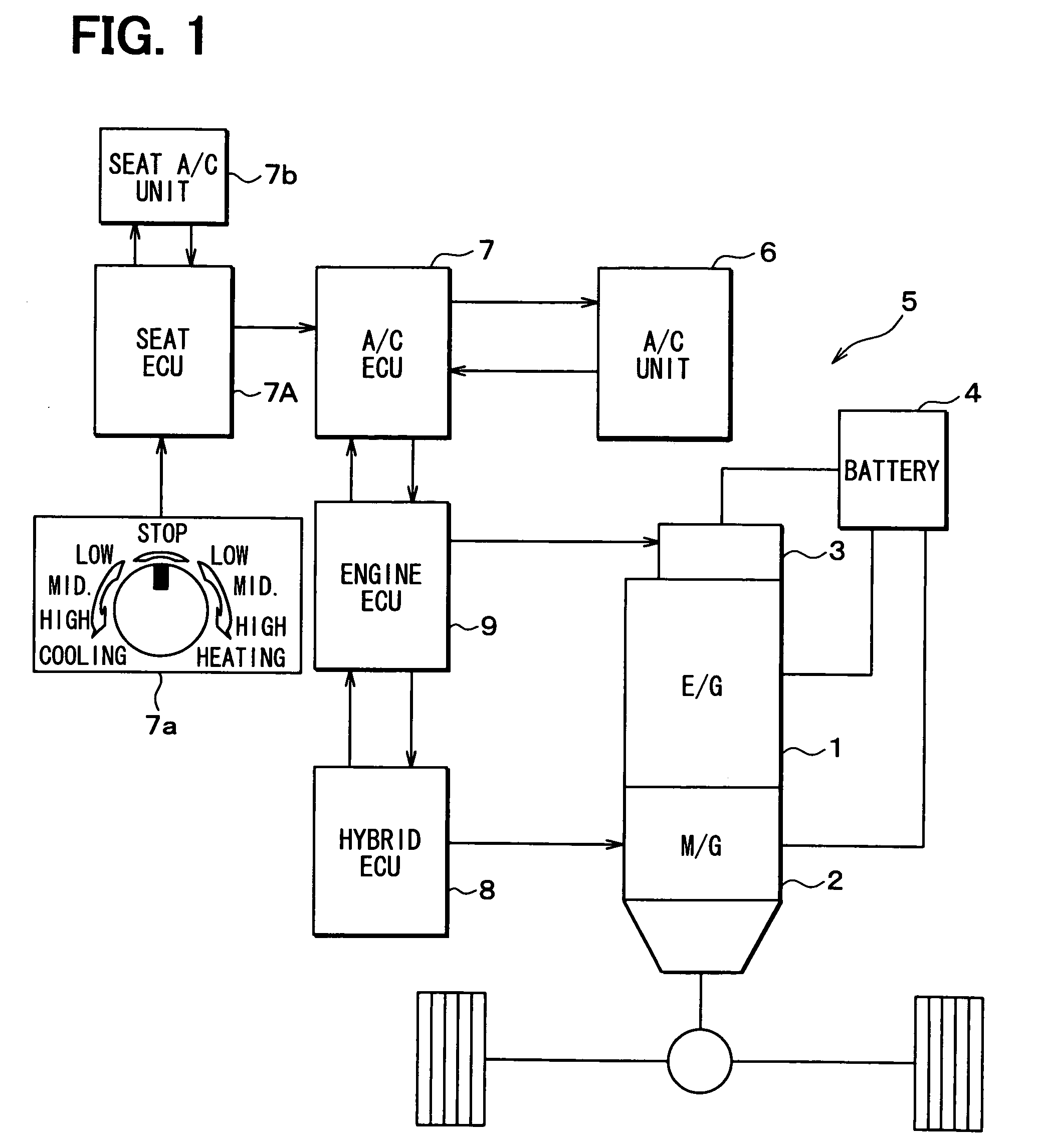
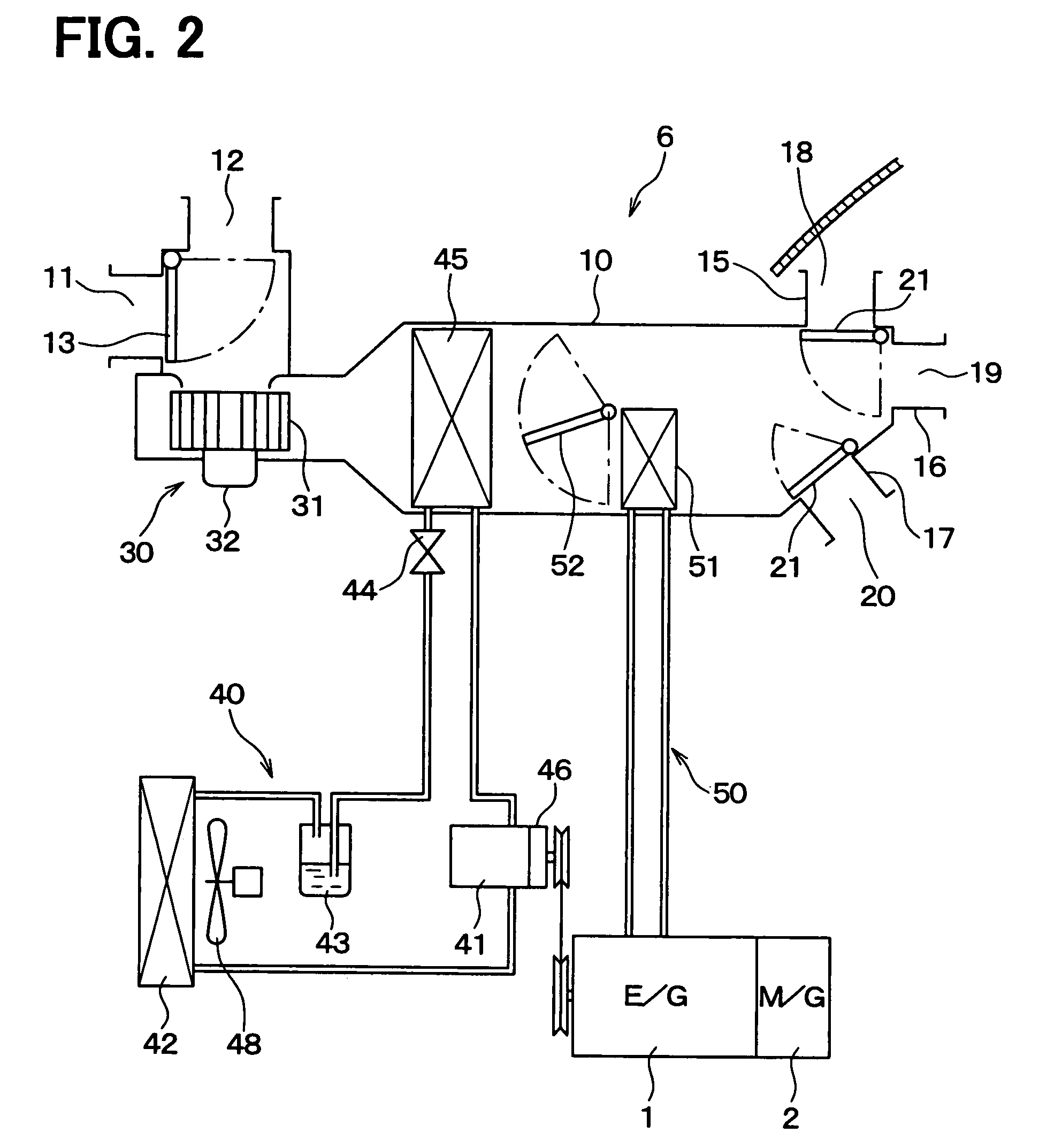
[0040]A first embodiment of the present invention will be now described with reference to FIGS. 1 to 12. FIG. 1 is a block diagram showing a schematic configuration of a hybrid vehicle according to the first embodiment of the invention, and FIG. 2 is a schematic diagram showing a structure of an air conditioning unit shown in FIG. 1.
[0041]As shown in FIG. 1, a hybrid vehicle 5 of this embodiment includes an engine 1 (E / G) for vehicle running, an electric motor 2 (M / G) for vehicle running, an engine starter 3, a battery 4, an air conditioning unit 6 (A / C unit), an air conditioning ECU 7 (A / C ECU), a seat ECU 7A, a setting unit 7a, a seat air conditioning unit 7b, a hybrid ECU 8, and an engine ECU 9.
[0042]The engine 1 for vehicle running is disengageably connected to and driven by an axle of the hybrid vehicle 5. The electric motor 2 for vehicle running is disengageably connected to and driven by the axle of the hybrid vehicle 5. The motor 2 is adapted to be connected to the axle when...
second embodiment
[0118]In the above-described first embodiment as mentioned above, the gradient (TWS / TAO) of the target air outlet temperature (TAO) with respect to the preset coolant temperature (TWS) is the same or constant regardless of the auxiliary heating level as shown in FIG. 11. Instead of this, as shown in FIG. 13, the gradient (TWS / TAO) of the target air outlet temperature (TAO) with respect to the preset coolant temperature (TWS) may be set to be different for each auxiliary heating level.
[0119]Specifically, in a case of 30<TAO<55, the gradient (TWSfTAO) becomes different for each auxiliary heating level, whereas in a case of 55<TAO, the preset coolant temperature (TWS) takes the maximum value (guard value) that is different for each auxiliary heating level. Each of the maximum values (guard value such as 75, 72, 70, 68) is the same as the corresponding one in the first embodiment as described above.
[0120]In the second embodiment, the preset coolant temperature (TWS) can be set in detail...
third embodiment
[0122]Although in the above-described first embodiment, the setting unit 7a is directly connected to the seat ECU 7A, and the output signal from the setting unit 7a is directly input into the seat ECU 7A, the invention is not limited thereto. As shown in FIG. 14, the air conditioning ECU 7 may be located between the setting unit 7a and the seat ECU 7A, and the output signal from the setting unit 7a may be input to the seat ECU 7A via the air conditioning ECU 7.
[0123]In the third embodiment, the other parts may be the same as those of the above-described first or second embodiment.
PUM
 Login to View More
 Abstract
Description
Claims
Application Information
 Login to View More