
VLA-4 inhibitory drug
a technology of inhibitors and vla4 is applied in the field of vla4 inhibitors, which can solve the problems of short retention time in blood and poor oral absorption of most such compounds, and achieve excellent effects and high oral absorption
- Summary
- Abstract
- Description
- Claims
- Application Information
AI Technical Summary
Benefits of technology
Problems solved by technology
Method used
Image

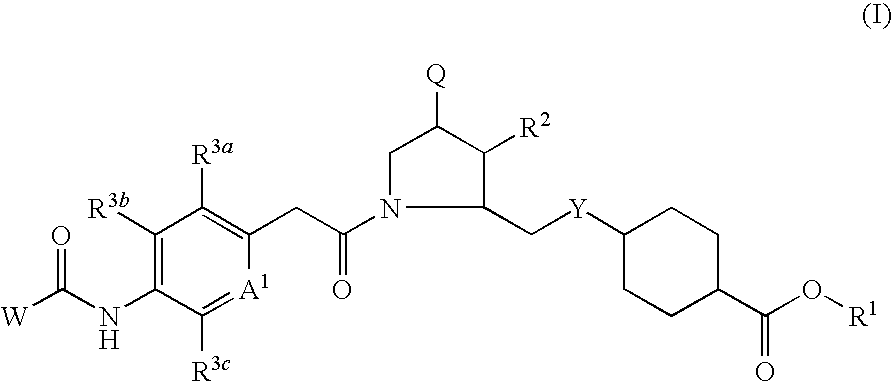
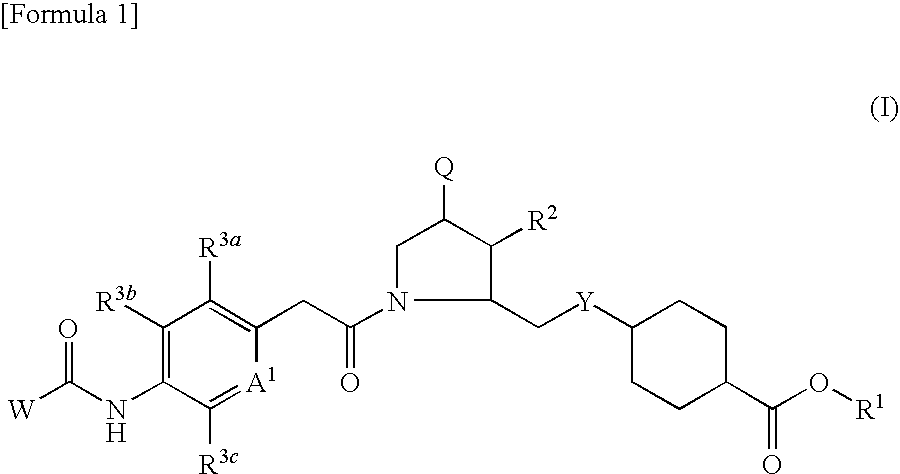
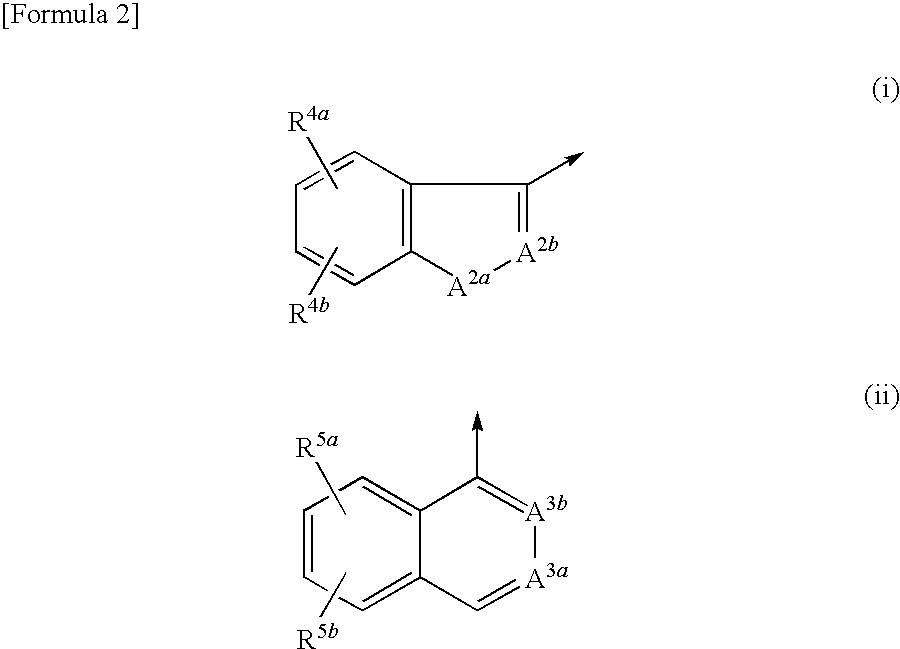
Examples
example 1
Trans-4-[1-[[5-chloro-2-fluoro-4-[(1-methyl-1H-indol-1-yl)-(2S)-pyrrolidinylmethoxy]cyclohexanecarboxylic acid
4-[(4R)-hydroxy-(2S)-pyrrolidinylmethoxy]benzoic acid ethyl ester
[0401]
[0402]To a methanol solution (300 mL) of 4-[1-(benzyloxycarbonyl)-(4R)-hydroxy-(2S)-pyrrolidinylmethoxy]benzoic acid ethyl ester (25.5 g, 63.8 mmol), 106 palladium hydroxide / carbon (5.1 g) was added, and the mixture was stirred for 4 hours under a hydrogen stream at normal pressure. The reaction mixture was filtered to eliminate the catalyst, and then the filtrate was concentrated under reduced pressure and dried, to obtain the title compound (17.9 g, 100%) as a solid.
[0403]NMR (CDCl3) δ: 1.38 (3H, t, J=7.1 Hz), 1.77-2.03 (total 3H, series of m, including 1H, broad s, at δ 1.91), 2.96-3.00 (1H, m), 3.11-3.15 (1H, m), 3.81-3.99 (3H, m), 4.34 (2H, q, J=7.1 Hz), 4.49-4.51 (1H, m), 6.91 (2H, d, J=8.8 Hz), 7.98 (2H, d, J=8.8 Hz).
4-[1-(Tert-butoxycarbonyl)-(4R)-hydroxy-(2S)-pyrrolidinylmethoxy]cyclohexanecarbox...
example 2
Trans-4-[1-[[2,5-dichloro-4-[(1-methyl-1H-indol-3-ylcarbonyl)amino]phenyl]acetyl]-(4S)-(3-methoxyazetidin-1-yl)-(2S)-pyrrolidinylmethoxy]cyclohexanecarboxylic acid
Trans-4-[1-[[2,5-dichloro-4-[(1-methyl-1H-indol-3-ylcarbonyl)amino]phenyl]acetyl]-(4S)-(3-methoxyazetidin-1-yl)-(2S)-pyrrolidinylmethoxy]cyclohexanecarboxylic acid ethyl ester
[0443]NMR (CDCl3) δ: 1.19-1.51 (9H, m), 1.87-2.33 (6H, m), 2.80-3.01 (3H, m), 3.16-3.25 (1H, m), 3.26 (0H, s), 3.26 (3H, s), 3.43-3.83 (7H, m), 3.87 (3H, s), 3.92-4.25 (4H, m), 7.32-7.44 (4H, m), 7.78-7.81 (1H, m), 8.10-8.17 (1H, m), 8.23 (1H, s), 8.77 (1H, dd, J=6.7, 1.1 Hz).
[0444]MS (ESI) m / z: 699 (M++1), 701 (M++3)
Trans-4-[1-[[2,5-dichloro-4-[(1-methyl-1H-indol-3-ylcarbonyl)amino]phenyl]acetyl]-(4S)-(3-methoxyazetidin-1-yl)-(2S)-pyrrolidinylmethoxy]cyclohexanecarboxylic acid
[0445]
[0446]NMR (CDCl3) δ: 1.15-1.57 (4H, m), 1.92-2.42 (6H, m), 3.28-3.96 (18H, m), 4.09-4.43 (2H, m), 7.29-7.45 (4H, m), 7.81 (1H, s), 8.12 (1H, t, J=4.5 Hz), 8.24 (1H, d, J=4...
example 3
Trans-4-[1-[[4-[(benzo[b]thiophen-3-ylcarbonyl)amino]-5-chloro-2-fluorophenyl]acetyl]-(4S)-(3-methoxyazetidin-1-yl)-(2S)-pyrrolidinylmethoxy]cyclohexanecarboxylic acid
Trans-4-[1-[[4-[(benzo[b]thiophen-3-ylcarbonyl)amino]-5-chloro-2-fluorophenyl]acetyl]-(4S)-(3-methoxyazetidin-1-yl)-(2S)-pyrrolidinylmethoxy]cyclohexanecarboxylic acid ethyl ester
[0451]NMR (CDCl3) δ: 1.13-1.55 (9H, m), 1.88-2.34 (6H, m), 2.80-3.01 and 3.27 (total 3H, each s, amide isomers), 3.44-3.85 (7H, m), 3.97-4.21 (4H, m), 7.39-7.55 (3H, m), 7.92 (1H, d, J=8.1 Hz), 8.10 (1H, d, J=5.9 Hz), 8.34 (1H, d, J=7.4 Hz), 8.39-8.51 (2H, m).
[0452]MS (ESI) m / z: 685 (M++1), 687 (M++3)
Trans-4-[1-[[4-[(benzo[b]thiophen-3-ylcarbonyl)amino]-5-chloro-2-fluorophenyl]acetyl]-(4S)-(3-methoxyazetidin-1-yl)-(2S)-pyrrolidinylmethoxy]cyclohexanecarboxylic acid
[0453]
[0454]NMR (CDCl3) δ: 1.37-1.37 (4H, m), 1.87-2.35 (7H, m), 2.99-3.30 and 7.91 (total 1H, each d, J=8.3 and 8.1 Hz, respectively, amide isomers), 8.09 (1H, d, J=4.4 Hz), 8.34 (1...
PUM
| Property | Measurement | Unit |
|---|---|---|
| temperature | aaaaa | aaaaa |
| boiling point | aaaaa | aaaaa |
| reaction time | aaaaa | aaaaa |
Abstract
Description
Claims
Application Information
 Login to View More