Unlock instant, AI-driven research and patent intelligence for your innovation.

Multi-bit memory error management

a multi-bit memory and memory manager technology, applied in error detection/correction, digital storage, instruments, etc., can solve problems such as occasional flaws or imperfections, volatile memory loses its content, and individual memory bit storage locations go bad

Active Publication Date: 2012-08-14
CRAY
View PDF33 Cites 11 Cited by
  • Summary
  • Abstract
  • Description
  • Claims
  • Application Information

AI Technical Summary

Benefits of technology

"The patent describes an apparatus and method for detecting and distinguishing between intermittent and persistent errors in data read from a memory device. The apparatus includes a memory device with multiple addressable memory locations and a memory manager with a scheduling unit that can detect multi-bit errors and retry the read operation to determine if the error is intermittent or persistent. The method involves requesting data to be read from a memory location, reading the data, and if an error is detected, initiating a retry operation with a maximum number of retries. The system includes a processor and interface with multiple memory managers, at least one of which has a scheduling unit for detecting and distinguishing between intermittent and persistent errors."

Problems solved by technology

Volatile memory loses its content when power is cut off, so while it is generally not useful for long-term storage, it is generally used for temporary storage of data while a computer is running.
But, the constant push to improve memory performance and the imperfect nature of manufactured goods in general suggest that occasional flaws or imperfections will occur.
Individual memory bit storage locations occasionally go bad, and sometimes even whole memory chips fail.
It is also known that various electrical phenomena can regularly cause memory read or write errors, such as electromagnetic noise causing a signal level to change or a cosmic ray changing the state of one or more bits of memory.
Error correction codes (ECC), such as single error correction with double error detection (SECDED), will tolerate a single “bit flip” event, but will fail if multiple bits within the protected region (the bits over which the ECC is protecting) are flipped.
A memory reference (read) to a location with a multi-bit error (MBE) will cause the application to fail.
It is possible to extend these techniques to allow multiple adjacent memory bits to be corrected, however, this approach is more expensive (requiring additional check bits) and only applies to soft errors that are clustered (effecting multiple adjacent bits within the word).
Further, it is possible for combinations of errors to simultaneously exist within data read from a given memory location, which gives the appearance of a single event with multi-bit errors.
By way of illustration, a single “bit flip” event in main memory, combined with the electrical noise on the memory interface pins, can result in a soft error that contain a MBE error in read data.
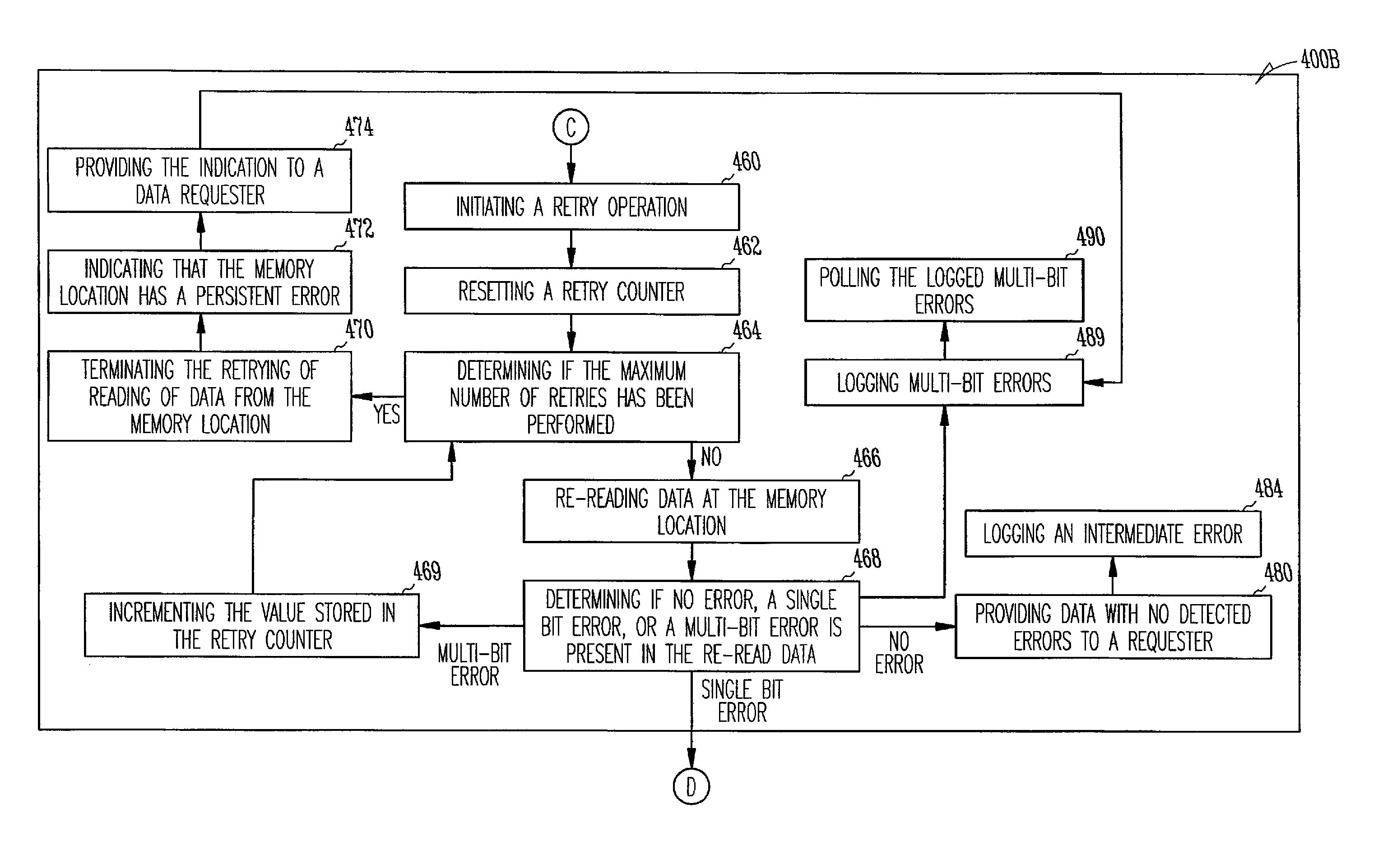
Persistent errors are determined to exist when a MBE error exists during an initial reading of data from a memory location, and a MBE error exists as a result of one or more retries of the read operations at the same memory location where the MBE error existed during the initial reading of the data.
In addition, conventional correction codes cannot disambiguate intermittent soft errors, such as those induced by electrical noise, from a persistent error, such as struck-at memory fault.
In various embodiments, a retry operation that results in a multi-bit error being detected in the re-read data will result in another retry.
In another instance, where N=10, up to ten retry operations may be performed when the original reading of the data and each of the subsequent 9 retry operations result in a multi-bit error being detected in the re-read data.
If all the readings for the data from the given memory location result in multi-bit error being detected, the given memory location will be deemed to have a persistent error.
In the worst case, a sufficient number of bits will be upset to result in silent data corruption.
However, this would result in a loss of the capability of detecting faulty stuck-at memory bits that can be found when a particular word consistently suffers from single-bit errors even after being scrubbed repeatedly.
However, with higher-density parts (with more rows that need to be refreshed in a distributed manner) the benefit is more modest.
Although soft errors in a memory system should be uniformly distributed within the memory space, the memory space is not necessarily uniformly accessed.
Therefore, commonly observed single-bit errors will be exposed by reading the histogram registers and examining the frequency of errors.
Poisoning may occur when a hardware error in the cache that corrupts the cache data is written back to the memory device.
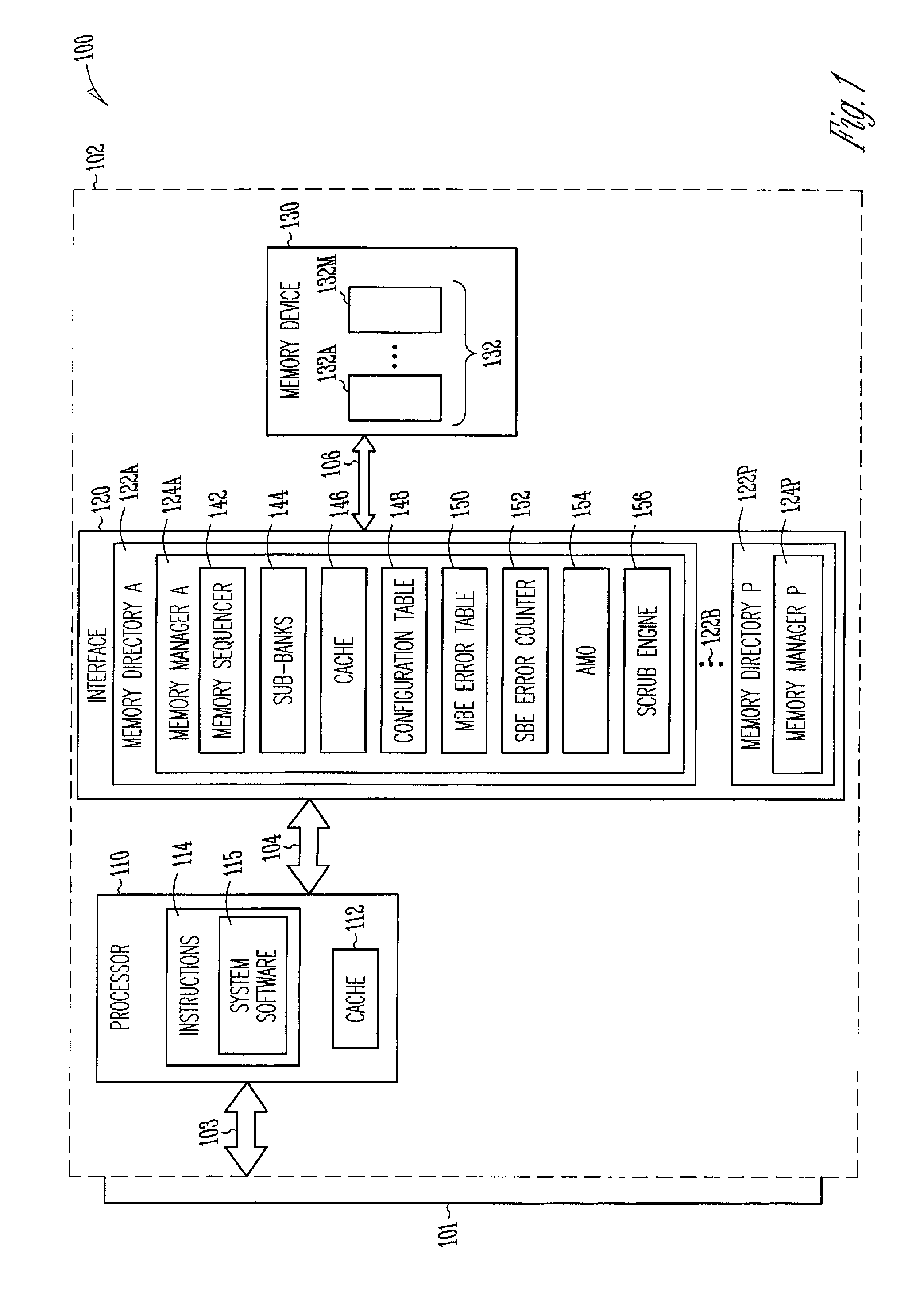
If an error is detected in the read data, the error is logged in the MBE error table.

Method used

the structure of the environmentally friendly knitted fabric provided by the present invention; figure 2 Flow chart of the yarn wrapping machine for environmentally friendly knitted fabrics and storage devices; image 3 Is the parameter map of the yarn covering machine
View more

Image

Smart Image Click on the blue labels to locate them in the text.
Viewing Examples
Smart Image
  • Multi-bit memory error management
  • Multi-bit memory error management
  • Multi-bit memory error management

Examples

Experimental program
Comparison scheme
Effect test

Embodiment Construction

[0018]Modern DRAM devices are built from high-density, low-voltage integrated circuits that are becoming increasingly susceptible to influences from external factors such as electrical noise, process variation, and natural radiation (particle-induced upsets). The resultant errors from these effects are referred to as “soft errors” since they can corrupt the state of a storage element, but generally do not cause any permanent damage to the underlying circuitry. The rate at which these events occur is referred to as the soft error rate (SER), and has been steadily increasing as transistor geometries shrink.

[0019]A variety of error mitigation techniques are applied to reduce the impact that soft errors have on a system composed of thousands of high-density memory devices. Error correction codes (ECC), such as single error correction with double error detection (SECDED), will tolerate a single “bit flip” event, but will fail if multiple bits within the protected region (the bits over wh...

the structure of the environmentally friendly knitted fabric provided by the present invention; figure 2 Flow chart of the yarn wrapping machine for environmentally friendly knitted fabrics and storage devices; image 3 Is the parameter map of the yarn covering machine
Login to View More

PUM

No PUM Login to View More

Abstract

Various embodiments include fault tolerant memory apparatus, methods, and systems, including an apparatus comprising a memory device including a plurality of addressable memory locations, and a memory manager coupled to the memory device, the memory manager including a scheduling unit operable to detect a multi-bit error in data read from the memory device, and to retry the read operation in order to distinguish between an intermittent error and a persistent error.

Description

RELATED APPLICATION[0001]This application claims the benefit under 35 U.S.C. 119(e) of U.S. Provisional Application Ser. No. 60 / 908,154 filed Mar. 26, 2007, which application is incorporated herein and made a part hereof.FEDERALLY SPONSORED RESEARCH OR DEVELOPMENT[0002]The U.S. Government has a paid-up license in this invention and the right in limited circumstances to require the patent owner to license others on reasonable terms as provided for by the terms of Contract No. MDA904-02-3-0052, awarded by the Maryland Procurement Office.FIELD OF THE INVENTION[0003]The invention relates generally to computer system memory, and more specifically to a memory manager that is operable in multiple error detection and correction modes.BACKGROUND[0004]A wide variety of computerized systems, from the smallest personal digital assistants to the most powerful supercomputers, use memory to store programs for fast execution, and to store data for rapid access while the computer system is operating...

Claims

the structure of the environmentally friendly knitted fabric provided by the present invention; figure 2 Flow chart of the yarn wrapping machine for environmentally friendly knitted fabrics and storage devices; image 3 Is the parameter map of the yarn covering machine
Login to View More

Application Information

Patent Timeline
no application Login to View More
Patent Type & Authority Patents(United States)
IPC IPC(8): G06F11/00
CPCG06F11/106G06F11/141G11C29/44G11C11/401G11C2029/0409
Inventor ABTS, DENNIS C.HIGGINS, MICHAELSNYDER, VAN L.
Owner CRAY
Features
  • R&D
  • Intellectual Property
  • Life Sciences
  • Materials
  • Tech Scout
Why Patsnap Eureka
  • Unparalleled Data Quality
  • Higher Quality Content
  • 60% Fewer Hallucinations
Social media
Patsnap Eureka Blog
Learn More