
Dynamic merging of pipeline stages in an execution pipeline to reduce power consumption
a pipeline and pipeline technology, applied in the field of data processing, can solve the problems of appreciable performance penalty, likewise reduced etc., and achieve the effect of reducing power consumption, reducing power consumption of the execution pipeline, and reducing the switching of the latch
- Summary
- Abstract
- Description
- Claims
- Application Information
AI Technical Summary
Benefits of technology
Problems solved by technology
Method used
Image

Examples
Embodiment Construction
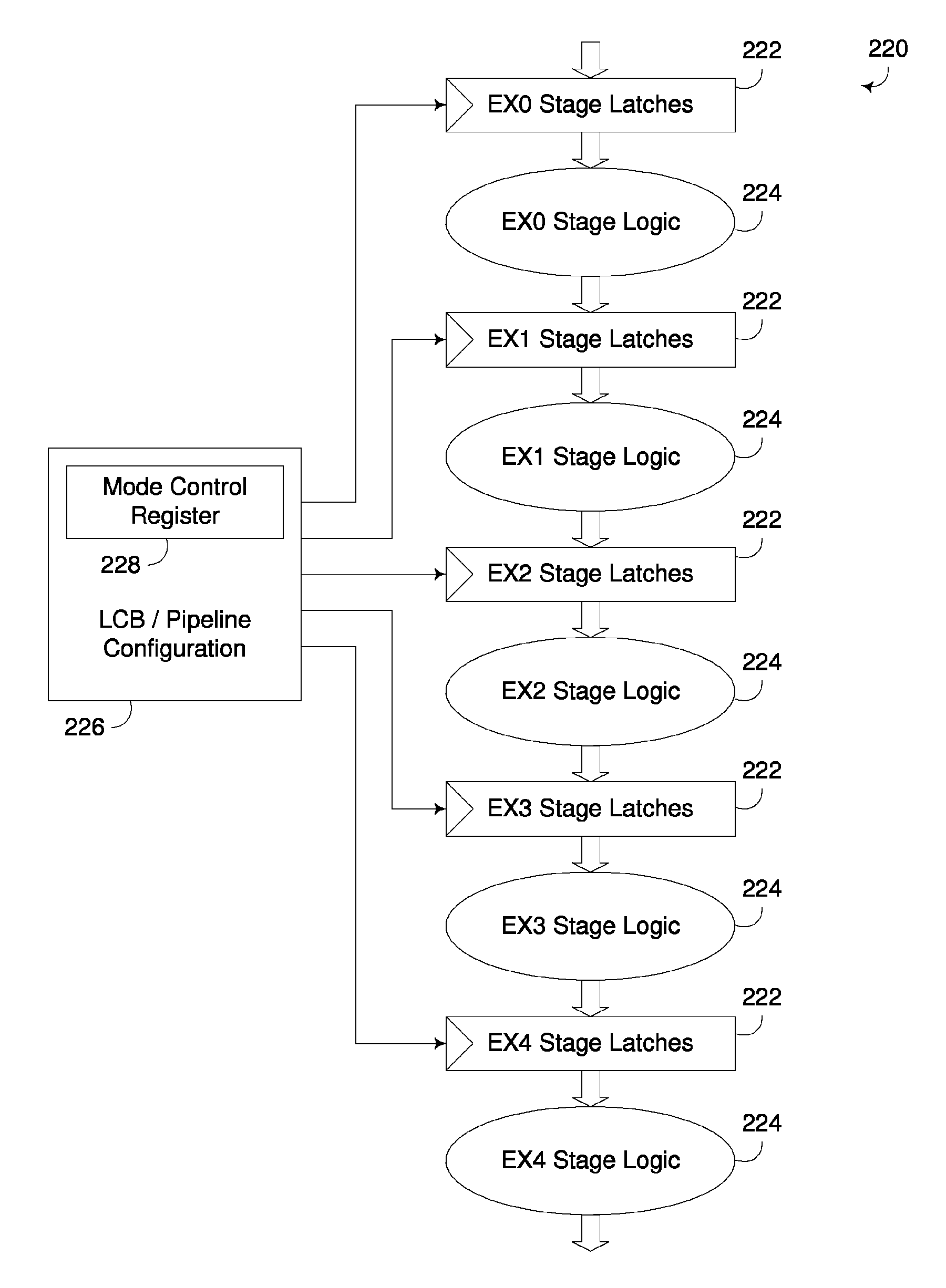
[0029]Embodiments consistent with the invention selectively set latches in the stages of an execution pipeline to a transparent state to dynamically configure the execution pipeline for the purpose of reducing power consumption by the execution pipeline. By setting latches to a transparent stage, the execution logic in the two stages that are otherwise separated by the latches becomes effectively merged so that input data provided to the earlier stage flows through the execution logic of both stages in a single clock cycle. In addition, in many instances, where the combined propagation delay of the merged execution logic exceeds that permitted in a single clock cycle, the frequency of the clock signal provided to the execution pipeline is reduced to accommodate the increased propagation delay.
[0030]In general, an execution pipeline consistent with the invention supports multiple modes. In a normal operating mode, the latches in each pipeline stage are all clocked, e.g., at a first c...
PUM
 Login to View More
 Abstract
Description
Claims
Application Information
 Login to View More