The
disadvantage of sticks for face and cheeks known hitherto is firstly the inadequate stability of the sticks.
Many sticks are sensitive to shear forces, and crumble easily, meaning that the decorative emulsion cannot be distributed on the skin very easily.
In addition, they are not particularly temperature-stable, smear and run upon use in the hot summer months, while in winter at cold temperatures they become brittle and dull.
Suitable for this purpose are stick formulations, although currently these are known in the market only in the form of lipcare sticks, foundation sticks and the like, and are not conceived for the reduction or prophylaxis of wrinkles.
The skin on the lips is therefore virtually free from lipids and is prone to
drying out, particularly in cold and dry weather.
However, the object of this layer is not primarily to protect the lip skin from
drying out.
A considerable shortcoming of the formulations of the prior art is, inter alia, that, due to the low water contents of per se acceptable emulsion sticks, it is virtually impossible to incorporate water-soluble
UV filter substances into such formulations.
These include the fact that water-soluble active ingredients are often not sufficiently fat-soluble to be incorporated into the cosmetic bases to a noteworthy degree.
In addition, it is therefore not possible to make sticks with very high water contents in accordance with the prior art because the water is incompatible with the hydrophobic oil /
wax / emulsifier matrix.
This is probably due to the fact that only extremely short-term moisturizing is brought about by water.
In addition, low-water or
anhydrous stick formulations are only therefore passively moisturizing because occlusive waxes are used which cause a build-up of water in the skin.
In addition, the waxes used could additionally cause occlusive effects, as in the case of
anhydrous sticks, resulting in a synergism from water, moisturizing agent and
wax for emulsion sticks designed in this way.
Pearlescent pigments are, for example, therefore difficult to integrate into water-containing formulations because they are shear-sensitive, meaning that the pearlescent effect fails to appear or only unstable formulations arise.
If cosmetic or pharmaceutical sticks are to contain certain active ingredients, it is conceivable that the other constituents are incompatible with the active ingredients.
Pearlescent pigments are difficult to integrate into water-containing formulations because they are shear-sensitive, meaning that the pearlescent effect fails to appear or only unstable formulations arise.
The incorporation of pigments into emulsion sticks may result in various instabilities.
In more serious cases, instabilities in the stick
system may arise where temperature stability and stability to breaking are impaired.
Also, the omission of polysaccharides while retaining the stick structure is not regarded as being advantageous.
A considerable shortcoming of the formulations of the prior art is, inter alia, that, due to the low water contents of perfectly acceptable emulsion sticks, it was virtually impossible to incorporate water-soluble antiacne active ingredients into such formulations.
A considerable shortcoming of the formulations of the prior art is, inter alia, that, due to the low water contents of per se acceptable emulsion sticks, it was virtually impossible to incorporate water-soluble antiwrinkle active ingredients into such formulations.
Pearlescent pigments are difficult to integrate into water-containing formulations because they are shear-sensitive, meaning that the pearlescent effect fails to appear or only unstable formulations arise.


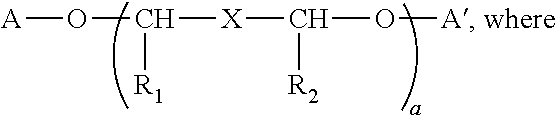
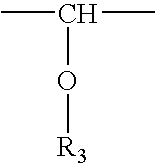
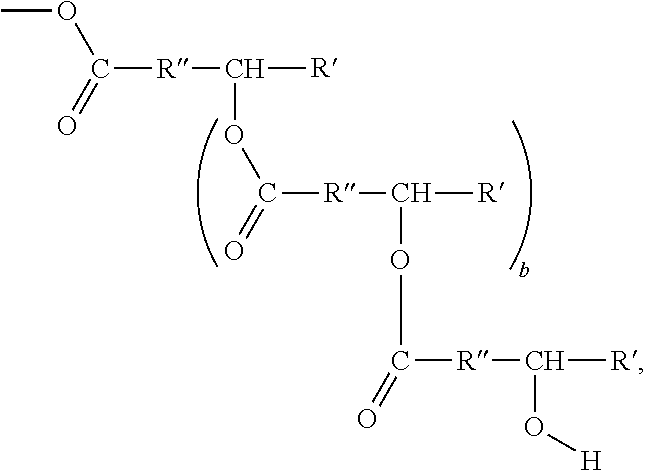
 Login to View More