Programming a non-volatile memory
a non-volatile memory and programming technology, applied in the field of non-volatile memory devices, can solve the problems of physical damage to the tunnel oxide insulation region, memory cell failure, and deterioration
- Summary
- Abstract
- Description
- Claims
- Application Information
AI Technical Summary
Benefits of technology
Problems solved by technology
Method used
Image



Examples
Embodiment Construction
[0015]With memory cell geometry for non-volatile memory (NVM) devices scaling down and the required number of programming cycles per lifetime increasing, high cycling performance and reliability can be achieved by distributing damage to an oxide region caused by hot carrier injection from a first electrode to both first and second electrodes on a memory cell. Embodiments of systems and methods disclosed herein use a switch matrix to alternate hot carrier injection (HCI) between first and second electrodes. The first and second electrodes are symmetrical and can be selected or exchanged to receive the high voltage during HCI programming. Programming signals can be sent to a switch matrix to select whether the voltage is applied to the first or second electrode of the memory cell.
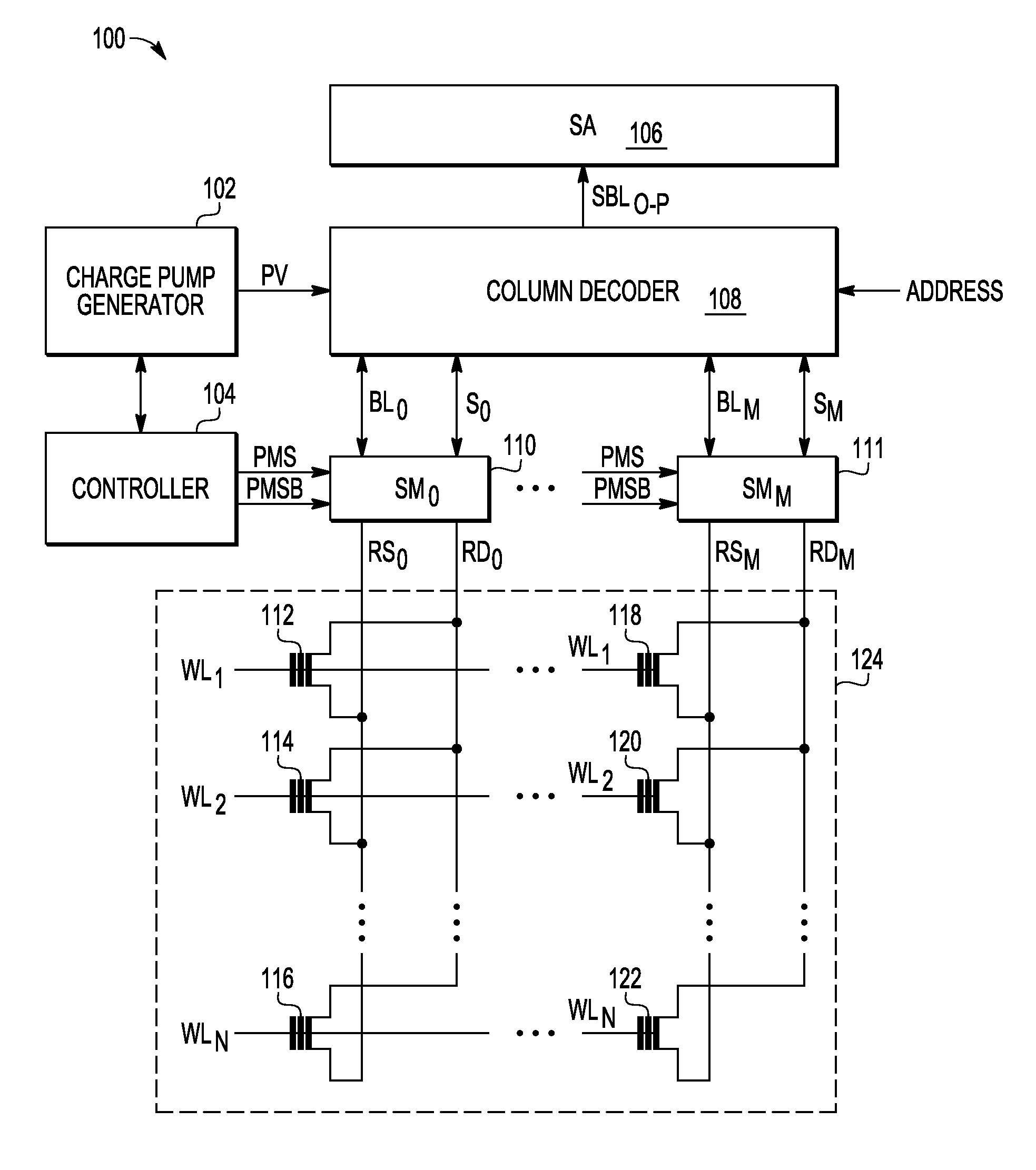
[0016]Referring to FIG. 1, a schematic diagram of an embodiment of a non-volatile memory (NVM) system 100 is shown in accordance with the present disclosure including charge pump 102, controller 104, sense am...
PUM
 Login to View More
 Abstract
Description
Claims
Application Information
 Login to View More