Unlock instant, AI-driven research and patent intelligence for your innovation.

Clock-data recovery and method for binary signaling using low resolution ADC

a clock-data recovery and binary signal technology, applied in the field of signal detection, can solve the problems of small eye opening and easy error by receivers

Active Publication Date: 2013-05-28
REALTEK SEMICON CORP
View PDF10 Cites 1 Cited by
  • Summary
  • Abstract
  • Description
  • Claims
  • Application Information

AI Technical Summary

Benefits of technology

This patent describes a new circuit and method for clock-data recovery (CDR) in a binary signaling system. The new CDR circuit includes a variable-gain amplifier, analog-digital converter, timing detection circuit, filter, controllable oscillator, automatic gain control, and data recovery. The new CDR method involves amplifying the input signal, quantizing it into a converter output, processing it to generate a timing error signal, filtering it to generate a control signal, controlling the recovered clock, and controlling the gain setting to recover the data. The technical effects of this invention include improved performance and reliability of CDR in binary signaling systems.

Problems solved by technology

Although the eye is still open, i.e. the two levels for the binary signaling are still distinguishable at an optimum sampling instant (121, 123), the eye opening is small and the receiver is prone to making an erroneous decision in presence of circuit noise or coupled noise.

Method used

the structure of the environmentally friendly knitted fabric provided by the present invention; figure 2 Flow chart of the yarn wrapping machine for environmentally friendly knitted fabrics and storage devices; image 3 Is the parameter map of the yarn covering machine
View more

Image

Smart Image Click on the blue labels to locate them in the text.
Viewing Examples
Smart Image
  • Clock-data recovery and method for binary signaling using low resolution ADC
  • Clock-data recovery and method for binary signaling using low resolution ADC
  • Clock-data recovery and method for binary signaling using low resolution ADC

Examples

Experimental program
Comparison scheme
Effect test

embodiment 200

[0026]FIG. 2 depicts a functional block diagram of an embodiment 200 of a clock-data recovery (CDR) circuit in accordance with the present invention. CDR circuit 200 comprises: a variable-gain amplifier (VGA) 210 for amplifying an input signal with a gain factor controlled by a gain setting to generate an amplified signal; a low-resolution ADC (analog-digital converter) 220 for converting the amplified signal into 3-bit data D[2:0] in accordance with a timing provided by a recovered clock; a 4-level slicer 280 for slicing the 3-bit data D[2:0] into a 2-bit slicer output data S[1:0]; a timing detection circuit 240 for processing the 2-bit slicer output data S[1:0] to generate a timing error signal; a filter 260 for filtering the timing error signal to generate a control voltage; a VCO (voltage controlled oscillator) 250 for generating the recovered clock under a control of the control voltage; an AGC (automatic gain control) block 270 for processing the 2-bit slicer output data S[1:0...

embodiment 640

[0060]Now refer to FIG. 6A. For a high frequency application, the unit-delay circuits 610 and 620 need to operate at a high clock frequency. For instance, for a 5 Gigabit-per-second link, the unit-delay circuits 610 and 620 need to operate at 5 GHz. A straight implementation using 5 GHz clock may not be easily practical. In this case, one can use a serial-to-parallel conversion to convert the serial 3-bit data D[2:0] into a block of 3-bit data at a lower frequency and perform block signal processing, as shown in embodiment 640 of FIG. 6B. The high frequency clocked 3-bit converter output data D[2:0] is converted into a block of lower frequency clock data by the S / P block 642 using a lower frequency clock. For instance, the serial 3-bit converter output data D[2:0] at 5 GHz can be converted into a block of twenty parallel 3-bit dada at 250 MHz. The method for performing such a serial-to-parallel conversion (S / P block 642) is well known to those of ordinary skill in the art and thus n...

embodiment 700

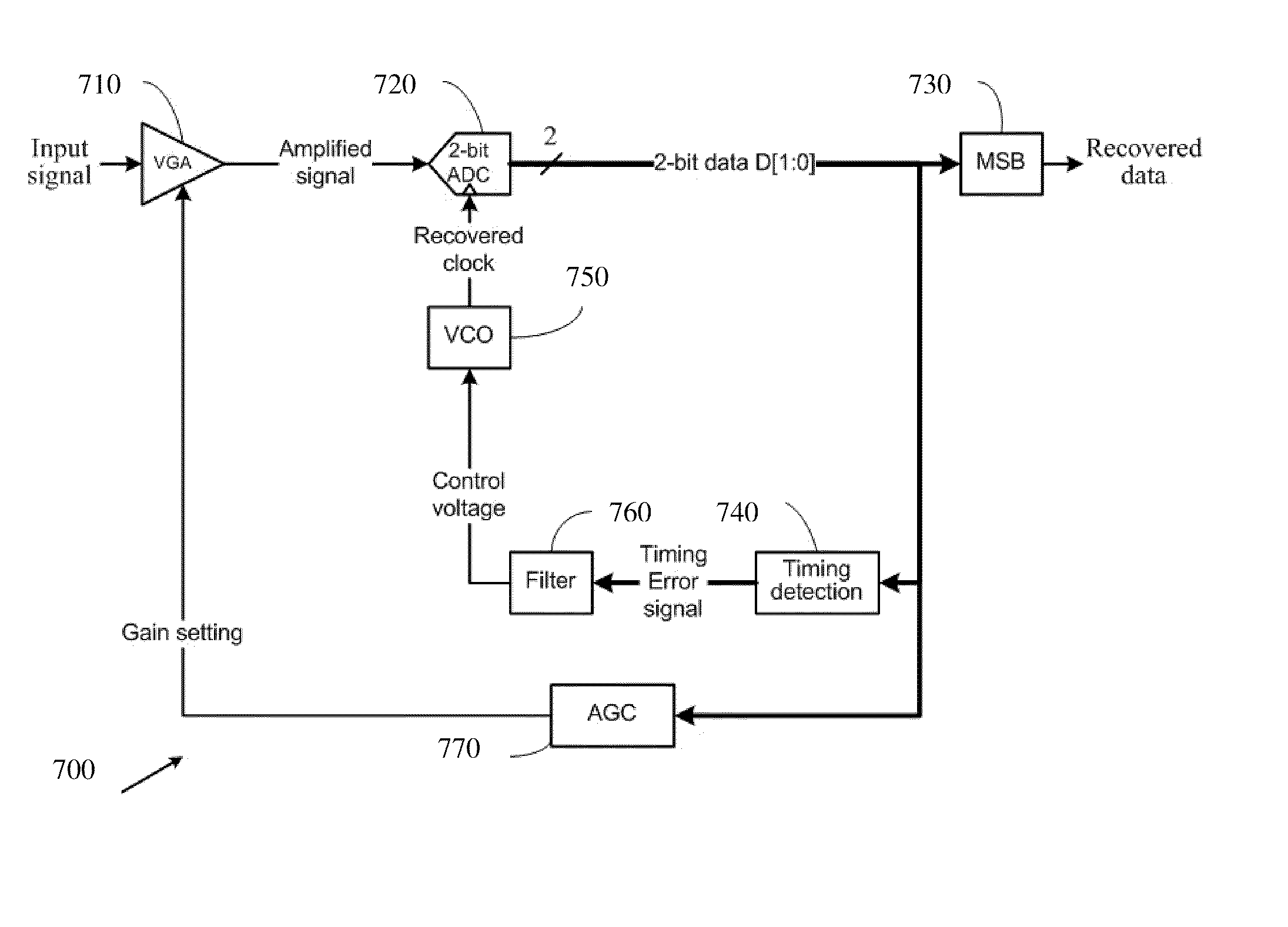
[0062]FIG. 7 depicts a functional block diagram of an embodiment 700 of a clock-data recovery (CDR) circuit in accordance with the present invention. CDR circuit 700 comprises: a variable-gain amplifier (VGA) 710 for amplifying an input signal with a gain factor controlled by a gain setting to generate an amplified signal; a 2-bit ADC (analog-digital converter) 720 for converting the amplified signal into 2-bit data D[1:0] in accordance with a timing provided by a recovered clock; a MSB functional block 730 for extracting the most significant bit of the 2-bit data D[1:0] to form the recovered data; a timing detection circuit 740 for processing the 2-bit data D[1:0] to generate a timing error signal; a filter 760 for filtering the timing error signal to generate a control voltage; a VCO (voltage controlled oscillator) 750 for generating the recovered clock under a control of the control voltage; and an AGC (automatic gain control) block 770 for processing the 2-bit data D[1:0] to gen...

the structure of the environmentally friendly knitted fabric provided by the present invention; figure 2 Flow chart of the yarn wrapping machine for environmentally friendly knitted fabrics and storage devices; image 3 Is the parameter map of the yarn covering machine
Login to View More

PUM

No PUM Login to View More

Abstract

A binary signal detection based on low resolution ADC includes: a variable-gain amplifier for amplifying an input signal with a gain factor controlled by a gain setting to generate an amplified signal; an ADC for converting the amplified signal into a converter output in accordance with a timing provided by a recovered clock, wherein the converter output has N levels; a timing detection circuit for generating a timing error signal based on the converter output; a filter for filtering the timing error signal to generate a control signal; a controllable oscillator for generating the recovered clock under a control of the control voltage; an automatic gain control for processing the converter data to set the gain setting to control the gain factor; and a data recovery circuit for generate a recovered data based on the converter output.

Description

CROSS REFERENCE TO RELATED APPLICATIONS[0001]This application claims the benefit of U.S. Provisional Application No. 61 / 103,559, filed on Oct. 7, 2008 and entitled “CLOCK-DATA RECOVERY FOR BINARY SIGNALING USING TWO-BIT ADC”, and the benefit of U.S. Provisional Application No. 61 / 105,733, filed on Oct. 15, 2008 and entitled “BINARY SIGNAL DETECTION BASED ON THREE-BIT ADC”, these contents of which are incorporated herein by reference.BACKGROUND OF THE INVENTION[0002]1. Field of the Invention[0003]The present invention relates to signal detection, in particular to signal detection for binary signal based on a low resolution analog-to-digital conversion and a logical operation on an output of the conversion.[0004]2. Description of Related Art[0005]Binary signaling is a popular scheme widely used in serial data link; for instance, SATA (Serial Advanced Technology Attachment). In such a serial data link, a bit stream is transmitted at a certain nominal rate fs in accordance with a first ...

Claims

the structure of the environmentally friendly knitted fabric provided by the present invention; figure 2 Flow chart of the yarn wrapping machine for environmentally friendly knitted fabrics and storage devices; image 3 Is the parameter map of the yarn covering machine
Login to View More

Application Information

Patent Timeline
no application Login to View More
Patent Type & Authority Patents(United States)
IPC IPC(8): H04L27/00H04L27/06
CPCG11B20/14H03L7/091H04L7/0062H04L7/033H04L27/063G11B20/10027G11B20/10037G11B20/10046G11B20/10222G11B20/1496G11B20/10009
Inventor LIN, CHIA-LIANG
Owner REALTEK SEMICON CORP