AI technical title is built by Patsnap AI team. It summarizes the technical point description of the patent document.
a technology of percutaneous puncture and renal access, which is applied in the field of percutaneous puncture system, can solve the problems of increased bleeding risk of antegrade approach, high radiation exposure of procedure, and high skill intensity of antegrade approach, so as to reduce tissue injury risk, and reduce the effect of caliber
Active Publication Date: 2014-07-08
RETROPERC LLC
View PDF2 Cites 8 Cited by
Summary
Abstract
Description
Claims
Application Information
AI Technical Summary
This helps you quickly interpret patents by identifying the three key elements:
Problems solved by technology
Method used
Benefits of technology
Benefits of technology
This patent describes a method for reducing damage to tissues during a medical procedure, such as in the kidneys. This is done by using a special wire that is placed to shield a portion of the wire that bends around the ureteropelvic junction, which helps to reduce trauma to tissues. The patent also explains different variations of the wire that can be used, such as a larger caliber wire or a wire with a coating to reduce the risk of injury. Overall, this invention helps to safely and effectively perform medical procedures without causing unnecessary harm to the patient.
Problems solved by technology
The antegrade approach holds increased bleeding risk due to the puncture needle puncturing the interlobar arteries as it passes into the collecting system.
This antegrade approach is also skill intensive because it requires advancing from the flank to an “unknown” calyx.
In fact, studies have shown that recent urology resident graduates often do not continue to perform the antegrade nephrostomy technique after graduating due to difficulty of this procedure.
The procedure also requires a relatively large amount of radiationexposure.
However, it is recognized that due to obstructions, e.g. presence of calculi, it may not be possible to advance the catheter into the optimally desired calyx and consequently a less optimal calyx is selected by the surgeon.
However, despite its advantages over the antegrade approach, there are several disadvantages to the Lawson technique.
First, although requiring less radiationexposure, the patient is oftentimes still exposed to harmful doses of radiation.
Secondly, it is often difficult to navigate the ureteric catheter beyond large obstructive stones in the renal pelvis.
This inability to direct the catheter to the desired site (calyx) often leads the surgeon to access a less optimal calyx.
Thirdly, fluoroscopy provides only a two dimensional view of the renal anatomy, thereby limiting the ability to confidently select the calyx for tract dilation.
Sometimes, there is even uncertainty as to which calyx is actually chosen due to the limited visibility provided by fluoroscopy.
Although the Munch technique solves some of the problems associated with the Lawson technique, it is deficient in several respects.
First, the Munch technique leaves the puncture wire exposed to the ureteropelvic junction.
This creates the risk of cutting inside tissue, especially at the ureteropelvic junction, across which the very thin puncture wire passes.
Second, at the time of deployment of the puncture wire, the Munch technique fails to secure the wire assembly and ureteroscope, forcing either the surgeon or an assistant to devote two hands to opening the pin-vise lock and advancing the puncture wire, all while holding the flexible ureteroscope in position in a selected calyx.
This makes wire deployment cumbersome for the surgeon, less likely to be successful, requiring more skilled assistance, and increases the chances the tip of the flexible cystoscope will move out of a selected location for nephrostomy creation.
Third, Munch's technique of antegrade wire exchange is ineffectual and risks cutting the puncture wire with passage of 18 gage hollow bore needle over the wire.
This large jump from an 18 gauge needle to a 9 French fascial dilator is also cumbersome and has a high chance of failing to grant access to the kidney.
Method used
the structure of the environmentally friendly knitted fabric provided by the present invention; figure 2 Flow chart of the yarn wrapping machine for environmentally friendly knitted fabrics and storage devices; image 3 Is the parameter map of the yarn covering machine
View more
Image
Smart Image Click on the blue labels to locate them in the text.
Viewing Examples
Smart Image
Click on the blue label to locate the original text in one second.
Reading with bidirectional positioning of images and text.
Smart Image
Examples
Experimental program
Comparison scheme
Effect test
Embodiment Construction
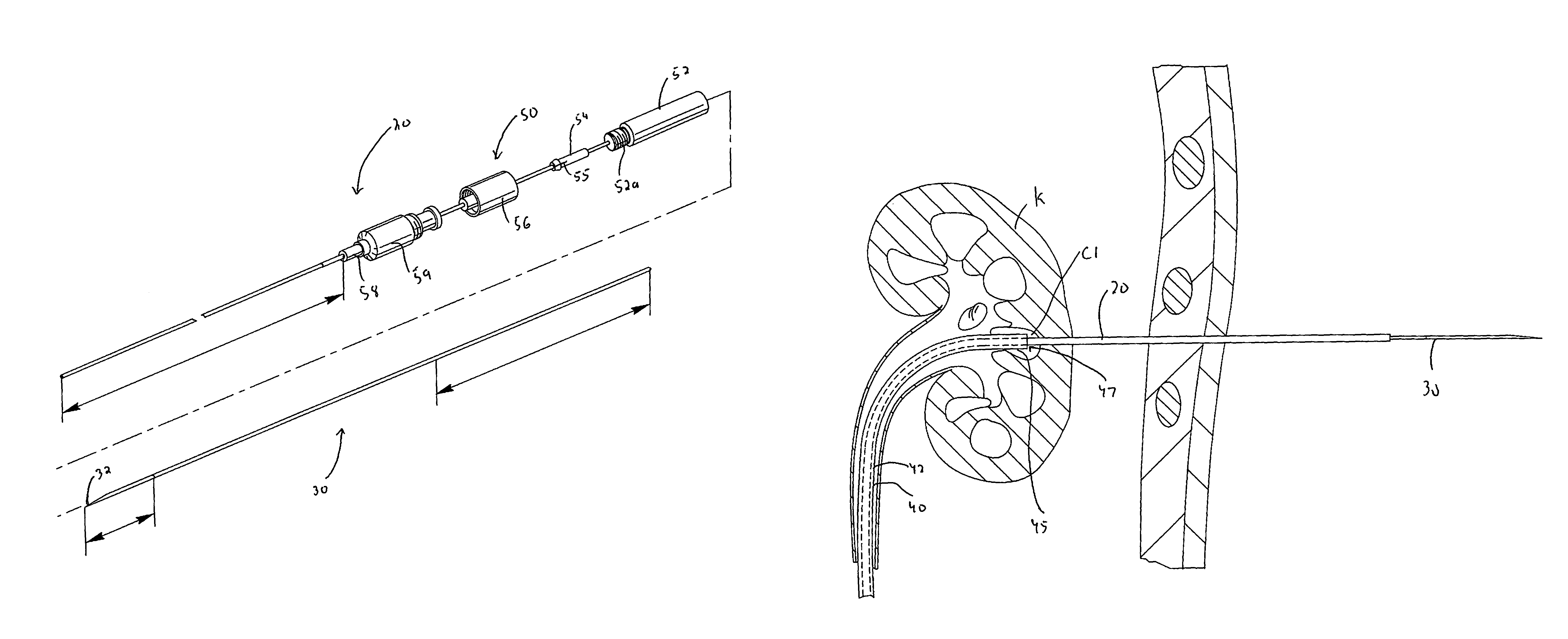
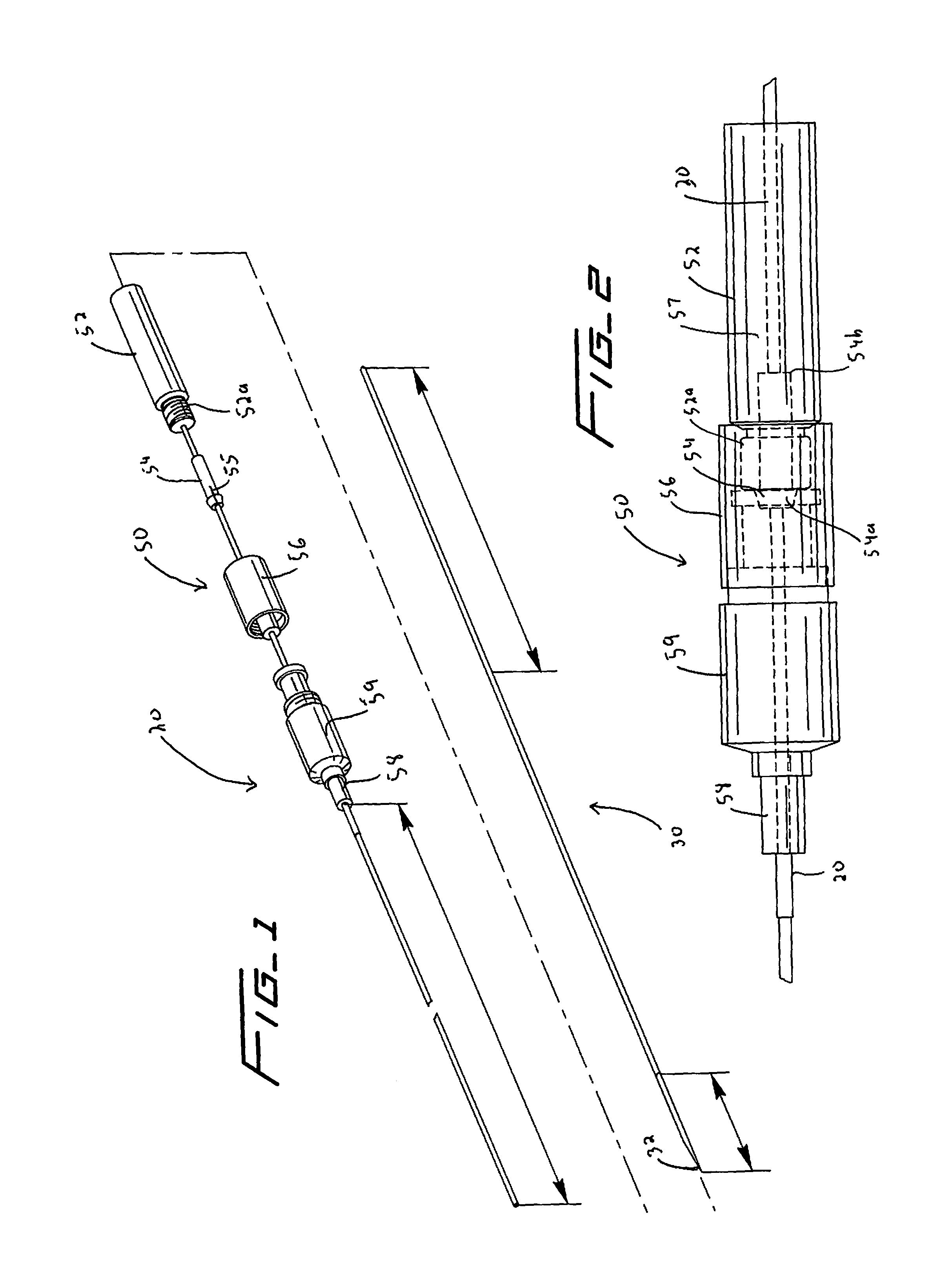
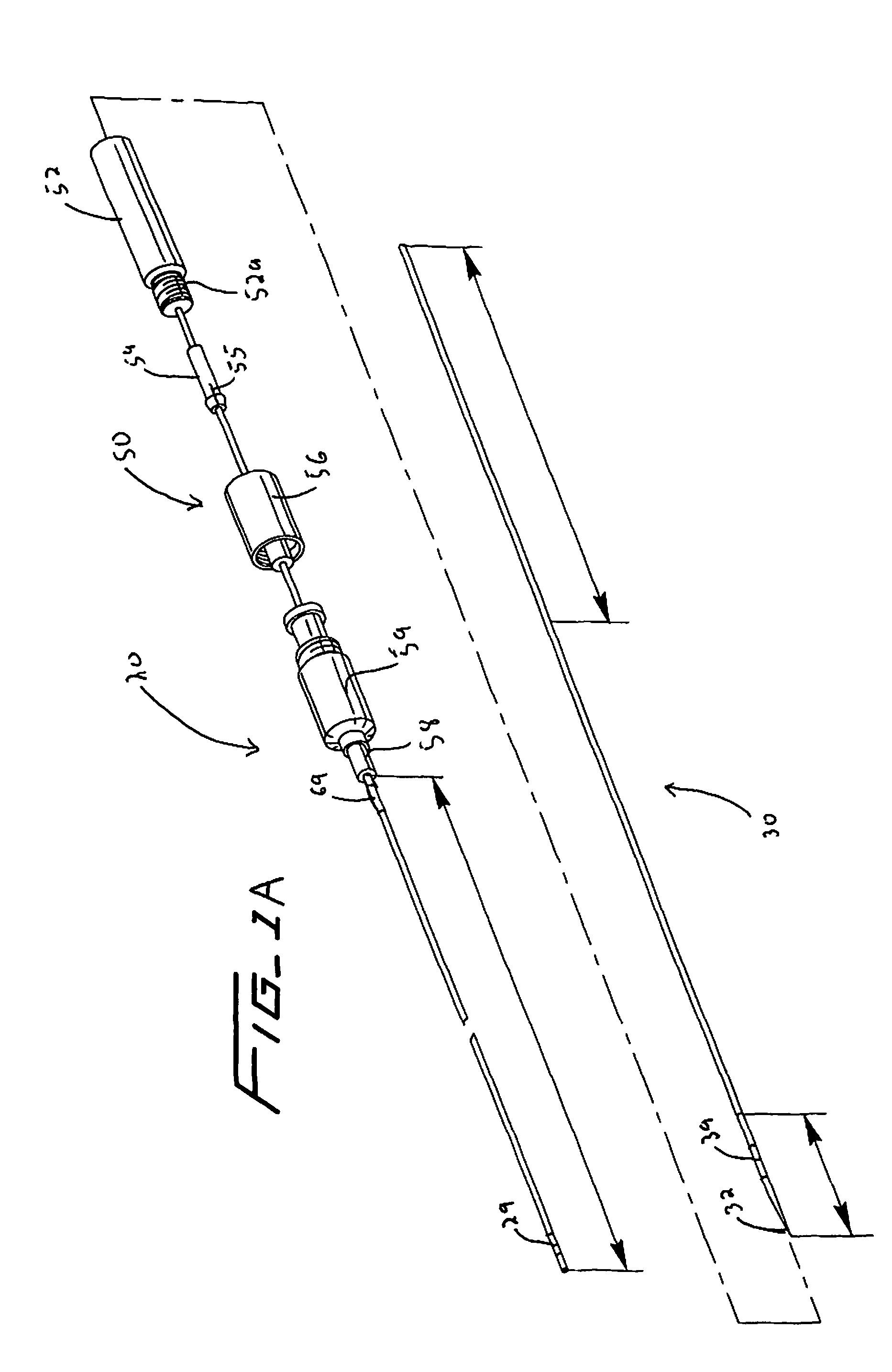
[0108]Referring now in detail to the drawings wherein like reference numerals identify similar or like components throughout the several views, FIGS. 1-22 illustrate various embodiments of the present invention. The present invention provides accessing as well as selecting a calyx under direct visualization utilizing an ureteroscope in order to create a nephrostomy tract for nephrostomy tube creation.
[0109]A puncture wire is advanced through a working channel of an ureteroscope which has been passed into the kidney in retrograde fashion. The puncture wire is then deployed from the ureteroscope working channel through a surgeon selected calyx and through the kidney and out the flank and skin in a retrograde fashion. This technique obviates the need for antegrade access to the calyx as antegrade access disadvantageously requires significant technical skill due to advancement into the “unknown calyx” and creates potential risks for the patient including relatively high radiation exposu...
the structure of the environmentally friendly knitted fabric provided by the present invention; figure 2 Flow chart of the yarn wrapping machine for environmentally friendly knitted fabrics and storage devices; image 3 Is the parameter map of the yarn covering machine
Login to View More
PUM
Login to View More
Abstract
A method for creating a tract for nephrostomy tube creation comprising the steps of providing a puncture wire having a tissue penetrating tip shielded in a sheath, the puncture wire slidable within the sheath and releasably lockingly engaged thereto, inserting the puncture wire and sheath in a first direction through a working channel of an ureteroscope to exit the channel of the ureteroscope, releasing the puncture wire from the sheath and advancing the puncture wire a first distance from the sheath while visualizing via the ureteroscope the position of the puncture wire, advancing the puncture wire and the sheath into a selected calyx and through a flank of a patient, removing the puncture wire from the sheath in a second direction different from the first direction and inserting a guidewire through the sheath.
the structure of the environmentally friendly knitted fabric provided by the present invention; figure 2 Flow chart of the yarn wrapping machine for environmentally friendly knitted fabrics and storage devices; image 3 Is the parameter map of the yarn covering machine
Login to View More
Application Information
Patent Timeline
Application Date:The date an application was filed.
Publication Date:The date a patent or application was officially published.
First Publication Date:The earliest publication date of a patent with the same application number.
Issue Date:Publication date of the patent grant document.
PCT Entry Date:The Entry date of PCT National Phase.
Estimated Expiry Date:The statutory expiry date of a patent right according to the Patent Law, and it is the longest term of protection that the patent right can achieve without the termination of the patent right due to other reasons(Term extension factor has been taken into account ).
Invalid Date:Actual expiry date is based on effective date or publication date of legal transaction data of invalid patent.



 Login to View More
  Login to View More