Unlock instant, AI-driven research and patent intelligence for your innovation.

Colored noise reduction method and device for optical remote airflow measurement apparatus

a measurement apparatus and color noise technology, applied in the direction of distance measurement, force measurement by measuring optical property variation, instruments, etc., can solve the problems of inability to respond, noise cannot be reduced, and use signals cannot be distinguished, so as to prevent deterioration of measurement precision and enlarge the measurement range

Active Publication Date: 2015-04-28
JAPAN AEROSPACE EXPLORATION AGENCY
View PDF9 Cites 0 Cited by
  • Summary
  • Abstract
  • Description
  • Claims
  • Application Information

AI Technical Summary

Benefits of technology

The present invention aims to improve the accuracy of optical remote airflow measurement by reducing the effect of colored noise caused by external factors such as wind and sun. By doing so, the apparatus is better able to measure airflow over longer distances and at a range of flying speeds.

Problems solved by technology

Typical conventional techniques involve smoothing noise by integrating measurement signals and superimposing the signals, but when a noise generation characteristic is irregular, or in other words in relation to colored noise, useful signals cannot be distinguished, and therefore the noise cannot be reduced.
However, this method cannot respond to variation in a condition of the colored noise during measurement, and an offset velocity cannot be varied during measurement.

Method used

the structure of the environmentally friendly knitted fabric provided by the present invention; figure 2 Flow chart of the yarn wrapping machine for environmentally friendly knitted fabrics and storage devices; image 3 Is the parameter map of the yarn covering machine
View more

Image

Smart Image Click on the blue labels to locate them in the text.
Viewing Examples
Smart Image
  • Colored noise reduction method and device for optical remote airflow measurement apparatus
  • Colored noise reduction method and device for optical remote airflow measurement apparatus
  • Colored noise reduction method and device for optical remote airflow measurement apparatus

Examples

Experimental program
Comparison scheme
Effect test

first embodiment

[0053](First Embodiment)

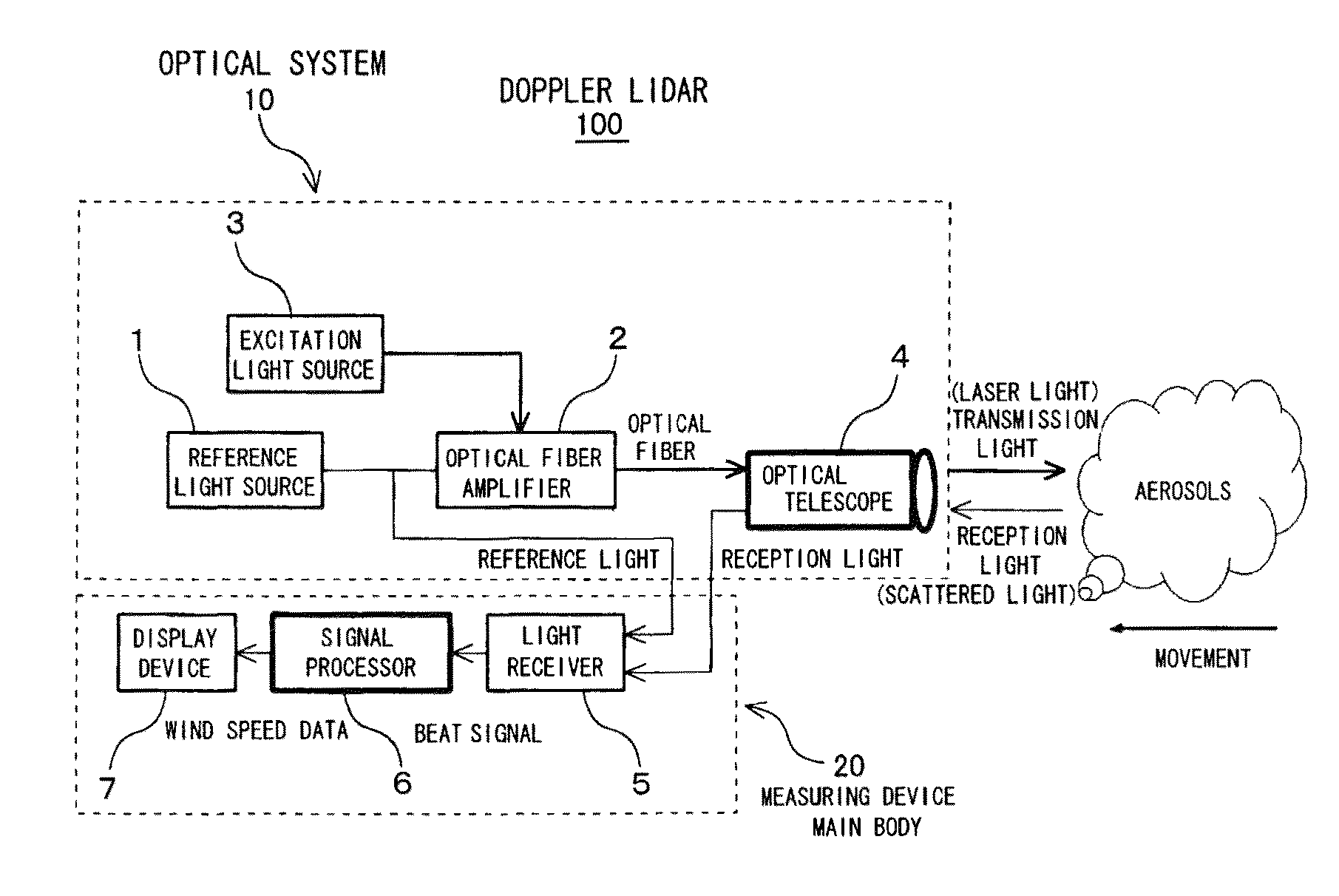
[0054]FIG. 6 is a view showing an example of an air turbulence measurement result according to a first embodiment of the present invention. Data obtained in an actual flight experiment are used, and FIG. 6A shows an air turbulence measurement result measured using the Doppler LIDAR 100 prior to noise reduction, while FIG. 6B shows an air turbulence measurement result following noise reduction according to the present invention. The averaged number of stages used to estimate the colored noise is set at L=16. In FIGS. 6A and 6B, the airframe travels at a speed of approximately 220 m / s in a vertical axis upward direction, and a vertical length (a range bin length ΔR) of one small square is 300 m. A vertical single series of data can be measured simultaneously over one second, and the data are arranged horizontally in time series. In other words, the scattered light power spectrum S(m, n) (m=0 to M−1, n=0 to N−1) shown in FIG. 2 is measured at one second interval...

second embodiment

[0058](Second Embodiment)

[0059]In the colored noise estimation / reduction according to the first embodiment of the present invention, as shown in FIG. 2, colored noise estimation was performed using a fixed range of range bin numbers m (=M−L to M−1) having the averaged number of stages L as the colored noise estimation range. However, the measurement distance varies according to an aerosol density of the atmosphere and so on, and therefore a range of the remote measurement region in which the signal strength of the scattered light is substantially non-existent also varies. When the region becomes smaller, a region in which the scattered light possesses signal strength maybe included in the colored noise estimation range so as to have an adverse effect on the signal component. Therefore, a region in which the scattered light is assumed to possess substantially no signal strength, i.e. a region assumed to include only noise, is estimated, and colored noise estimation / reduction is perfo...

third embodiment

[0066](Third Embodiment)

[0067]FIG. 12 is a view showing procedures for estimating colored noise according to a third embodiment of the present invention. In a device currently under development by JAXA, a repetition frequency fp of an emitted pulse-form laser beam is 4 kHz, and a pulse width is 500 to 950 ns. Hence in a measurement region having a distance of no more than approximately 37 km (≃c / (2 fp), c: light speed), a following laser pulse is not emitted until an initial laser pulse finishes reciprocating, and therefore reception light generated by the following laser pulse can be differentiated from that of the initial laser pulse. In other words, when a signal measurement region is set at 0 to (M−1) ΔR in a measurable region of 0 to 37 km, colored noise estimation can be performed using a region of (K−L) ΔR to (K−1) ΔR, from within the remaining region of M ΔR to 37 km, as the colored noise estimation region.

the structure of the environmentally friendly knitted fabric provided by the present invention; figure 2 Flow chart of the yarn wrapping machine for environmentally friendly knitted fabrics and storage devices; image 3 Is the parameter map of the yarn covering machine
Login to View More

PUM

No PUM Login to View More

Abstract

An object of the present invention is to provide an optical remote airflow measurement apparatus with which even colored noise corresponding to an external environment of the apparatus can be reduced, thereby reducing measurement reliability deterioration and enabling long-distance measurement in a wide flying speed range. A colored noise reduction method according to the present invention includes: considering a signal strength of scattered light to be substantially non-existent in a remotest region and beyond; calculating a noise distribution by performing processing to average the signal strength in respective Doppler frequency components divided at intervals of a certain frequency in the remotest measurement region and beyond, and performing subtraction processing in each of the Doppler frequency components on all signal strength distributions of the measurement region, which are obtained by dividing the noise distribution at intervals of a certain distance.

Description

BACKGROUND OF THE INVENTION[0001]1. Field of the Invention[0002]The present invention relates to an optical remote airflow measurement apparatus, and more particularly to an optical remote airflow measurement apparatus that measures a wind speed in a remote region of approximately several hundred meters up to several tens of kilometers away on the basis of a Doppler Effect by emitting laser light into the atmosphere and receiving scattered light generated from the laser light in the atmosphere.[0003]2. Description of the Related Art[0004]In recent years, air turbulence has gained attention as a principle cause of aircraft accidents, and therefore research and development is being undertaken into a Doppler LIDAR using laser light as an apparatus installed in an aircraft to detect air turbulence in advance (see H. Inokuchi, H. Tanaka, and T. Ando, “Development of an Onboard Doppler LIDAR for Flight Safety,” Journal of Aircraft, Vol. 46, No. 4, pp. 1411-1415, July-August 2009, for exam...

Claims

the structure of the environmentally friendly knitted fabric provided by the present invention; figure 2 Flow chart of the yarn wrapping machine for environmentally friendly knitted fabrics and storage devices; image 3 Is the parameter map of the yarn covering machine
Login to View More

Application Information

Patent Timeline
no application Login to View More
Patent Type & Authority Patents(United States)
IPC IPC(8): G01P3/36G01S7/487G01S17/58G01S17/95
CPCG01S17/95G01S17/58G01S7/4876Y02A90/10
Inventor ASAHARA, TAKASHIINOKUCHI, HAMAKI
Owner JAPAN AEROSPACE EXPLORATION AGENCY