
Physical face cloning
a physical face and face technology, applied in the field of physical face cloning and computer graphics modeling to clone physical faces, can solve the problems of requiring a significant amount of manual work of skilled animators, mechanical engineers, material designers, etc., and the creation of animatronic figures remains a difficult and labor-intensive process, so as to reduce costly trial and error and increase the realism of the resulting animatronic face
- Summary
- Abstract
- Description
- Claims
- Application Information
AI Technical Summary
Benefits of technology
Problems solved by technology
Method used
Image

Examples
Embodiment Construction
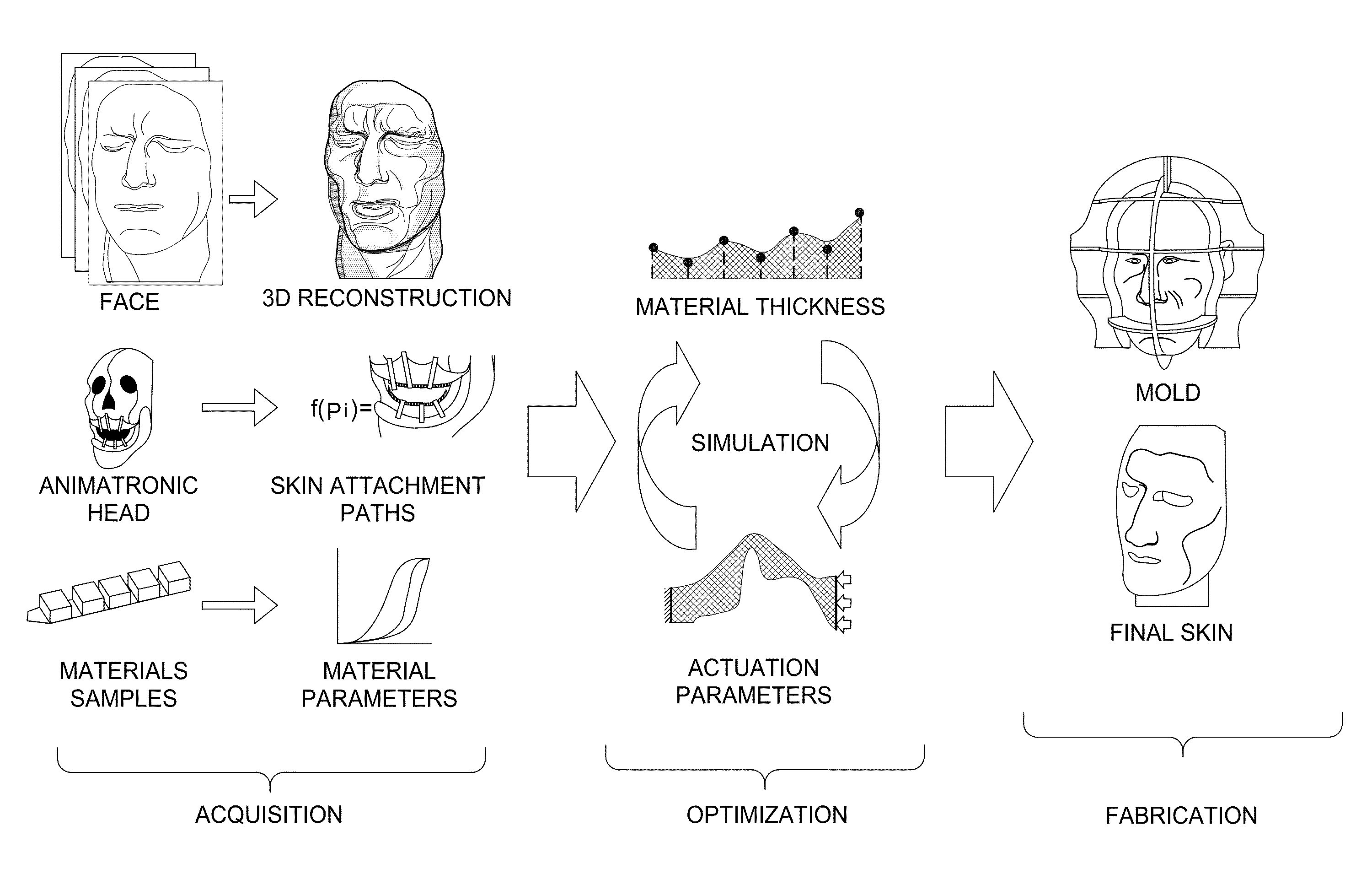
[0021]Embodiments of the invention provide a technique for physical face cloning that uses facial performance capture, physics-based simulation, and fabrication-oriented material design to model, optimize, and fabricate synthetic skin for animatronics characters. Embodiments of the invention provide a processing pipeline that accepts a number of captured input data. For example, facial expression poses are captured for a given target human face. In another example, elastic material properties are captured for a range of possible synthetic skin materials using a custom measurement system. The captured input data is incorporated into a computational model that simulates deformation behavior of a synthetic skin.
[0022]Embodiments of the invention provide techniques for modifying, sometimes referred to as “optimizing”, a skin geometry, actuation parameters, and other parameters to provide a closer match to a target shape as compared to prior to the modification. One embodiment of the inv...
PUM
 Login to View More
 Abstract
Description
Claims
Application Information
 Login to View More