Supercharge Your Innovation With Domain-Expert AI Agents!

Method for producing Kluyveromyces marxianus transformant

a technology of kluyveromyces marxianus and transformants, which is applied in the field of producing kluyveromyces marxianus transformants, can solve the problems of high cost, difficult production, and inability to meet the requirements of the procedure,

Active Publication Date: 2016-09-27
YAMAGUCHI UNIV
View PDF2 Cites 0 Cited by
  • Summary
  • Abstract
  • Description
  • Claims
  • Application Information

AI Technical Summary

Benefits of technology

Enables convenient and efficient production of Kluyveromyces marxianus transformants with integrated DNA ligation products, facilitating gene cloning and production of useful substances without the need for specific restriction enzymes or expensive equipment.

Problems solved by technology

Since such a DNA ligation method using restriction enzymes and DNA ligase, however, achieves ligation only between DNA molecules prepared in advance to have corresponding ends, the Cohen-Boyer method requires complicated in vitro procedures such as PCR and restriction enzyme treatment for preparing constructs for transformation and further requires a lot of time for selecting E. coli comprising the construct of interest from among colonies of transformed E. coli.
These methods, however, require particular DNA sequences present in both ends of insert DNA and in vectors and therefore, are not excellent in versatility.
Both of these methods, however, utilize homologous recombination and thus require adding a sequence homologous to a vector to insert DNA.
The in vivo homologous recombination method using E. coli further requires electroporation for obtaining high transformation efficiency and disadvantageously requires, for example, expensive apparatuses or instruments for the procedures.
Unfortunately, bakery yeast-E. coli shuttle vectors are not generally used and require time and effort for their preparation.
It is uncertain whether this method can be applied to the circularization of a DNA fragment free from repeating sequences.

Method used

the structure of the environmentally friendly knitted fabric provided by the present invention; figure 2 Flow chart of the yarn wrapping machine for environmentally friendly knitted fabrics and storage devices; image 3 Is the parameter map of the yarn covering machine
View more

Image

Smart Image Click on the blue labels to locate them in the text.
Viewing Examples
Smart Image
  • Method for producing <i>Kluyveromyces marxianus </i>transformant
  • Method for producing <i>Kluyveromyces marxianus </i>transformant
  • Method for producing <i>Kluyveromyces marxianus </i>transformant

Examples

Experimental program
Comparison scheme
Effect test

example 1

Preparation of DNA Ligation Product Encoding URA3

1. Preparation of DNA Fragments

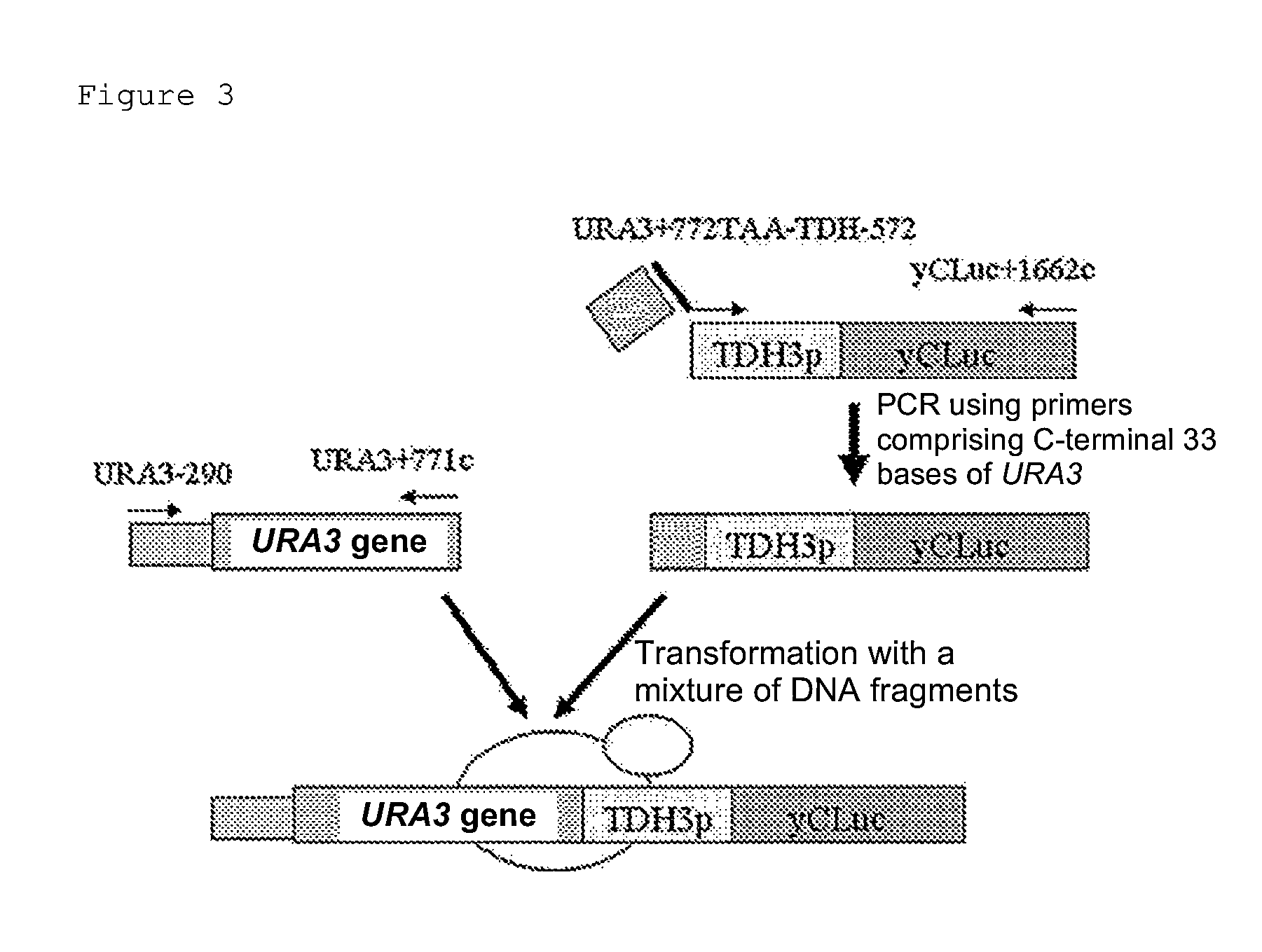
[0043]PCR reaction was performed with Saccharomyces cerevisiae BY4704-derived DNA as a template using KOD-plus polymerase (manufactured by TOYOBO CO., LTD.) to prepare DNA fragments comprising the whole or a portion of the URA3 gene (URA3-290-280c, URA3-290+771c, and URA3+772-280c). The sequences of primers used in the PCR reaction are as shown below. The DNA fragment URA3-290-280c comprising the whole URA3 was prepared using a forward primer URA3-290 and a reverse primer URA3-280c; the DNA fragment URA3-290+771c comprising a portion (encoding the N-terminal region) of URA3 was prepared using a forward primer URA3-290 and a reverse primer URA3+771c; and the DNA fragment URA3+772-280c comprising a portion (encoding the C-terminal region) of URA3 was prepared using a forward primer URA3+772 and a reverse primer URA3-280c.

[0044]

(Forward primer)URA3-290(5′-GAGAAGGGCAACGGTTCATCATCTC-3′; SEQ ID NO: 6)URA3+772(...

example 2

2. Preparation of Transformants

[0047]A Kluyveromyces marxianus RAK3605 strain having uracil auxotrophic genetic mutation was inoculated to 10 ml of a YPD medium (1% yeast extracts, 2% polypeptone, and 2% glucose) and cultured at 28° C. for 20 hours. The culture solution was collected, transferred to two 15-mL tubes, and centrifuged at 8000 rpm for 3 minutes. The supernatant was discarded, and 300 μL / tube of a solution for transformation [2000 μl of 60% PEG3350, 150 μL of 4 M lithium acetate, 300 μL of 1 M DTT, and 550 μL of sterile water] was added to the precipitated cells, followed by stirring with a vortex mixer. The solution was centrifuged again at 8000 rpm for 3 minutes, and the supernatant was discarded. 600 μL / tube of a solution for transformation was added to the precipitated cells, and the mixture was then dispensed in an amount of 100 μL / tube to 1.5-mL tubes. The DNA fragments (3 μL each of the fragments) prepared in Example 1 were added alone or in combination thereto an...

example 3

Preparation of DNA Ligation Product Encoding URA3, TDH3p, and yCLuc

1. Preparation of DNA Fragments

[0049]PCR reaction was performed with Saccharomyces cerevisiae BY4704-derived DNA as a template using KOD-plus polymerase (manufactured by TOYOBO CO., LTD.) to prepare DNA fragments comprising the whole or a portion of the URA3 gene (URA3-290-280c, URA3-290+771c, and URA3+772-280c). The sequences of primers used in the PCR reaction are as shown below. The DNA fragment URA3-290-280c comprising the whole URA3 was prepared using a forward primer URA3-290 and a reverse primer URA3-280c; the DNA fragment URA3-290+771c comprising a portion (encoding the N-terminal region) of URA3 was prepared using a forward primer URA3-290 and a reverse primer URA3+771c; and the DNA fragment URA3+772-280c comprising a portion (encoding the C-terminal region) of URA3 was prepared using a forward primer URA3+772 and a reverse primer URA3-280c.

[0050]

(Forward primer)URA3-290(5′-GAGAAGGGCAACGGTTCATCATCTC-3′; SEQ ...

the structure of the environmentally friendly knitted fabric provided by the present invention; figure 2 Flow chart of the yarn wrapping machine for environmentally friendly knitted fabrics and storage devices; image 3 Is the parameter map of the yarn covering machine
Login to View More

PUM

PropertyMeasurementUnit
lengthaaaaaaaaaa
timeaaaaaaaaaa
lengthsaaaaaaaaaa
Login to View More

Abstract

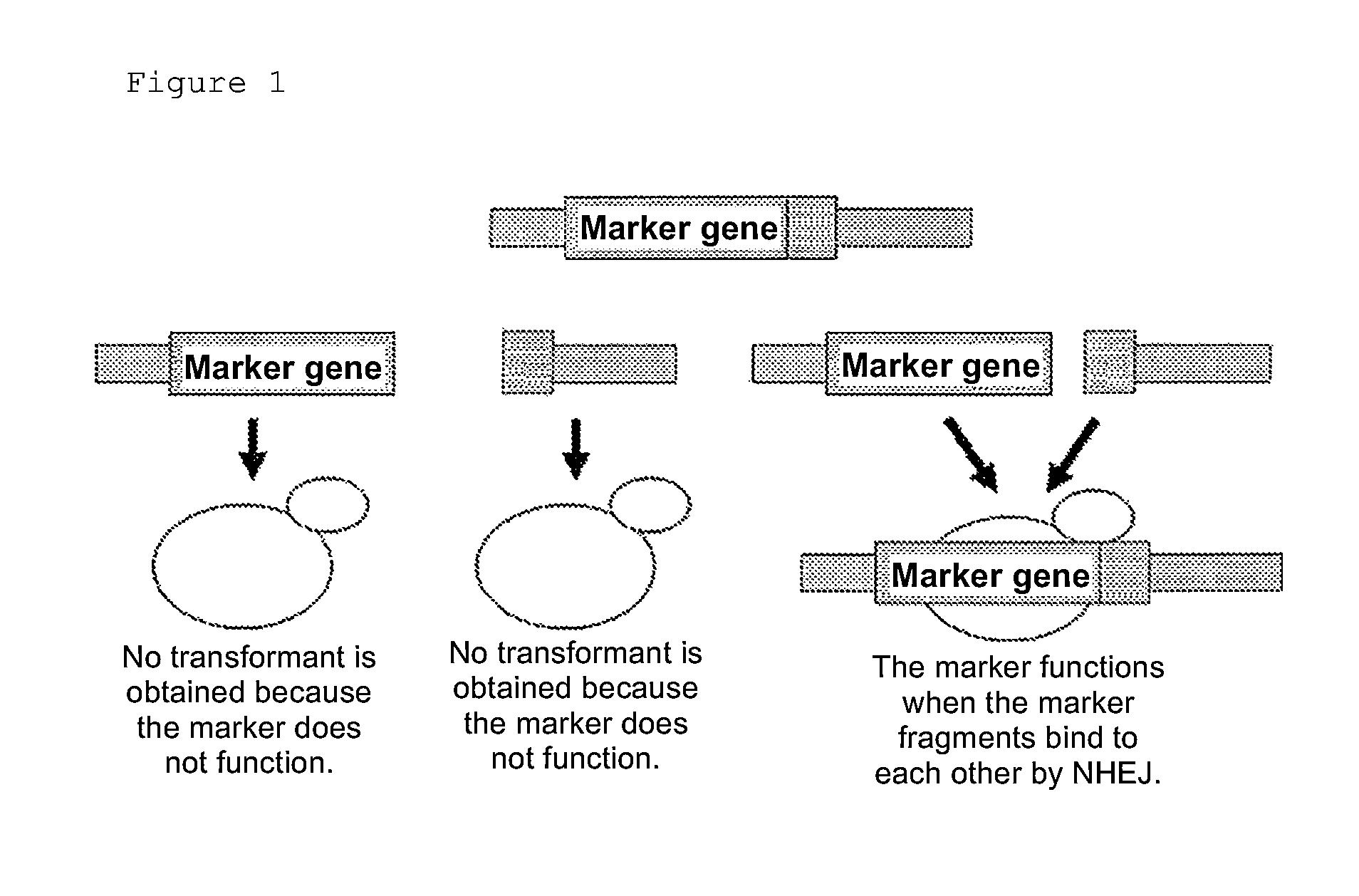
An object to be solved by the present invention is to provide, for example, a method for producing a Kluyveromyces marxianus transformant by a method for conveniently and efficiently connecting the ends of DNA fragments without using specific restriction enzymes or their recognition sequences, and a method for producing a useful substance using the transformant. The present inventors have found, as means to solve the object, a method comprising introducing two or more linear double-stranded DNA fragments free from a Kluyveromyces marxianus autonomously replicating sequence into Kluyveromyces marxianus and selecting a transformant comprising a desired DNA ligation product with marker gene expression by the desired DNA ligation product as an index, or comprising introducing a linear double-stranded DNA fragment comprising a Kluyveromyces marxianus autonomously replicating sequence, alone or in combination with one or more linear double-stranded DNA fragment(s) different therefrom into Kluyveromyces marxianus and selecting a transformant comprising a desired circular DNA ligation product with marker gene expression by the desired circular DNA ligation product as an index.

Description

TECHNICAL FIELD[0001]The present invention relates to, for example, a method for producing a Kluyveromyces marxianus transformant and a method for producing a useful substance using the transformant.BACKGROUND ART[0002]The technique of connecting the ends of DNA fragments to prepare arbitrary DNA molecules is a basic technique essential for many experimental procedures in the molecular biological field, including cloning. A current approach most generally used for ligating DNA fragments involves binding blunt-ended DNA molecules or DNA molecules complementary to each other at their sticky ends using DNA ligase. Also, the Cohen-Boyer method (see non-patent document 1) is known as a cloning method based on this approach. This method involves cleaving insert DNA and a vector with their respective restriction enzymes, purifying the fragments, and then ligating the fragments using DNA ligase to prepare the construct of interest, with which E. coli is then transformed, followed by amplifi...

Claims

the structure of the environmentally friendly knitted fabric provided by the present invention; figure 2 Flow chart of the yarn wrapping machine for environmentally friendly knitted fabrics and storage devices; image 3 Is the parameter map of the yarn covering machine
Login to View More

Application Information

Patent Timeline
no application Login to View More
Patent Type & Authority Patents(United States)
IPC IPC(8): C12N15/74C12N15/81C12N15/64C07K14/37C12N1/19
CPCC12N15/815C07K14/37C12N15/64
Inventor AKADA, RINJIHOSHIDA, HISASHIABDEL-BANAT, BABIKER MOHAMED AHMEDASAKAWA, JUN
Owner YAMAGUCHI UNIV
Features
  • R&D
  • Intellectual Property
  • Life Sciences
  • Materials
  • Tech Scout
Why Patsnap Eureka
  • Unparalleled Data Quality
  • Higher Quality Content
  • 60% Fewer Hallucinations
Social media
Patsnap Eureka Blog
Learn More