Unlock instant, AI-driven research and patent intelligence for your innovation.

One-pot process and reagents for preparing long chain branched polymers

A polymer and long-chain branched technology, applied in the field of preparation of long-chain branched polyolefins, can solve problems such as catalyst system difficulties

Inactive Publication Date: 2007-09-12
PENN STATE RES FOUND
View PDF4 Cites 5 Cited by
  • Summary
  • Abstract
  • Description
  • Claims
  • Application Information

AI Technical Summary

Problems solved by technology

Therefore, it is extremely difficult to find a catalyst system that fits all needs, i.e. in situ formation of large quantities of vinyl-terminated PP macromonomers and further incorporation of macromonomers into the LCBPP structure

Method used

the structure of the environmentally friendly knitted fabric provided by the present invention; figure 2 Flow chart of the yarn wrapping machine for environmentally friendly knitted fabrics and storage devices; image 3 Is the parameter map of the yarn covering machine
View more

Image

Smart Image Click on the blue labels to locate them in the text.
Viewing Examples
Smart Image
  • One-pot process and reagents for preparing long chain branched polymers
  • One-pot process and reagents for preparing long chain branched polymers
  • One-pot process and reagents for preparing long chain branched polymers

Examples

Experimental program
Comparison scheme
Effect test

Embodiment 1

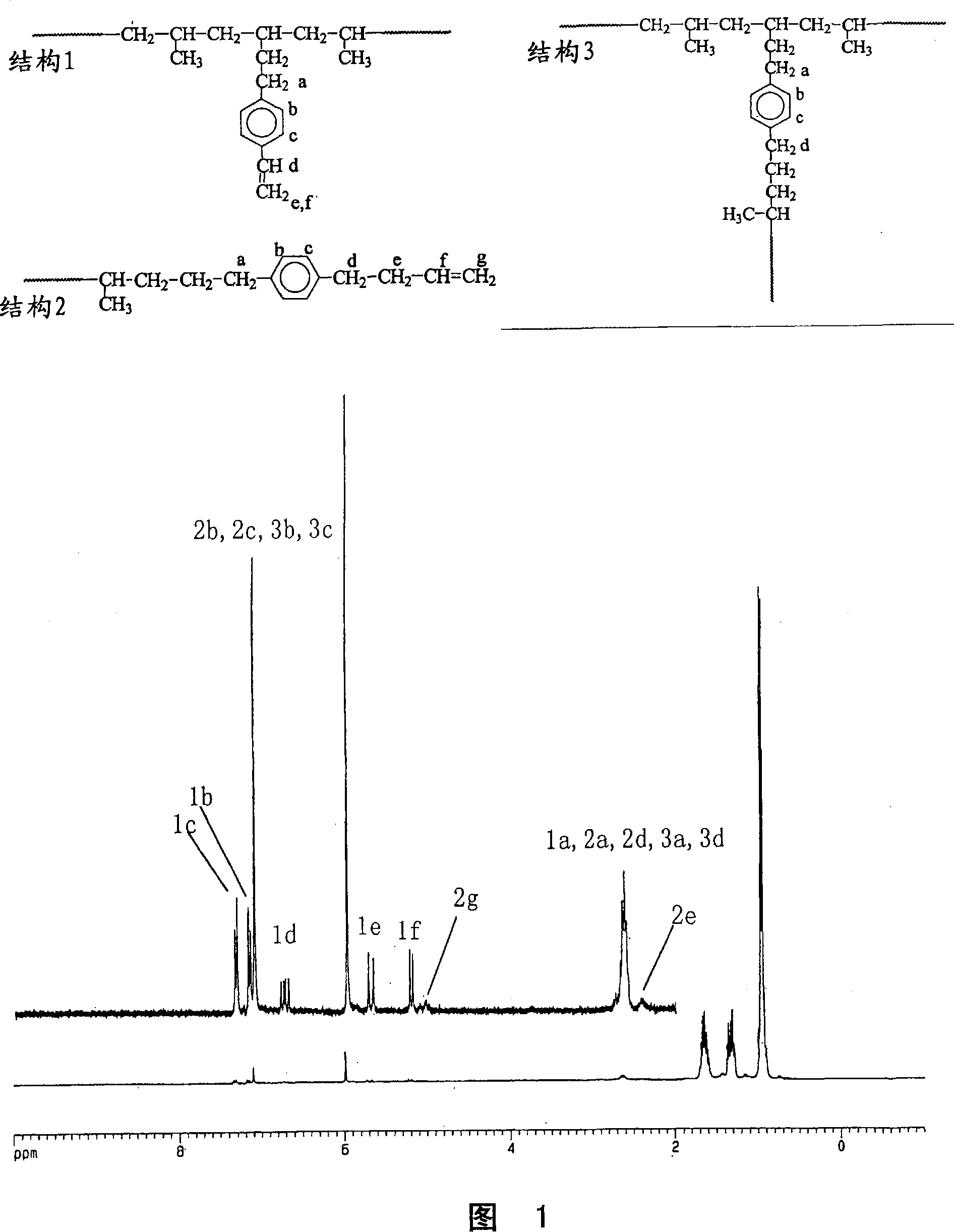
[0097]The LCB polymer is synthesized according to the method of the present invention, then weighed and analyzed in combination with a variety of analytical methods, including nuclear magnetic resonance (NMR), differential scanning calorimetry (DSC) and the use of three detectors - including Reflectance, Light Scattering, and Intrinsic ViscosityGel Permeation Chromatography (GPC-Triple Detector) to Determine Monomer Conversion, Polymer Composition, Thermal Transition Temperature, Molecular Weight, and LCB Molecular Structure, which will be used in Describe in detail below. For comparison, some control linear polymers were also prepared and tested under the same reaction conditions except that two modified monofunctional T reagents were used, the two "T" reagents containing X or Y functionality to prepare the corresponding backbone and side chains for LCB polyolefins.

[0098] As shown in the figure below, for comparison, two control reactions were made - the two control reac...

Embodiment 2

[0102] Control reaction 1 - using rac-Me 2 Si[2-Me-4-Ph(Ind)] 2 ZrCl 2 / MAO

[0103] Catalyst for the Copolymerization of Propylene and Butenylbenzene

[0104] This control reaction was performed to detect the use of rac-Me 2 Si[2-Me-4-Ph(Ind)] 2 ZrCl 2 Copolymerization activity between propylene and butenylbenzene (V') in the formation of linear propylene / butenylbenzene copolymer (VII') in the / MAO catalyst system. In a dry box, 50 ml of toluene and 1.5 ml of MAO (30 wt% in toluene) were charged into a 450 ml parr stainless steel autoclave with mechanical stirrer. After the reactor was removed from the dry box, 1 ml of butenylbenzene was first injected into it, and then 100 psi of propylene was introduced to make the toluene solution saturated at ambient temperature. Then inject into the reactor containing about 1.25×10 -6 Moore rac-Me 2 Si[2-Me-4-Ph(Ind)] 2 ZrCl 2 toluene solution to start the copolymerization reaction. After 3 minutes, polymerizatio...

Embodiment 3

[0106] Control reaction 2 - using p-butylstyrene (VI') / H 2 rac-Me chain transfer agent 2 Si[2-Me-4-Ph(Ind)] 2 ZrCl 2 / MAO-mediated propylene polymerization

[0107] chain transfer reaction

[0108] In a dry box, 50 ml of toluene and 1.5 ml of MAO (30 wt% in toluene) were charged into a 450 ml parr stainless steel autoclave with mechanical stirrer. After the reactor was removed from the dry box, it was purged with hydrogen (20 psi) and injected with 0.5 ml of p-butylstyrene. The toluene solution was then saturated at ambient temperature with 100 psi of propylene and the total pressure in the reactor was increased to 120 psi. Then inject into the reactor with about 1.25×10 -6 Moore rac-Me 2 Si[2-Me-4-Ph(Ind)] 2 ZrCl 2 solution in toluene to initiate the polymerization reaction. Additional propylene was fed to the reactor throughout the polymerization to maintain a constant pressure (120 psi). After 15 minutes of reaction at 30°C, the polymer ...

the structure of the environmentally friendly knitted fabric provided by the present invention; figure 2 Flow chart of the yarn wrapping machine for environmentally friendly knitted fabrics and storage devices; image 3 Is the parameter map of the yarn covering machine
Login to View More

PUM

No PUM Login to View More

Abstract

A one-pot polymerization process of preparing long chain branching polymers is provided. Also described is a ''T'' reagent that serves as a link between main and side chains of an inventive long chain branching polymer. A ''T'' reagent has at least two functionalities, serving as both co-monomer and chain transfer reaction agent. Optionally, a copolymerization reaction between an alpha-olefin and ''T'' reagent takes place initially to incorporate some ''T'' molecules in the polyolefin main chain, and the incorporated ''T'' units then behave as chain transfer agents for reacting with the propagating polyolefin chains to form side chains. In a particular embodiment, a polymerization process for preparing long chain branching polyethylene (LCBPE) and long chain branching polypropylene (LCBPP) is detailed.

Description

[0001] References to Related Applications [0002] This application claims priority to US Provisional Patent Application Serial No. 60 / 584,838, filed July 1, 2004, which is hereby incorporated by reference in its entirety. technical field [0003] The present invention relates to long-chain branched polymers, methods for their synthesis and reagents for their synthesis. In one embodiment, the present invention is directed to a one pot polymerization process for the preparation of long chain branched polyolefins, including long chain branched polypropylene. Background technique [0004] A long chain branched (LCB) polymer is a polymer containing one or more side chain branches with a chain length comparable to or longer than the critical entanglement length. Compared with linear polymers with the same molecular weight, long-chain branched polymers exhibit high shear sensitivity, zero-shear viscosity, melt elasticity and high impact strength (Graessley, Acc.Chem.Res.1977, 10,...

Claims

the structure of the environmentally friendly knitted fabric provided by the present invention; figure 2 Flow chart of the yarn wrapping machine for environmentally friendly knitted fabrics and storage devices; image 3 Is the parameter map of the yarn covering machine
Login to View More

Application Information

Patent Timeline
no application Login to View More
IPC IPC(8): C08F4/64C08F236/02C08F236/20
Inventor T-G·丘昂
Owner PENN STATE RES FOUND