Unlock instant, AI-driven research and patent intelligence for your innovation.

Method for electrolytic production and refining of metals

A technology of refining metals and electrolysis, which is applied in electric furnaces, crucible furnaces, rotary drum furnaces, etc., and can solve problems such as destroying the properties of electrolytes

Inactive Publication Date: 2009-04-01
ELKEM
View PDF3 Cites 12 Cited by
  • Summary
  • Abstract
  • Description
  • Claims
  • Application Information

AI Technical Summary

Problems solved by technology

[0006] However, the above-mentioned process disclosed in U.S. Patent No. 1,534,318 cannot be used for electrolytic refining of metals having a high melting point above 1000° C., because a large amount of chloride vapor is formed in a chloride-based molten electrolyte at this high temperature, thereby destroy the properties of the electrolyte

Method used

the structure of the environmentally friendly knitted fabric provided by the present invention; figure 2 Flow chart of the yarn wrapping machine for environmentally friendly knitted fabrics and storage devices; image 3 Is the parameter map of the yarn covering machine
View more

Image

Smart Image Click on the blue labels to locate them in the text.
Viewing Examples
Smart Image
  • Method for electrolytic production and refining of metals
  • Method for electrolytic production and refining of metals
  • Method for electrolytic production and refining of metals

Examples

Experimental program
Comparison scheme
Effect test

Embodiment Construction

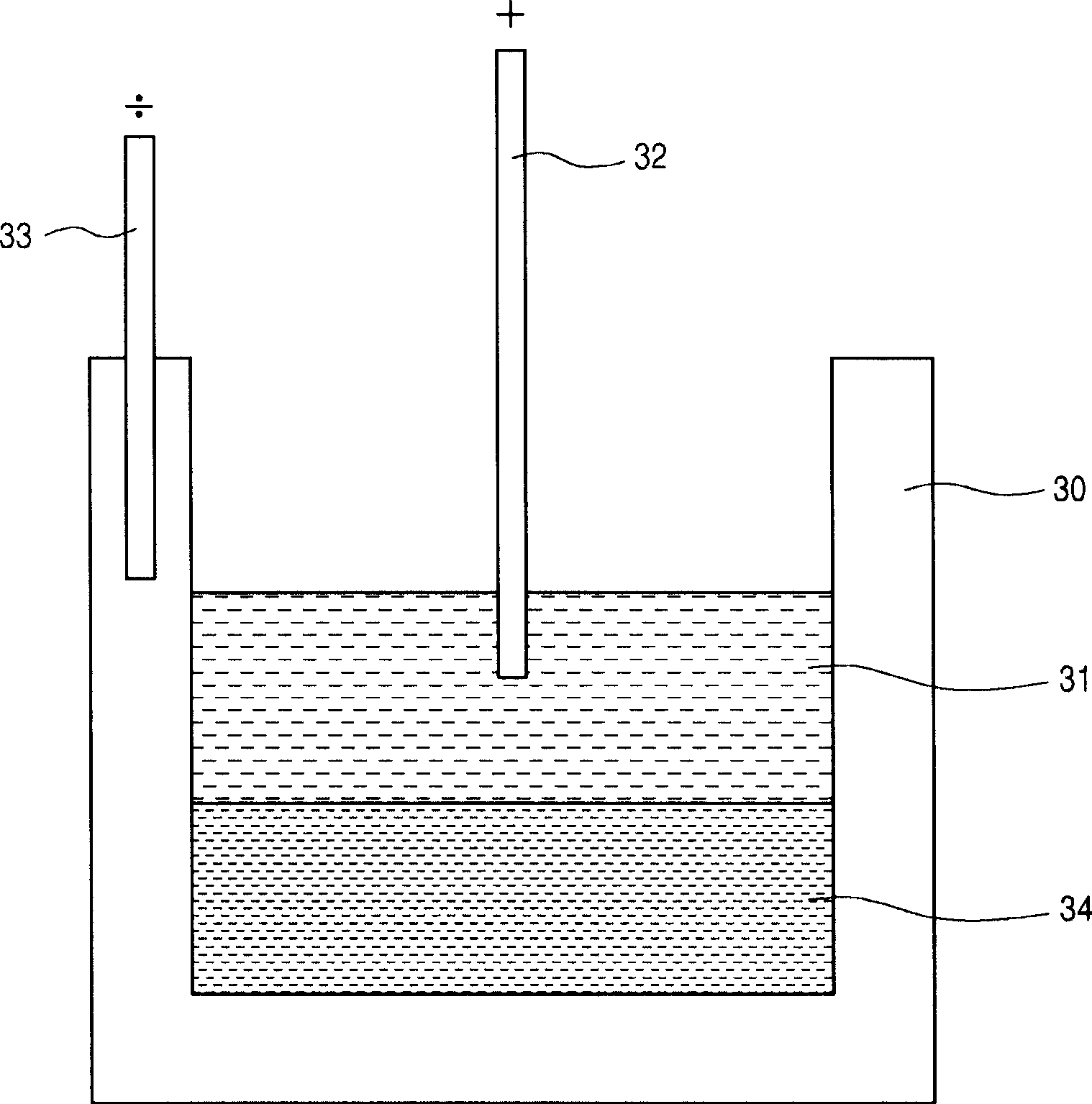
[0077] figure 1 Shown is a schematic diagram of an electrolytic cell, which is used to implement the method for refining silicon of the present invention. The electrolytic cell includes a container 1 having a refractory layer 2. The electrolytic cell has a bottom layer 3 of an alloy of silicon and a metal more expensive than silicon, such as a Cu-Si alloy, which serves as an anode in the electrolytic cell. On the bottom alloy layer 3 there is an oxide-based electrolyte 4 which has a density lower than that of the anode alloy 3 and higher than that of molten silicon. Suitable electrolyte 4 is 50wt% CaO and 50wt% SiO 2 mixture. On top of the electrolyte layer 4 there is a layer 5 of pure silicon metal as a cathode. The anode 4 and the cathode 5 are connected to a DC power source (not shown) through contacts 6 and 7, respectively, to introduce current into the electrolytic cell. When a direct current passes through the electrolytic cell, the silicon in the anode alloy 3 enters the ...

the structure of the environmentally friendly knitted fabric provided by the present invention; figure 2 Flow chart of the yarn wrapping machine for environmentally friendly knitted fabrics and storage devices; image 3 Is the parameter map of the yarn covering machine
Login to View More

PUM

No PUM Login to View More

Abstract

The present invention relates to a method for electrolytic production and refining of metals having a melting point above about 1000 0C, particularly silicon, where there is provided a first electrolytic cell having an upper molten electrolyte layer of a first electrolyte, a lower molten alloy layer of an alloy of the metal to be refined and at least one metal more noble than the metal to be refined. The lower alloy layer is the cathode in the first cell and an anode is positioned in the upper molten electrolyte layer. A second electrolytic cell is also provided with an upper molten metal layer of the same metal as the metal to be refined, said layer constituting a cathode, a lower molten alloy layer, said lower layer constituting an anode, said alloy having a higher density than the metal to be refined, and an intermediate molten electrolyte layer having a density between the density of the upper and lower molten layers. Both electrolytes are oxide based electrolytes containing oxide of the metal to be refined, and the electrolyte is in molten state and has a melting point below the operating temperature of the process. Raw material comprising an oxide of the metal to be refined is added to the first cell and direct electric current is passed through the anode to the cathode such that the metal to be refined is moved from the anode and deposited in molten state at the cathode. The two cells can be operated in two separate steps. One to produce an alloy and the other to refine metal from the alloy.

Description

Technical field [0001] The present invention relates to a method for electrolytic production and refining of metals with a high melting point higher than about 1000°C, especially silicon. Background technique [0002] There is a growing demand for high-purity metals, especially high-purity solar grade and electronic grade silicon. Solar-grade silicon raw materials for solar cells have been based on electronic-grade silicon scraps / scraps from the semiconductor industry. Electronic grade silicon is produced by silane production from metallurgical silicon and gas phase reduction of silane to silicon. However, this method is very expensive. In addition, the available amount of scrap / scrap in the semiconductor industry is now small and cannot supply the rapidly growing solar cell market. [0003] From U.S. Patent No. 3,219,561, it is known that the production is produced by passing a direct current between an anode in contact with a molten salt bath containing fluoride and silicon or ...

Claims

the structure of the environmentally friendly knitted fabric provided by the present invention; figure 2 Flow chart of the yarn wrapping machine for environmentally friendly knitted fabrics and storage devices; image 3 Is the parameter map of the yarn covering machine
Login to View More

Application Information

Patent Timeline
no application Login to View More
IPC IPC(8): C22B15/00
Inventor S·唐纳K·约翰森B·迈尔M·恩沃尔K·恩沃尔
Owner ELKEM
Features
  • R&D
  • Intellectual Property
  • Life Sciences
  • Materials
  • Tech Scout
Why Patsnap Eureka
  • Unparalleled Data Quality
  • Higher Quality Content
  • 60% Fewer Hallucinations
Social media
Patsnap Eureka Blog
Learn More