Duck source coronavirus ORF1a protein gene and cloning method and application thereof
What is AI technical title?
AI technical title is built by Patsnap AI team. It summarizes the technical point description of the patent document.
Technology of a coronavirus, cloning method, applied in the field of bioengineering
Inactive Publication Date: 2011-02-02
HENAN INST OF SCI & TECH
View PDF1 Cites 0 Cited by
Summary
Abstract
Description
Claims
Application Information
AI Technical Summary
This helps you quickly interpret patents by identifying the three key elements:
Problems solved by technology
Method used
Benefits of technology
Problems solved by technology
The ORF1a protein gene contains a functional domain encoding parvovirus-like 3C protease, which is involved in viral replication, indicating that the IBV ORF1a protein has RNApolymerase activity, however, no protein with this activity has been isolated and identified
Method used
the structure of the environmentally friendly knitted fabric provided by the present invention; figure 2 Flow chart of the yarn wrapping machine for environmentally friendly knitted fabrics and storage devices; image 3 Is the parameter map of the yarn covering machine
View more
Image
Smart Image Click on the blue labels to locate them in the text.
Viewing Examples
Smart Image
Click on the blue label to locate the original text in one second.
Reading with bidirectional positioning of images and text.
Smart Image
Examples
Experimental program
Comparison scheme
Effect test
Embodiment 1
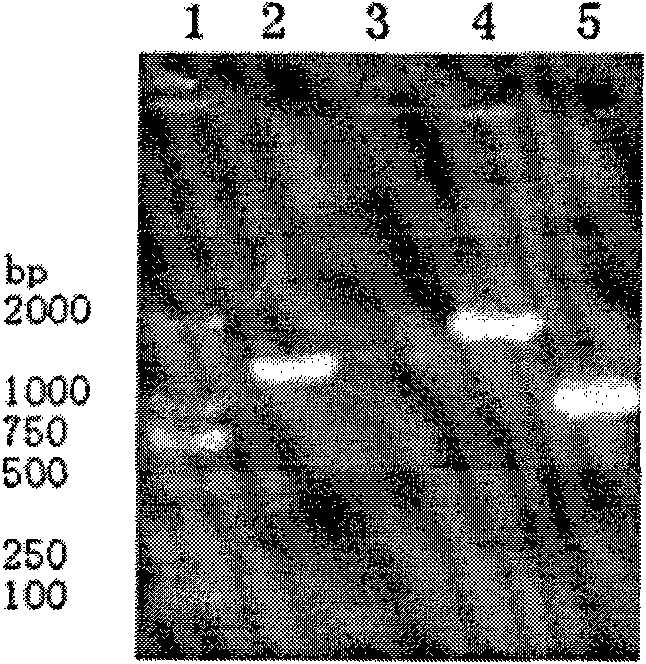
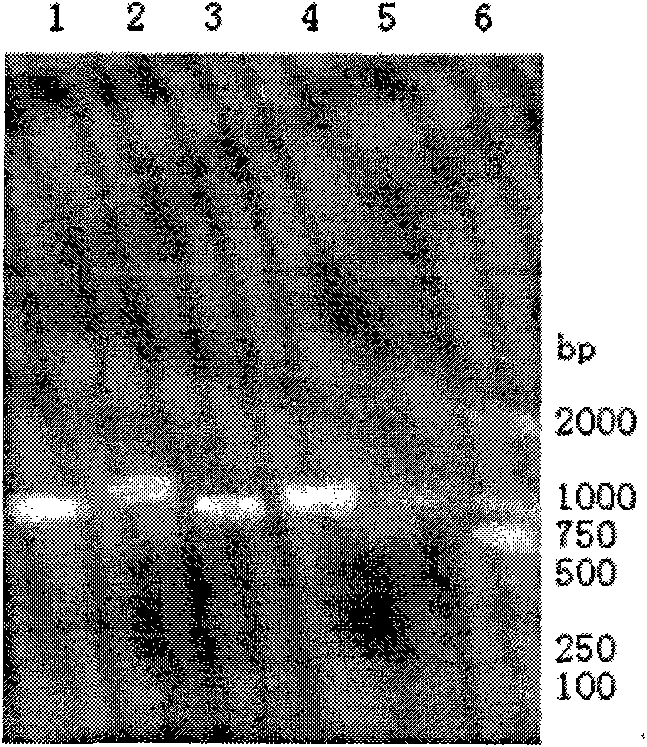
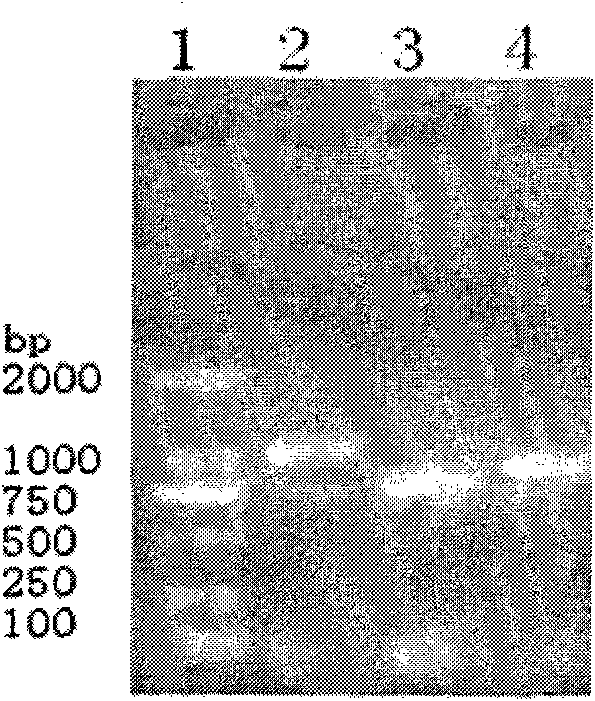
[0038] Embodiment 1 A kind of cloning method of the ORF1a gene of duck origin coronavirus ZZ2004
[0039] (1) PCR primer design
[0040] The duck-derived coronavirus ZZ2004 strain was selected, and 12 pairs of primers were designed using the homologous sequence of the duck-derived coronavirus ZZ2004 strain as a template, as shown in Table 1
[0041] Table 1 ORF1a protein gene amplification primers
[0042]
[0043] (2) The enrichment method of ZZ2004 strain
[0044] Dilute the allantoic fluid infected by the ZZ2004 strain 1:10 with sterilized PBS, inoculate 0.2ml into the chorioallantoic cavity of 9-day-old SPF chicken embryos, incubate at 37°C for 36-48h, place at 4°C for 12h, and harvest the chicken Embryoallantoic fluid.
[0045] Take 50ml of SPF chick embryoallantoic fluid infected by ZZ2004 strain into three sterilized centrifuge tubes, centrifuge at 5000rpm for 20min; discard the precipitate respectively, take the supernatant in another sterilized centrifuge tube...
Embodiment 2
[0091] Example 2 Alignment of amino acidsequence homology deduced from the ORF1a gene of IBV ZZ2004 strain (see Figure 4 )
[0092]Compared with IBV reference strain, the homology rate of 1a gene of IBV ZZ2004 strain was 85.6~93.1%. Compared with the classic strain Beaudette strain, its variation segments are mainly concentrated in 698-703nt, 1079-1100nt, 1220-1233nt, 1730-2254nt, 2900-2930nt, 2944-2948nt, 3231-3542nt, 3840-3865nt, 3970-3991nt , 4988~4996nt, 5370~5412nt, 5503~5520nt, 7325~7400nt and other regions, and there are still many scattered point mutations in other regions; compared with the SAIBK strain with the highest homology rate, its mutations are mainly concentrated in 2888~2889nt, 2911~2942nt, 3280~3300nt, 7918~7919nt, 7930~7980nt, 9907~9927nt, 9941~9943nt and other regions, and there are some scattered point mutations in other regions.
[0093] genetic tree (see Figure 5 ) analysis results showed that the isolate ZZ2004 ORF1a protein belonged to the same...
the structure of the environmentally friendly knitted fabric provided by the present invention; figure 2 Flow chart of the yarn wrapping machine for environmentally friendly knitted fabrics and storage devices; image 3 Is the parameter map of the yarn covering machine
Login to View More
PUM
Login to View More
Abstract
The invention discloses an ORF1a proteingene of duck source coronavirus ZZ2004 and a cloning method and application thereof. An ORF1a proteingene sequence 11859bp codes ORF1a protein of 3952 amino acid residues; a virus sequence having high homology with the ORF1a protein gene sequence is found by random PCR, and the virus sequence is used as a template to design 12 pairs of specific primers to amplify corresponding segments, and then the ORF1a protein gene segments are connected with a pMD18-T carrier respectively. As IBV ORF1a protein has the activity of RNApolymerase and the spectrum of infection of the virus is very different from other strains, the ORF1a protein gene is important for studying IBV, then revealing the epidemic and variation rules of the IBV in a molecular level, developing IBV nucleic acid vaccine, live carrier vaccine and medicines for preventing and curing infectious bronchitis of chicken and preventing and controlling the occurrence and prevalence of IB.
Description
technical field [0001] The invention relates to the field of bioengineering, in particular to an ORF1a protein gene of duck-derived coronavirus ZZ2004, a cloning method and application thereof. Background technique [0002] In 1937, coronaviruses (Coronaviruses) were first isolated from chickens. In 1965, the first human coronavirus was isolated. It is named "coronavirus" because it can be observed under an electronmicroscope that there are obvious rod-shaped particle protrusions on its outer membrane, making it look like the crown of a medieval European emperor. According to the serological characteristics of the virus and the differences in nucleotide sequences, the Coronaviridae family is currently divided into two genera, coronavirus and torovirus. The representative strain of Coronaviridae is Avian infectious bronchitis virus (IBV). The virus is an enveloped, moderately pleomorphic spherical or oval virion with rod-shaped protrusions on the surface. [0003] Avian ...
Claims
the structure of the environmentally friendly knitted fabric provided by the present invention; figure 2 Flow chart of the yarn wrapping machine for environmentally friendly knitted fabrics and storage devices; image 3 Is the parameter map of the yarn covering machine
Login to View More
Application Information
Patent Timeline
Application Date:The date an application was filed.
Publication Date:The date a patent or application was officially published.
First Publication Date:The earliest publication date of a patent with the same application number.
Issue Date:Publication date of the patent grant document.
PCT Entry Date:The Entry date of PCT National Phase.
Estimated Expiry Date:The statutory expiry date of a patent right according to the Patent Law, and it is the longest term of protection that the patent right can achieve without the termination of the patent right due to other reasons(Term extension factor has been taken into account ).
Invalid Date:Actual expiry date is based on effective date or publication date of legal transaction data of invalid patent.



 Login to View More
  Login to View More