Composite material with formaldehyde purification function and production method thereof
What is AI technical title?
AI technical title is built by Patsnap AI team. It summarizes the technical point description of the patent document.
A composite material and functional technology, applied in the fields of building materials, chemical industry, and light industry, can solve the problems of long absorption and conversion cycle, discontinuous degradation, inconvenient use, etc., and achieve a significant purification effect.
Active Publication Date: 2014-07-30
湖北格林森绿色环保材料股份有限公司
View PDF4 Cites 1 Cited by
Summary
Abstract
Description
Claims
Application Information
AI Technical Summary
This helps you quickly interpret patents by identifying the three key elements:
Problems solved by technology
Method used
Benefits of technology
Problems solved by technology
It is characterized by the use of chemical oxidation reaction to degrade formaldehyde, the cost is relatively high, and substances harmful to the body such as ozone may be produced, there are discontinuous degradation, unstable degradation effect, inconvenient use, and high volatility
The bioabsorption method is to use specific plants to absorb formaldehyde and achieve the purpose of formaldehyde absorption and transformation through photosynthesis. It is characterized by low absorption rate and long absorption and transformation cycle.
The adsorption method mainly uses solid adsorbents. At present, solid adsorbents based on various activated carbons and their products, through the adsorption principle, have poor formaldehyde purification effects and are far from meeting the requirements for purifying formaldehyde.
[0004] At present, there are several types of formaldehyde purification materials: first, porous zeolite and activated carbon-based purification materials based on physical adsorption method, formaldehyde purification is mainly adsorption, and the purification capacity is limited; second, environmental mineral materials such as Nano photocatalytic materials with sepiolite and zeolite as the carrier, use photocatalystase to catalyze the oxidation reaction to degrade formaldehyde, the cost is relatively high, the degradation is discontinuous, the degradation effect is unstable, and it is inconvenient to use; Or the inorganic macromolecular polymer forms a porous porous adsorption to formaldehyde, and then performs nucleophilic addition reaction or chemical bonding degradation to formaldehyde by the internal small molecule functional group components, the adsorption rate is low, and the absorption conversion cycle is long
Method used
the structure of the environmentally friendly knitted fabric provided by the present invention; figure 2 Flow chart of the yarn wrapping machine for environmentally friendly knitted fabrics and storage devices; image 3 Is the parameter map of the yarn covering machine
View more
Image
Smart Image Click on the blue labels to locate them in the text.
Viewing Examples
Smart Image
Click on the blue label to locate the original text in one second.
Reading with bidirectional positioning of images and text.
the structure of the environmentally friendly knitted fabric provided by the present invention; figure 2 Flow chart of the yarn wrapping machine for environmentally friendly knitted fabrics and storage devices; image 3 Is the parameter map of the yarn covering machine
Login to View More
PUM
Property
Measurement
Unit
particle size
aaaaa
aaaaa
length
aaaaa
aaaaa
length
aaaaa
aaaaa
Login to View More
Abstract
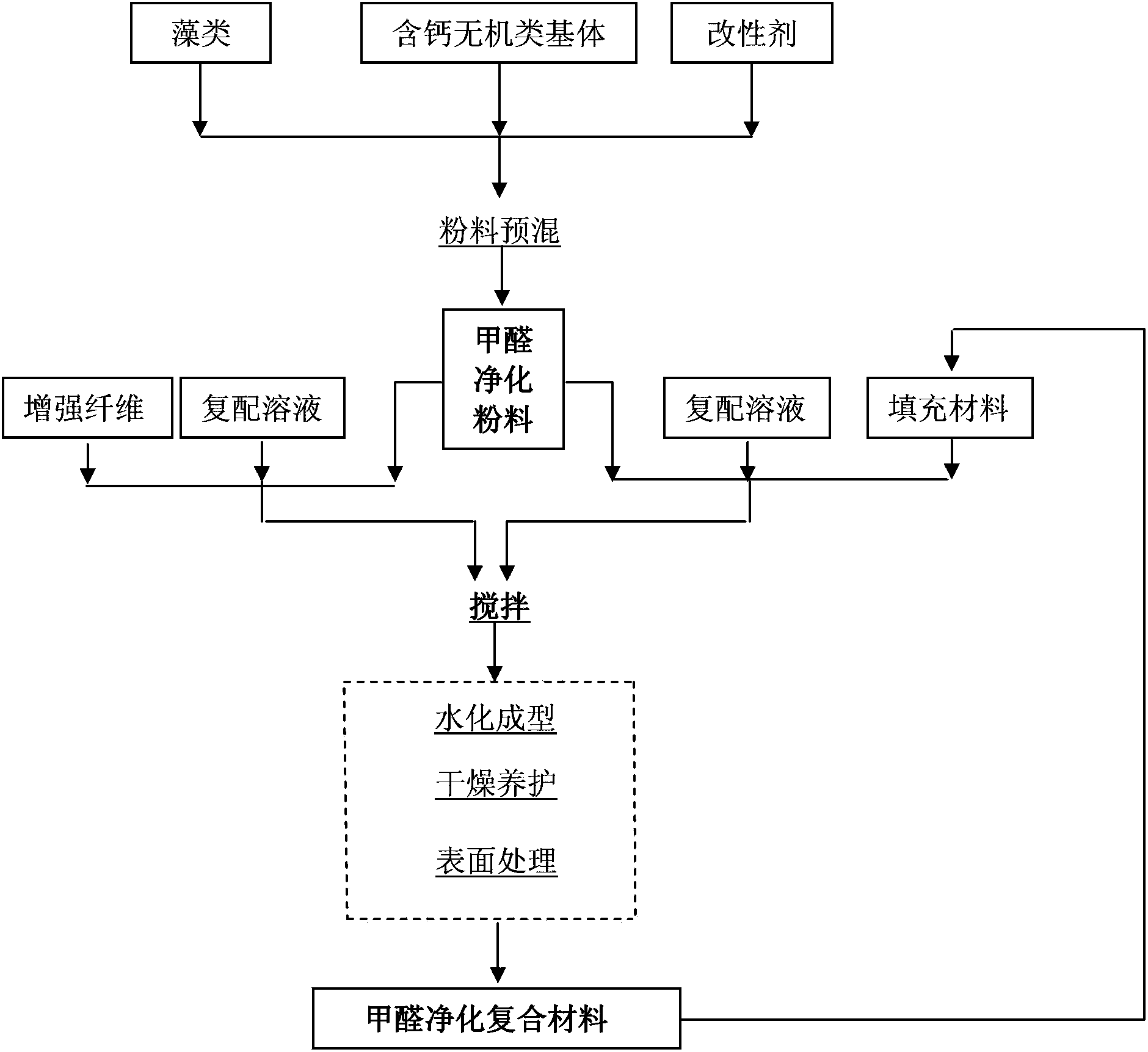
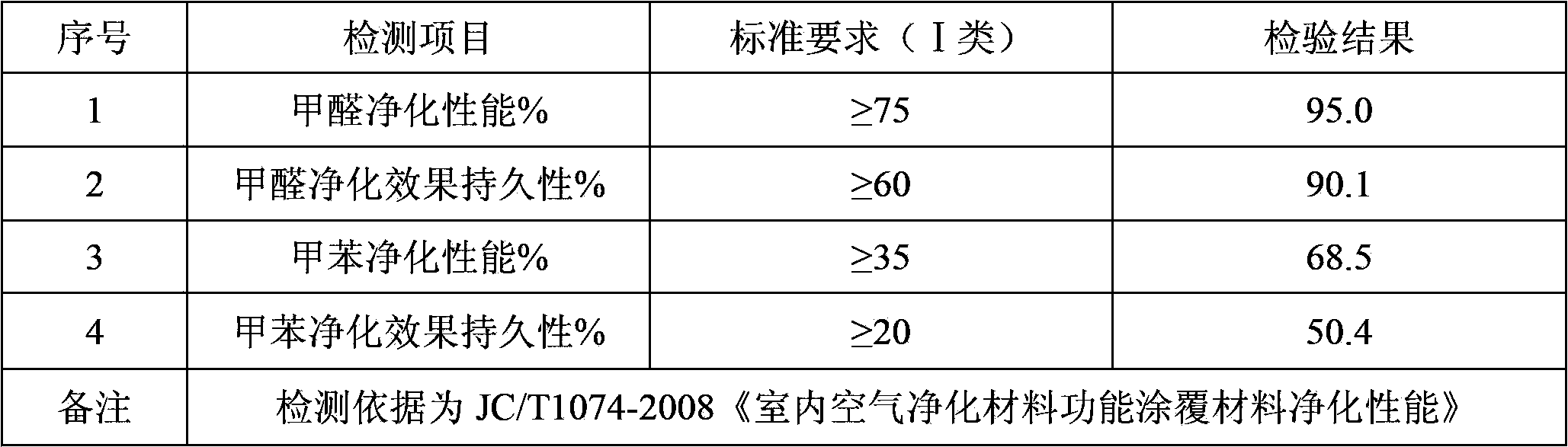
The invention provides a composite material with formaldehyde purification function, which is prepared by dissolving 45-73 parts by weight of powder with formaldehyde purification function, and one or both of 0.15-1.2 parts by weight of reinforcing fiber and 15-20 parts by weight of filling material in 20-40 parts of compound solution. The powder with formaldehyde purification function is prepared by mixing 38-55 parts by weight of calcic inorganic base, 6-16 parts by weight of algae and 3-6 parts by weight of modifier; and the compound solution is compounded from 100 parts by weight of clear water, 1.5-2.0 parts by weight of crystal modifier, 0.4-0.5 part by weight of waterproofing agent and 0.4-0.5 part by weight of defoaming agent. The formaldehyde adsorption rate of the composite material is 95%, the formaldehyde purifying effect durability is up to 90%, the methylbenzene adsorption rate is 68.5%, and the methylbenzene purifying effect durability is up to 50.4%. Compared with the chemical process, biosorption process and adsorption process adopted by the traditional formaldehyde purification material, the invention has the advantages of natural and environment-friendly raw materials, obvious purifying effect, wide product derivation performance and low cost.
Description
technical field [0001] The invention belongs to the fields of building materials, light industry, chemical industry and the like, in particular to the field of building materials, and is used for improving indoor air quality. Background technique [0002] The sources of formaldehyde mainly include: (1) Urea-formaldehyde resin plywood, blockboard, medium densityfiberboard and particleboard, etc. Wood-based panels and furniture made of wood-based panels; (2) Other decorative materials containing formaldehyde, such as white latex, foam plastics, paints and coatings; Textiles prepared by adding formaldehyde additives, including bedding, wall coverings, wallpaper, chemical fiber carpets, curtains and fabric furniture. (4) Treatment of formaldehyde tail gas and waste liquid in the chemical industry; from the investigation of indoor formaldehyde pollution and the analysis of various building materials, it can be seen that building materials are an important source of indoor forma...
Claims
the structure of the environmentally friendly knitted fabric provided by the present invention; figure 2 Flow chart of the yarn wrapping machine for environmentally friendly knitted fabrics and storage devices; image 3 Is the parameter map of the yarn covering machine
Login to View More
Application Information
Patent Timeline
Application Date:The date an application was filed.
Publication Date:The date a patent or application was officially published.
First Publication Date:The earliest publication date of a patent with the same application number.
Issue Date:Publication date of the patent grant document.
PCT Entry Date:The Entry date of PCT National Phase.
Estimated Expiry Date:The statutory expiry date of a patent right according to the Patent Law, and it is the longest term of protection that the patent right can achieve without the termination of the patent right due to other reasons(Term extension factor has been taken into account ).
Invalid Date:Actual expiry date is based on effective date or publication date of legal transaction data of invalid patent.


 Login to View More