
Preparation method and application of n-p junction type ferrum-copper based oxide gas sensitive element
A gas-sensing element, iron-copper-based technology, which is applied in the field of preparation of n-p junction iron-copper-based oxide gas-sensing elements, can solve the problems of no technical enlightenment, no disclosure, etc., and achieve good synergistic sensitization effect and heat capacity. large, avoid the effect of mutual influence
- Summary
- Abstract
- Description
- Claims
- Application Information
AI Technical Summary
Problems solved by technology
Method used
Image

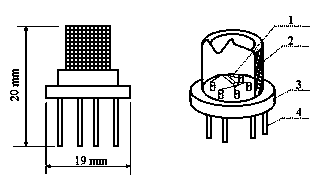
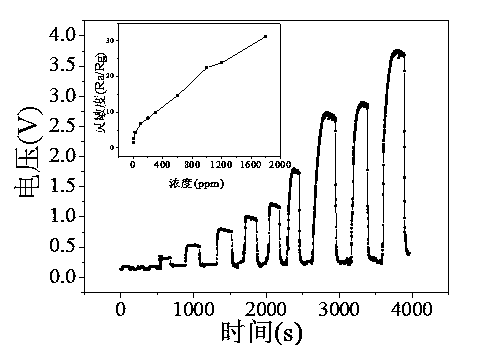
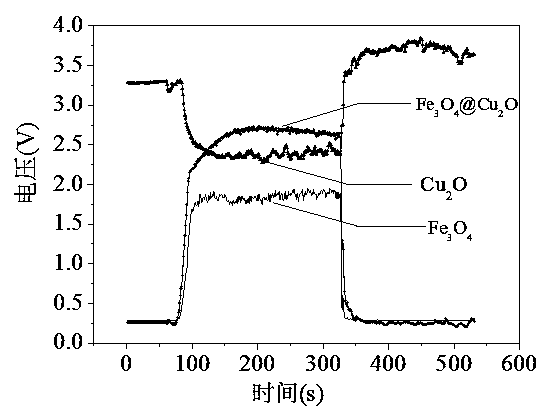
Examples
Embodiment 1
[0034] (1) Preparation of monodisperse mesoporous Fe3O4 nanomaterials: 0.8 g FeCl 3 ?6H 2O was dissolved in 18 mL of ethylene glycol solution to form a transparent solution, then 2.6 g of anhydrous NaAc and 9.0 mL of ethylenediamine were added, the mixture was fully stirred for 32 min, and it was packaged in a polytetrafluoroethylene reactor and heated at 200 After 6.0 h at ℃, cool to room temperature, wash the black solid with water several times until neutral, and dry the solid in a vacuum oven at 50 °C for 8.5 h to obtain monodisperse mesoporous ferric oxide nanoparticles; The ethylenediamine is excessive, and the excess ethylenediamine makes the surface of ferric oxide contain 0.1 μg / mg of amino groups; the pore diameter of the monodisperse mesoporous ferric oxide nanoparticles is 3 nm.
[0035] (2) Preparation of cuprous oxide nanomaterials: 0.5 mL, 0.68 mol / L CuSO 4 and 0.7 g of polyvinylpyrrolidone K30 (PVP K30) were dissolved in 15 mL of ultrapure water, added to a r...
Embodiment 2
[0038] (1) Preparation of monodisperse mesoporous Fe3O4 nanomaterials: 0.9 g FeCl 3 ?6H 2 O was dissolved in 18 mL of ethylene glycol solution to form a transparent solution, then 2.7 g of anhydrous NaAc and 9.2 mL of ethylenediamine were added, the mixture was fully stirred for 33 min, and it was packaged in a polytetrafluoroethylene reactor and heated at 200 After 6.5 h at ℃, cool to room temperature, wash the black solid with water several times until neutral, and dry the solid in a vacuum oven at 50 °C for 9.0 h to obtain monodisperse mesoporous ferric oxide nanoparticles; The ethylenediamine is in excess, and the excess ethylenediamine makes the surface of ferric oxide contain 0.15 μg / mg of amino groups; the pore size of the monodisperse mesoporous ferric oxide nanoparticles is 12 nm.
[0039] (2) Preparation of cuprous oxide nanomaterials: 0.6 mL, 0.68 mol / L CuSO 4 and 0.8 g of polyvinylpyrrolidone K30 (PVP K30) were dissolved in 16 mL of ultrapure water, added to a ro...
Embodiment 3
[0042] (1) Preparation of monodisperse mesoporous iron oxide nanomaterials: 1.0 g FeCl 3 ?6H 2 O was dissolved in 18 mL of ethylene glycol solution to form a transparent solution, then 2.6 g of anhydrous NaAc and 9.4 mL of ethylenediamine were added, the mixture was fully stirred for 33 min, and it was packaged in a polytetrafluoroethylene reactor and heated at 200 After 7.0 h at ℃, cool to room temperature, wash the black solid with water several times until neutral, and dry the solid in a vacuum oven at 50 °C for 9.0 h to obtain monodisperse mesoporous ferric oxide nanoparticles; The ethylenediamine is excessive, and the excess ethylenediamine makes the surface of ferric oxide contain 0.2 μg / mg of amino groups; the pore diameter of the monodisperse mesoporous ferric oxide nanoparticles is 8 nm.
[0043] (2) Preparation of cuprous oxide nanomaterials: 0.7 mL, 0.68 mol / L CuSO 4 and 0.75 g of polyvinylpyrrolidone K30 (PVP K30) were dissolved in 15 mL of ultrapure water, added...
PUM
| Property | Measurement | Unit |
|---|---|---|
| pore size | aaaaa | aaaaa |
| thickness | aaaaa | aaaaa |
| thickness | aaaaa | aaaaa |
Abstract
Description
Claims
Application Information
 Login to View More