Check patentability & draft patents in minutes with Patsnap Eureka AI!

Biocompatible magnetic rare earth nanoparticles, their preparation and magnetic resonance imaging applications

A technology of magnetic nanoparticles and biocompatibility, which is applied in the fields of material chemistry, nanoscience and biomedicine, can solve the problems of low colloidal stability, poor binding force, and insufficient coordination ability of nanoparticles, and achieve the goal of overcoming colloids. The effect of low stability and high crystallinity

Active Publication Date: 2017-09-12
苏州欣影生物医药技术有限公司
View PDF1 Cites 0 Cited by
  • Summary
  • Abstract
  • Description
  • Claims
  • Application Information

AI Technical Summary

Problems solved by technology

The water-soluble rare earth nanoparticles reported in the current literature are not stable in colloids in physiological buffers, and are prone to aggregation and precipitation due to insufficient coordination ability and poor binding force between the surface ligands and nanoparticles.
Therefore, it cannot be used to construct molecular imaging probes suitable for in vivo applications

Method used

the structure of the environmentally friendly knitted fabric provided by the present invention; figure 2 Flow chart of the yarn wrapping machine for environmentally friendly knitted fabrics and storage devices; image 3 Is the parameter map of the yarn covering machine
View more

Image

Smart Image Click on the blue labels to locate them in the text.
Viewing Examples
Smart Image
  • Biocompatible magnetic rare earth nanoparticles, their preparation and magnetic resonance imaging applications
  • Biocompatible magnetic rare earth nanoparticles, their preparation and magnetic resonance imaging applications
  • Biocompatible magnetic rare earth nanoparticles, their preparation and magnetic resonance imaging applications

Examples

Experimental program
Comparison scheme
Effect test

Embodiment 1

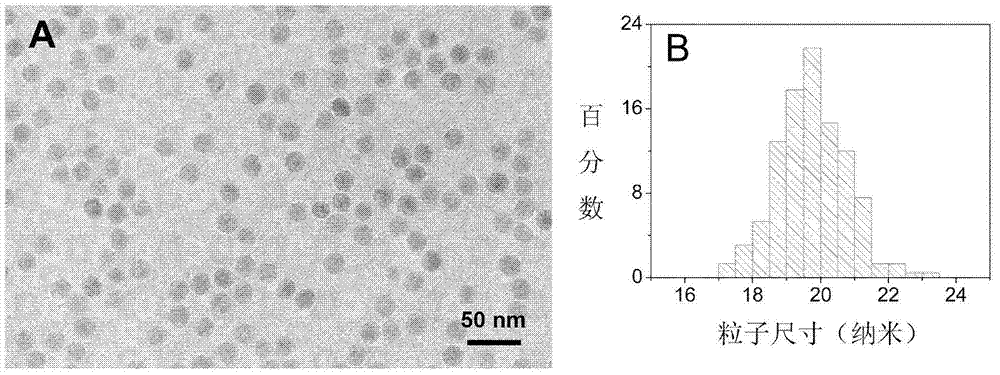
[0064] Dissolve 0.742g of gadolinium chloride hexahydrate and 6mL of oleic acid in 30mL of octadecene, then transfer the above solution into a 100mL three-necked flask, heat and dehydrate under vacuum (90°C) for 5 hours, and cool the reaction solution to room temperature. Dissolve 0.45 g of sodium hydroxide and 0.6 g of ammonium fluoride in 10 mL of methanol, and add them to the above reaction solution. The reaction was stopped after passing nitrogen gas and heating to 350°C for 10 hours. After the reaction solution was cooled to room temperature, NaGdF was precipitated with ethanol 4 The nanoparticles were washed three times, and the nanoparticles were obtained by centrifugation. The resulting crystals were dissolved in toluene and characterized by transmission electron microscopy (TEM). figure 1 NaGdF 4 TEM photo of paramagnetic nanoparticles (A) and histogram of particle size distribution (B). It can be seen from electron microscope photos that the biocompatible magneti...

Embodiment 2

[0066] Dissolve 0.742g of gadolinium chloride hexahydrate and 6mL of oleic acid in 30mL of octadecene, then transfer the above solution into a 100mL three-necked flask, heat and dehydrate under vacuum (90°C) for 5 hours, and cool the reaction solution to room temperature. Dissolve 0.45 g of sodium hydroxide and 0.6 g of ammonium fluoride in 10 mL of methanol, and add them to the above reaction solution. The reaction was stopped after passing nitrogen gas and heating to 280°C for 10 hours. All the other operations are with embodiment 1, gained NaGdF 4 The average particle size of the nanoparticles is 14.8 nm. attached image 3 NaGdF 4 TEM photo of paramagnetic nanoparticles (A) and histogram of particle size distribution (B).

Embodiment 3

[0068] Dissolve 0.742g of gadolinium chloride hexahydrate and 6mL of oleic acid in 30mL of octadecene, then transfer the above solution into a 100mL three-necked flask, heat and dehydrate under vacuum (90°C) for 5 hours, and cool the reaction solution to room temperature. Dissolve 0.45 g of sodium hydroxide and 0.6 g of ammonium fluoride in 10 mL of methanol, and add them to the above reaction solution. The reaction was stopped after passing nitrogen gas and heating to 250°C for 10 hours. All the other operations are with embodiment 1, gained NaGdF 4 The average particle size of the nanoparticles is 5.4 nm. attached Figure 4 NaGdF 4 TEM photo of paramagnetic nanoparticles (A) and histogram of particle size distribution (B).

the structure of the environmentally friendly knitted fabric provided by the present invention; figure 2 Flow chart of the yarn wrapping machine for environmentally friendly knitted fabrics and storage devices; image 3 Is the parameter map of the yarn covering machine
Login to View More

PUM

PropertyMeasurementUnit
boiling pointaaaaaaaaaa
solubility (mass)aaaaaaaaaa
particle diameteraaaaaaaaaa
Login to View More

Abstract

The invention relates to biocompatible magnetic rare earth nanoparticles modified by biocompatible ligands having more than two complexing groups capable of combining with nanoparticles, a preparation method thereof, and applications of magnetic resonance imaging and magnetic resonance / optical imaging. The technical method adopted in the present invention has the characteristics of simple process and convenient operation. The magnetic nanoparticles prepared by this technology have uniform and controllable particle size, high crystallinity, and good biocompatibility, and the nanoparticles can have fluorescence or up-conversion fluorescence properties by doping with different rare earth elements. The most important thing is that the obtained magnetic nanoparticle samples show good colloidal stability in physiological buffer, and still maintain high aqueous phase dispersion and magnetic properties after long-term storage. Therefore, biological Compatible magnetic nanoparticles are suitable for large-scale and commercial production, and have broad application prospects and market prospects in the field of magnetic resonance imaging.

Description

technical field [0001] The invention belongs to the fields of material chemistry, nanoscience and biomedicine, and particularly relates to the preparation of biocompatible magnetic rare earths with high crystallinity, high solubility and stable dispersion in physiological buffer solution by using high temperature reaction method and "ligand replacement" method nanoparticles. Background technique [0002] Magnetic rare earth nanoparticles have broad application prospects in biomedical fields such as nuclear magnetic resonance imaging (MRI), cell separation and labeling, and targeted drug carriers. However, the magnetic response properties, biocompatibility, and stability under physiological conditions of nanoparticles have always restricted the application of magnetic nanoparticles in the above fields. [0003] At present, the chemical preparation methods of magnetic nanoparticles mainly include: co-precipitation method, high temperature reaction method, microemulsion method...

Claims

the structure of the environmentally friendly knitted fabric provided by the present invention; figure 2 Flow chart of the yarn wrapping machine for environmentally friendly knitted fabrics and storage devices; image 3 Is the parameter map of the yarn covering machine
Login to View More

Application Information

Patent Timeline
no application Login to View More
Patent Type & Authority Patents(China)
IPC IPC(8): A61K49/18A61K49/00
Inventor 侯毅高振宇
Owner 苏州欣影生物医药技术有限公司
Features
  • R&D
  • Intellectual Property
  • Life Sciences
  • Materials
  • Tech Scout
Why Patsnap Eureka
  • Unparalleled Data Quality
  • Higher Quality Content
  • 60% Fewer Hallucinations
Social media
Patsnap Eureka Blog
Learn More