Chiral sulfinylamine monophosphine, and full-configuration preparation method and application thereof
What is AI technical title?
AI technical title is built by Patsnap AI team. It summarizes the technical point description of the patent document.
A technology of sulfenamide and phosphine ligands, which is applied in the chemical industry and can solve the problems of long reaction time, expensive raw materials, and low yield
Active Publication Date: 2014-04-09
苏州凯若利新材料科技有限公司
View PDF3 Cites 24 Cited by
Summary
Abstract
Description
Claims
Application Information
AI Technical Summary
This helps you quickly interpret patents by identifying the three key elements:
Problems solved by technology
Method used
Benefits of technology
Problems solved by technology
[0004] The present invention overcomes the disadvantages of expensive raw materials, long synthetic route, low yield and long reaction time in synthesizing phosphine-containing compounds in the prior art, and provides a kind of low-cost raw material, easy to transform, convenient and efficient synthesis of the whole structure Synthetic system of type ligand
Method used
the structure of the environmentally friendly knitted fabric provided by the present invention; figure 2 Flow chart of the yarn wrapping machine for environmentally friendly knitted fabrics and storage devices; image 3 Is the parameter map of the yarn covering machine
View more
Image
Smart Image Click on the blue labels to locate them in the text.
Viewing Examples
Smart Image
Click on the blue label to locate the original text in one second.
Reading with bidirectional positioning of images and text.
Smart Image
Examples
Experimental program
Comparison scheme
Effect test
Embodiment 1
[0078] The synthesis of embodiment 1 (Rs, R)-tert-butylsulfinyl-1-(2-diphenylphosphino) phenethylamine [1a (R, R)]
[0081] Refer to Route 1. The first step: In a 500mL three-necked flask, add 2-diphenylphosphinebenzaldehyde (50mmol) and (R)-(+)-tert-butylsulfinamide (50mmol), add 150mL under nitrogenatmosphere Add tetraisopropyl titanate (100 mmol) to THF, stir at 50° C. for 10 hours, and the yield is 85%. Infrared: 1087cm -1 .Proton NMR (400MHz, CDCl 3 ): δ1.08(s, 9H), 6.94-6.98(m, 1H), 7.23-7.48(m, 12H), 7.98-8.02(m, 1H), 9.11(d, 1H, J=4.8). Phosphine Spectrum NMR (160MHz, CDCl 3 ): δ-11.7. Mass Spectrum (FAB): m / z 394 (MH + ). Elemental analysis theoretical data C 23 h 24 NOPS: C, 70.21; H, 6.15; measured data N, 3.56.: C, 70.03; H, 6.27; N, 3.36.
[0082]
[0083] The second step: add the imine (1.91 g, 5 mmol) prepared in the first step into a ...
Embodiment 2
[0084] Synthesis of Example 2 (Rs, S)-tert-butylsulfinyl-1-(2-diphenylphosphino) phenethylamine [1a(R, S)]
[0085]
[0086] Refer to Route 1. Other operations refer to Example 1, the metal reagent used is methylmagnesium bromide, and the total yield is 60%. Proton NMR (400MHz, CDCl 3 )δ=7.58~7.51(m, lH), 7.41~7.18(m, 12H), 6.96~6.92(m, 1H), 5.49~5.46(m, 1H), 3.58(d, J=3.3Hz , 1 H), 1.38(d, J=6.6Hz, 3H), 1.13(t, 9H); carbon NMR (100MHz, CDCl 3 )δ=23.60, 24.56, 52.21, 53.56, 56.58, 126.10, 127.88, 128.05, 128.60, 129.49, 133.56, 133.99, 134.20; Phosphine NMR (162MHz, CDCl 3 )δ=-17.59ppm. High resolutionmass spectrometry theoretical data C 24 h 28 NOPS: 409.5240; experimental data: 409.5233.
Embodiment 3
[0087] Synthesis of Example 3 (Ss, R)-tert-butylsulfinyl-1-(2-diphenylphosphino) phenethylamine [1a(S, R)]
[0088]
[0089] Refer to Route 1. Other operations refer to Example 1, the metal reagent used is methylmagnesium bromide, and the total yield is 60%. Proton NMR (400MHz, CDCl 3 )δ=7.58~7.51(m, 1H), 7.41~7.18(m, 12H), 6.96~6.92(m, 1H), 5.49~5.46(m, 1H), 3.58(d, J=3.3Hz, 1H) , 1.38(d, J=6.6Hz, 3H), 1.13(t, 9H); carbon NMR (100MHz, CDCl 3 )δ=23.60, 24.56, 52.21, 53.56, 56.58, 126.10, 127.88, 128.05, 128.60, 129.49, 133.56, 133.99, 134.20; Phosphine NMR (162MHz, CDCl 3 )δ=-17.59ppm. High resolutionmass spectrometry theoretical data C 24 h 28 NOPS: 409.5240; experimental data: 409.5233.
the structure of the environmentally friendly knitted fabric provided by the present invention; figure 2 Flow chart of the yarn wrapping machine for environmentally friendly knitted fabrics and storage devices; image 3 Is the parameter map of the yarn covering machine
Login to View More
PUM
Login to View More
Abstract
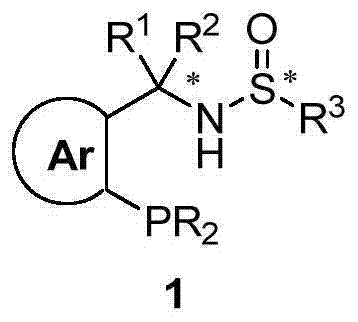
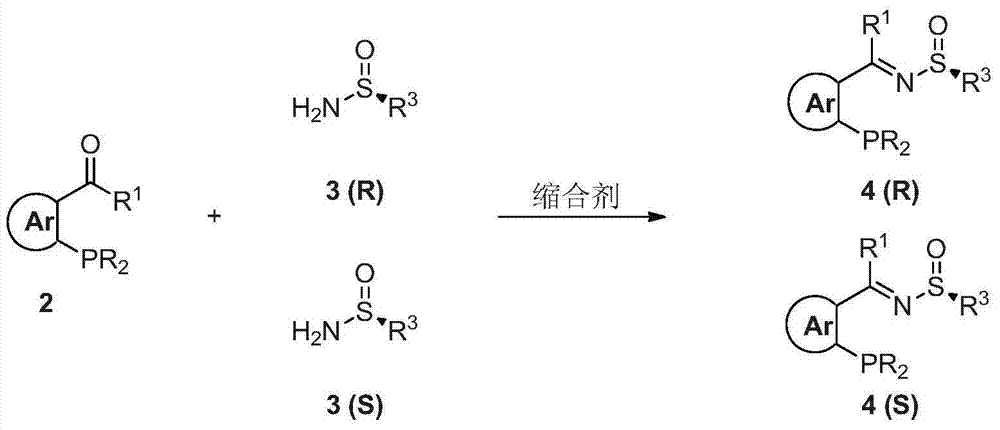
The invention provides a chiral sulfinylamine monophosphine and a preparation method thereof. The preparation method comprises the following steps: carrying out a condensation reaction of 2-disubstituted phosphinoaryl(heteroaryl)formaldehyde (ketone) 2 and chiral sulfonamide 3 to obtain a compound 4, and reacting the compound 4 with a nucleophilic reagent to prepare a compound 1; or carrying out a condensation reaction of aldehyde (ketone) 5 and the chiral sulfonamide 3 to obtain imine 6, and reacting the imine 6 with a 2-disubstituted phosphinoaryl(heteroaryl) metalreagent to obtain the compound 1; or reacting the imine 6 with the 2-disubstituted phosphinoaryl(heteroaryl) metalreagent to obtain a compound, and reducing the compound to obtain the compound 1; or carrying out a condensation reaction of 2-substituted phosphinoaryl(heteroaryl)formaldehyde (ketone) 8 and the chiral sulfonamide 3 to obtain an imine compound 9, reacting the imine compound 9 with the nucleophilic reagent to obtain a compound 7, and reducing the compound 7 to obtain the compound 1. Different chiral sulfenamides and different metal reagents are used to conveniently obtain the optically pure compound of four configurations comprising (R,R), (R,S), (S,S) and (S,R). The above ligand has the advantages of simple skeleton, synthesis convenience and easy reconstruction, can be applied in various metal-catalyzed asymmetric reactions, and has a very high reaction activity and stereoselectivity.
Description
technical field [0001] The invention relates to the technical field of chemical engineering, in particular to a preparation method of a chiral sulfinamide monophosphine ligand, a metal complex and an application thereof. Background technique [0002] In asymmetric synthesis, the catalytic system of chiral ligand and metal coordination is the key to the efficient and high enantioselective synthesis of target products, and the ligand is the source of chiral induction and regulation. How to design and synthesize chiral ligands with high selectivity and high catalytic activity is one of the research hotspots of organic chemists today. Chiral phosphine-containing compounds are a very important class of chiral ligands, which are widely used in asymmetric reactions catalyzed by transition metals. At present, a variety of chiral phosphine compounds have been applied to the production and research and development of chiral chemicals. As early as the 1960s, scientists began to study...
Claims
the structure of the environmentally friendly knitted fabric provided by the present invention; figure 2 Flow chart of the yarn wrapping machine for environmentally friendly knitted fabrics and storage devices; image 3 Is the parameter map of the yarn covering machine
Login to View More
Application Information
Patent Timeline
Application Date:The date an application was filed.
Publication Date:The date a patent or application was officially published.
First Publication Date:The earliest publication date of a patent with the same application number.
Issue Date:Publication date of the patent grant document.
PCT Entry Date:The Entry date of PCT National Phase.
Estimated Expiry Date:The statutory expiry date of a patent right according to the Patent Law, and it is the longest term of protection that the patent right can achieve without the termination of the patent right due to other reasons(Term extension factor has been taken into account ).
Invalid Date:Actual expiry date is based on effective date or publication date of legal transaction data of invalid patent.




 Login to View More
  Login to View More