
Polymer gene transfection vector based on nucleic acid base derivative and preparation method and application thereof
A nucleic acid base and gene transfection technology, which can be applied to other methods of inserting foreign genetic materials, recombinant DNA technology, etc. It can solve the problems of high cytotoxicity, high material cost, complex synthesis routes, etc. The effect of low cost and simple synthesis process
- Summary
- Abstract
- Description
- Claims
- Application Information
AI Technical Summary
Problems solved by technology
Method used
Image

Examples
Embodiment 1
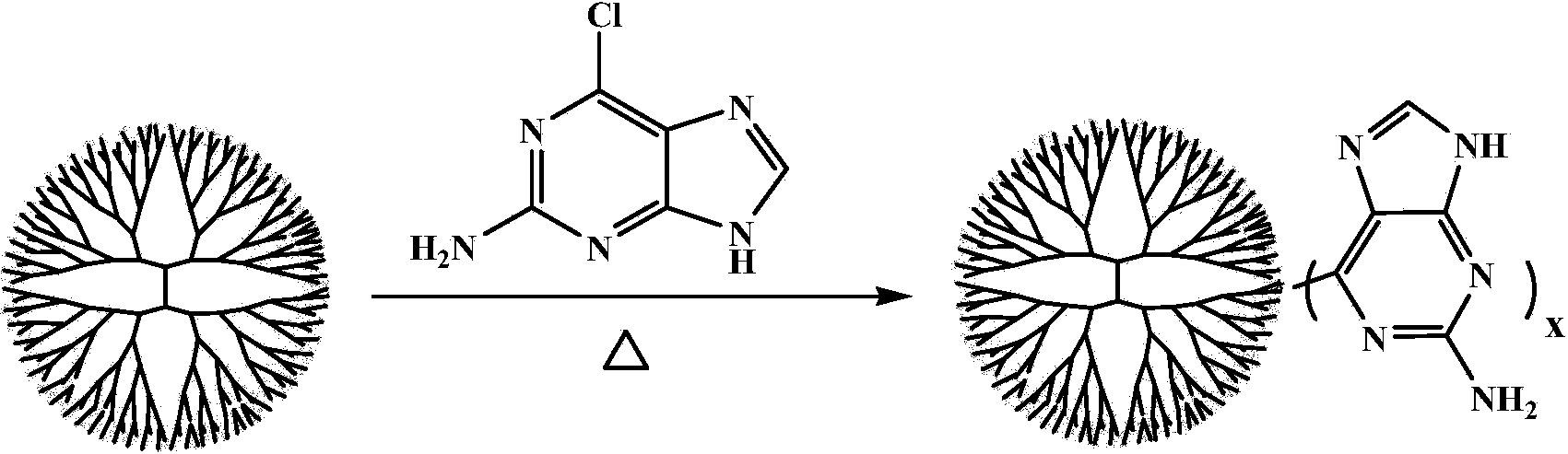
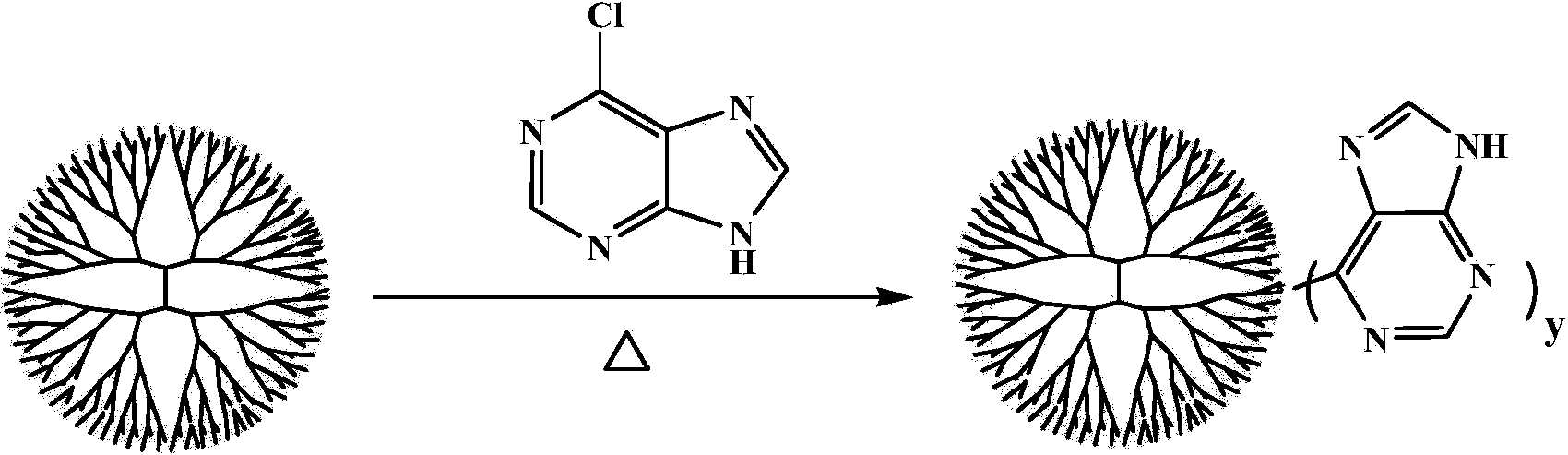
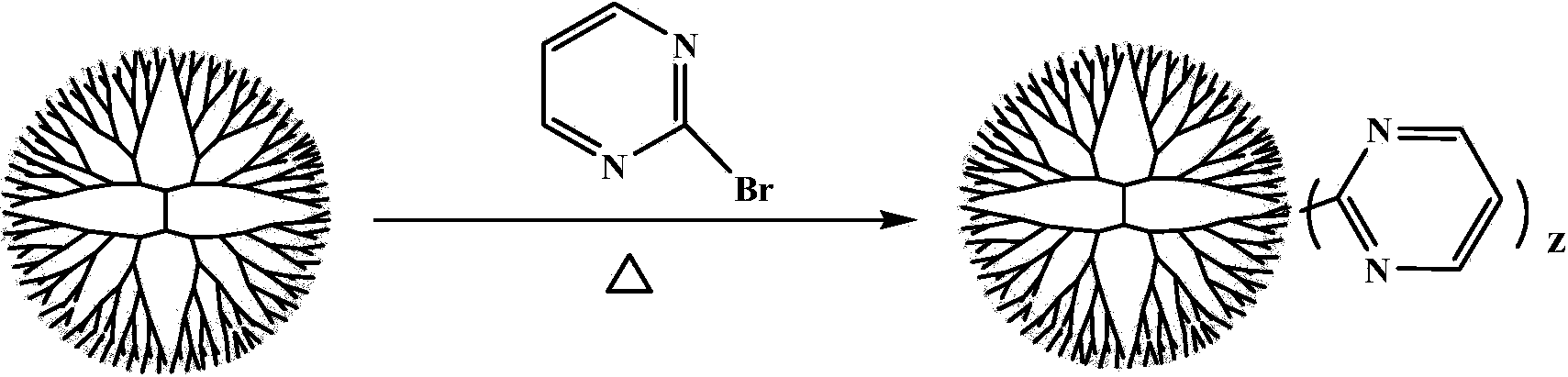
[0046] Preparation and Characterization of Gene Transfection Materials (G5-APu-x, G5-Pu-y, G5-Py-z) Based on Dendrimer and Nucleic Acid Base Derivatives
[0047] (1) if figure 1 The shown gene transfection material G5-APu-x based on dendrimer and nucleic acid base derivatives has a structural formula as shown in the following formula (1A):
[0048]
[0049] Among them, R=G5, is the fifth generation polyamide-amine dendrimer, the central core is ethylenediamine, the terminal group is a primary amine group, n is 6, m is 2; S=APu, is 2- Amino-6-chloropurine; x represents the number of 2-amino-6-chloropurine covalently attached to the surface of the fifth generation polyamido-amine dendrimer;
[0050] Wherein, the structure of G5 is as shown in formula (7A):
[0051]
[0052] In formula (7A), M is the central core of the fifth generation polyamidoamine dendrimer G5: ethylenediamine.
[0053] In a specific embodiment of the present invention, M can also be ammonia, ethylen...
Embodiment 2
[0074] Embodiment 2: Gene transfection experiment of gene transfection material G5-APu-x, G5-Pu-y, G5-Py-z on HEK293 cells
[0075] The gene transfection materials G5-APu-x, G5-Pu-y, G5-Py-z and green fluorescent protein plasmid or luciferase plasmid prepared respectively in Example 1 were formed into a complex at room temperature, and then in HEK293 Transfection was performed on the cells, and the gene transfection efficiency of the material was evaluated by detecting the expression of green fluorescent protein or luciferase. Specific experimental method: Culture HEK293 cells in a 24-well plate and incubate for 24 hours, mix 0.8 micrograms of green fluorescent protein or luciferase plasmid with G5-APu-x, G5-Pu-y, G5-Py-z with different nitrogen and phosphorus After mixing, add to the culture medium and mix evenly; add 500 microliters of culture medium containing 10% serum after incubating with the cells for 6 hours, and treat the cells after 18 hours. The expression of green...
Embodiment 3
[0082] Example 3: Cytotoxicity of gene transfection materials G5-APu-28, G5-Pu-27, G5-Py-16 on HEK293 cells
[0083] To study the cytotoxicity of the gene transfection materials G5-APu-28, G5-Pu-27, and G5-Py-16 in Example 1, the specific experimental method is: incubate HEK293 cells in a 96-well plate, and the cell density is 10 4 Cells / well, remove the medium after culturing for 12 hours, add 100 microliters of fresh medium (containing 10% serum) containing a certain amount of G5-APu-28, G5-Pu-27, and G5-Py-16, the concentration of which is transfection concentration, cultured for 24 hours. Cytotoxicity was detected by MTT assay.
[0084] Experimental results: if Figure 14 The comparison graph of the toxicity of the gene transfection vectors G5-APu-28, G5-Pu-27, G5-Py-16 and other transfection vectors on HEK293 cells shown. Figure 14 It shows that under cell transfection conditions, the gene transfection vectors G5-APu-28, G5-Pu-27, G5-Py-16 have lower cytotoxicity, and...
PUM
 Login to View More
 Abstract
Description
Claims
Application Information
 Login to View More