
A method for producing methane cogeneration liquid fuel from carbonaceous materials
A liquid fuel, carbonaceous technology, applied in the field of indirect conversion of carbonaceous materials, can solve the problems of reducing carbon use efficiency, low catalyst efficiency, increasing energy consumption, etc., to achieve the effects of saving energy consumption, low equipment utilization, and simplifying operations
- Summary
- Abstract
- Description
- Claims
- Application Information
AI Technical Summary
Problems solved by technology
Method used
Image


Examples
Embodiment 1
[0048] This example is used to illustrate the method for producing methane cogeneration liquid fuel oil from carbonaceous materials provided by the present invention.
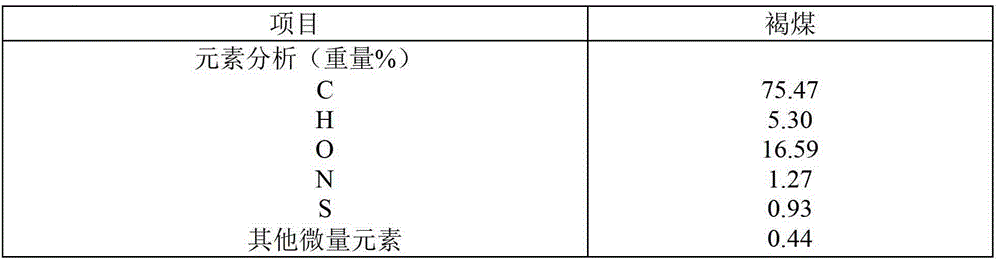
[0049] Lignite fragments with a particle size of 5-50 mm (see Table 1 for chemical composition) are gasified into crude synthesis gas with oxygen / water vapor as a gasification agent, and the obtained crude synthesis gas is sequentially cooled, detarred, crude desulfurized, After the fine desulfurization process, the net syngas (see Table 2 for the composition) is obtained, in which (CO+H 2 ) content is 63% by volume, H 2 / CO molar ratio is 1.59;
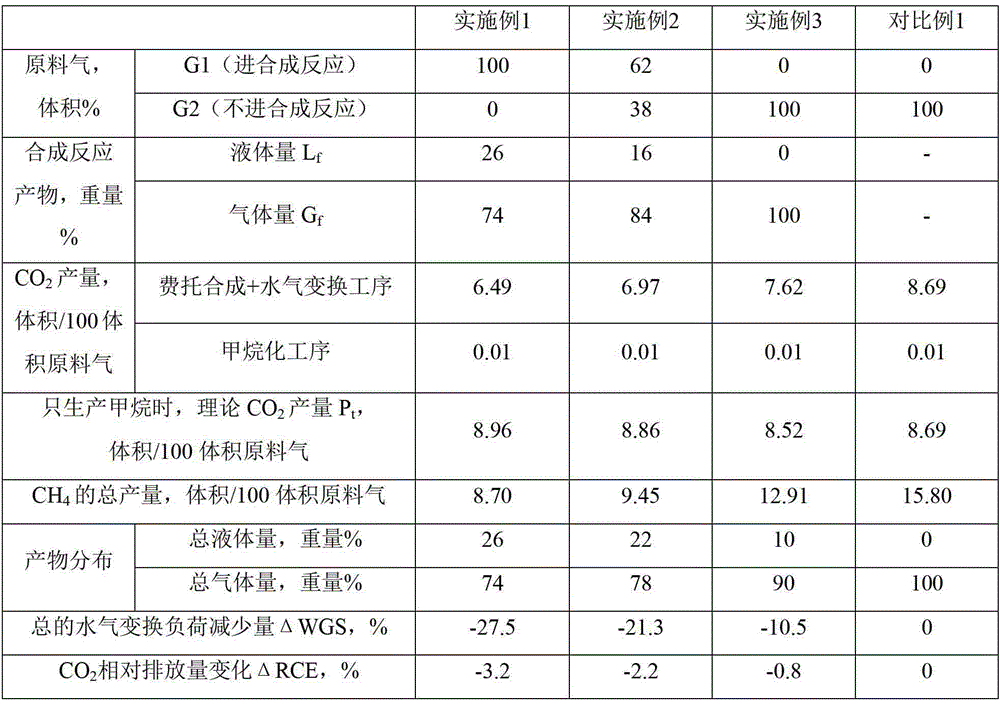
[0050]The net synthesis gas is divided into two streams, G1 and G2, wherein G1 is sent to the synthesis reactor after heat exchange and temperature rise, and is contacted and reacted with a fixed bed of a mixed catalyst. The catalyst bed is composed of a water-gas shift catalyst and a Fischer-Tropsch synthesis catalyst. Mixed, the mass ratio of the two is 1:1, where...
Embodiment 2
[0053] The preparation and composition of the net synthesis gas was the same as in Example 1. The entirety of this net synthesis gas is divided into two streams G1 and G2. Among them, G1 is sent to the synthesis reactor after heat exchange and temperature rise, and is contacted and reacted with the fixed bed of the mixed catalyst. The catalyst bed is formed by mixing the water-gas shift catalyst and the Fischer-Tropsch synthesis catalyst, and the mass ratio of the two is 0.6:1. Among them, the water gas shift catalyst is a Co-Mo catalyst (manufactured by Qingdao Lianxin Company, brand name QDB-03), and the Fischer-Tropsch synthesis catalyst is a molten iron catalyst (Fe 2 o 3 The content is 99.4% by weight, the particle size is 5-20 mesh); the composite reactor inlet temperature is 278°C, the outlet temperature is 332°C, the pressure is 3.33MPa, and the gas space velocity is 2000h -1 , the reacted product is cooled to 40°C by indirect heat exchange, and divided into gas stre...
Embodiment 3
[0056] The preparation and composition of the net synthesis gas was the same as in Example 1. The entirety of this net synthesis gas is divided into two streams G1 and G2. Among them, G1 is sent to the synthesis reactor after heat exchange and temperature rise, and is contacted and reacted with the fixed bed of the mixed catalyst. The catalyst bed is formed by mixing the water gas shift catalyst and the Fischer-Tropsch synthesis catalyst, and the mass ratio of the two is 3:1, wherein , the water gas shift catalyst is a Co-Mo catalyst (manufacturer is Qingdao Lianxin Company, brand name QDB-03), and the Fischer-Tropsch synthesis catalyst is a supported iron catalyst (32% by weight Fe 2 o 3 -1.5 wt%CuO-0.4 wt%K 2 O-66.1 wt SiO 2 ); the inlet temperature of the synthesis reactor is 221°C, the outlet temperature is 252°C, the pressure is 2.78MPa, and the gas space velocity is 1100h -1 , the reacted product is cooled to 40°C by indirect heat exchange, and divided into gas strea...
PUM
| Property | Measurement | Unit |
|---|---|---|
| particle size (mesh) | aaaaa | aaaaa |
Abstract
Description
Claims
Application Information
 Login to View More