A bactericidal composition containing cyprodinil and fluoxastrobin and its application
A technology of fluoxastrobin and fluoxastrobin, which is applied in the field of bactericidal compositions, can solve the problem of no combination of fluoxastrobin and fluoxastrobin, and achieve good synergistic effect, reduce adverse effects, and prevent effect. excellent effect
- Summary
- Abstract
- Description
- Claims
- Application Information
AI Technical Summary
Problems solved by technology
Method used
Image


Examples
example 1
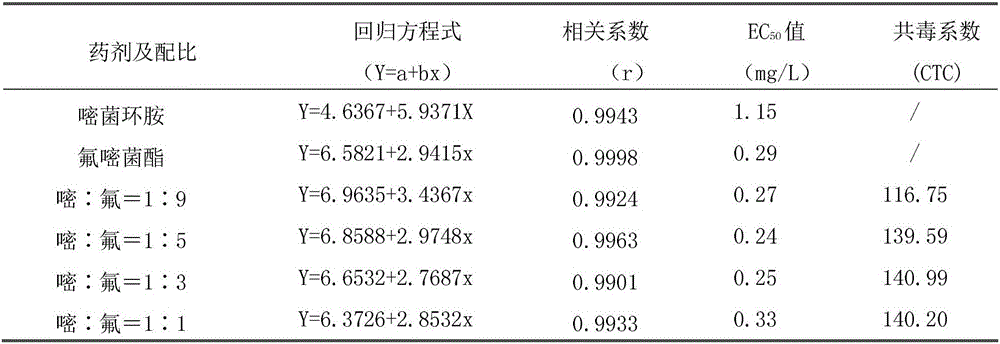
[0022] Physical measurement example 1: Toxicity determination of the combination of cyprodinil and fluoxastrobin to citrus scab
[0023] 1. Test object: Citrus citrus scab [Latin scientific name: Elsinoefewcetti]
[0024] 2. Test method: refer to "Pesticide Indoor Bioassay Test Guidelines NY / T1156.2-2006", and use the drug-containing medium method.
[0025] 3. Statistical analysis of data: use SAS6.12 statistical software for analysis. Calculate the mycelia growth inhibition rate (%) according to the test data, and obtain the virulence regression equation, correlation coefficient (r), EC 50 and co-toxicity coefficient.
[0026] 4. Evaluation method: Refer to "Pesticide Indoor Bioassay Test Guidelines NY / T1156.2-2006", according to SunJohnson (1960) co-toxicity coefficient method (CTC) to evaluate the synergistic effect of drug mixing, that is, CTC≤80 is antagonism 80<CTC<120 is an additive effect, and CTC≥120 is a synergistic effect.
[0027] 5. Results and Analysis
[00...
example 2
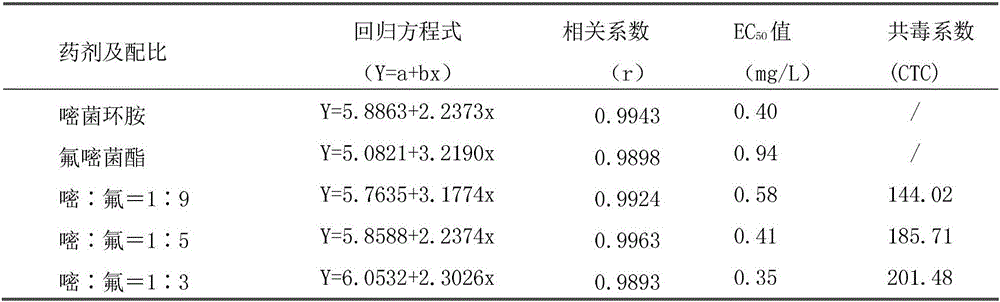
[0033] Physical measurement example 2: Toxicity determination of the combination of cyprodinil and fluoxastrobin to tea bud blight
[0034] 1. Test object: tea tree bud blight [Latin scientific name: Gibberella baccata]
[0035] 2. Test method: refer to "Pesticide Indoor Bioassay Test Guidelines NY / T1156.2-2006", and use the drug-containing medium method.
[0036] 3. Statistical analysis of data: use SAS6.12 statistical software for analysis. Calculate the mycelia growth inhibition rate (%) according to the test data, and obtain the virulence regression equation, correlation coefficient (r), EC 50 and co-toxicity coefficient.
[0037] 4. Evaluation method: Refer to the "Pesticide Indoor Bioassay Test Guidelines NY / T1156.2-2006", and evaluate the synergistic effect of drug mixture according to the co-toxicity coefficient method (CTC) of Sun & Johnson (1960), that is, CTC≤80 is antagonism 80<CTC<120 is an additive effect, and CTC≥120 is a synergistic effect.
[0038] 5. Resu...
example 3
[0044] Physical measurement example 3: Toxicity determination of the combination of cyprodinil and fluoxastrobin to the mango anthracnose bacteria
[0045] 1. Test object: mango anthracnose bacteria [Latin scientific name: Colletotrichum mgloeosporioiles]
[0046] 2. Test method: refer to "Pesticide Indoor Bioassay Test Guidelines NY / T1156.12-2008", using the drug-containing medium method.
[0047] 3. Statistical analysis of data: use SAS6.12 statistical software for analysis. Calculate the mycelia growth inhibition rate (%) according to the test data, and obtain the virulence regression equation, correlation coefficient (r), EC 50 and co-toxicity coefficient.
[0048]4. Evaluation method: Refer to the "Pesticide Indoor Bioassay Test Guidelines NY / T1156.12-2008", and evaluate the synergistic effect of the drug mixture according to the co-toxicity coefficient method (CTC) of Sun & Johnson (1960), that is, CTC≤80 is antagonism 80<CTC<120 is an additive effect, and CTC≥120 is ...
PUM
 Login to View More
 Abstract
Description
Claims
Application Information
 Login to View More
 - R&D
- Intellectual Property
- Life Sciences
- Materials
- Tech Scout
- Unparalleled Data Quality
- Higher Quality Content
- 60% Fewer Hallucinations
Browse by: Latest US Patents, China's latest patents, Technical Efficacy Thesaurus, Application Domain, Technology Topic, Popular Technical Reports.
© 2025 PatSnap. All rights reserved.Legal|Privacy policy|Modern Slavery Act Transparency Statement|Sitemap|About US| Contact US: help@patsnap.com