
SAR image de-noising algorithm based on Primal Sketch classification and SVD domain improvement MMSE estimation
An image and algorithm technology, applied in the field of image denoising, which can solve problems such as difficulty in maintaining point targets and easy blurring of edges.
- Summary
- Abstract
- Description
- Claims
- Application Information
AI Technical Summary
Problems solved by technology
Method used
Image

Examples
Embodiment Construction
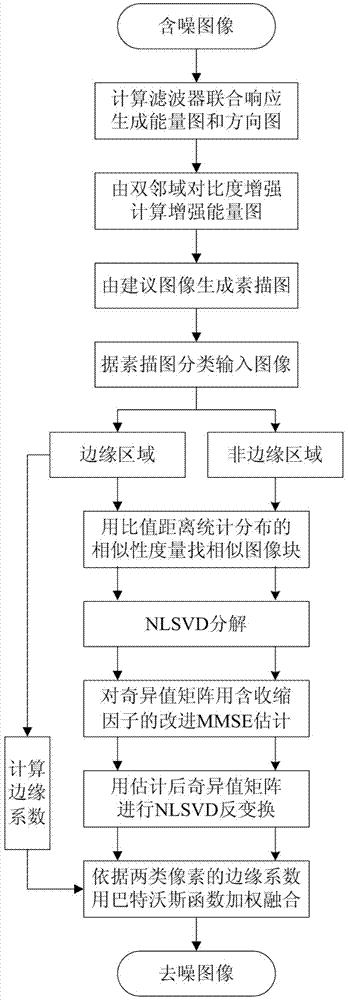
[0063] figure 1 It is a flow chart of the present invention; the present invention provides a kind of SAR image denoising algorithm based on PrimalSketch classification and SVD domain improvement MMSE estimation, comprises the steps:
[0064] Step 1: Input a SAR image Y, the size of the image is M×N, M and N are the number of pixels in the row and column of the image respectively;
[0065] Step 2: Use a local filter bank to convolve each pixel of the input image Y, and solve the joint response, and combine the convolution value corresponding to the maximum response value in the joint response with the direction θ of the filter m , as the energy value and direction of the pixel respectively, traverse all the pixels to get the energy image ES and direction image ER;
[0066] 2a) Filter the input image Y, the local filters used are Gauss-Laplace (LoG) filter, Gaussian offset difference (DooG) filter and odd symmetric Gaussian offset difference (osDooG) filter Three categories. ...
PUM
 Login to View More
 Abstract
Description
Claims
Application Information
 Login to View More