
Addition type liquid fluorinated silicone rubber base rubber and preparation method thereof
A technology of liquid fluorosilicone and base rubber, applied in the field of addition type liquid fluorosilicone rubber base rubber and its preparation, can solve the problems of affecting vinyl crosslinking activity, impairing oil resistance of fluorosilicone rubber, product turbidity, etc. Steric hindrance effect, reducing shielding effect, ensuring the effect of cross-linking activity
- Summary
- Abstract
- Description
- Claims
- Application Information
AI Technical Summary
Problems solved by technology
Method used
Image

Examples
Embodiment 1
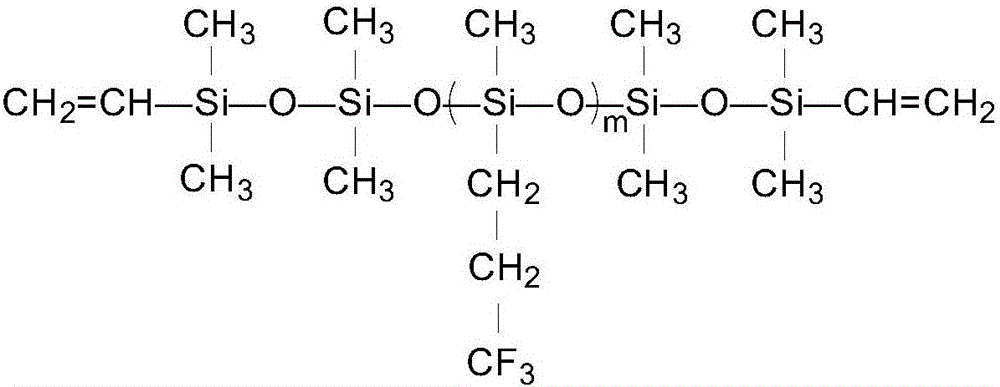
[0039] An addition-type liquid fluorosilicone rubber base rubber has the following structural formula:
[0040] Vi(Me) 2 SiO-Si(Me) 2 O-[Si(Rf)(Me)O] 35 -Si(Me) 2 O-Si(Me) 2 Vi
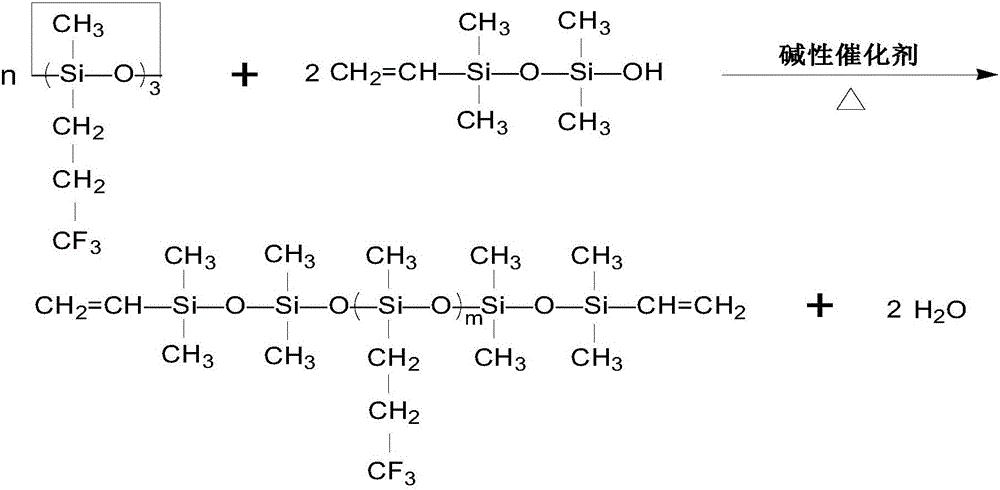
[0041] The preparation steps are as follows:
[0042] (1) Add 600g trifluoropropylmethylcyclotrisiloxane (D 3 F), 37.5g 1-vinyl-3-hydroxyl-1,1,3,3-tetramethyldisiloxane (purity 96%) and 0.5g sodium hydroxide silicon alkoxide (NaOH content 4.05%), stirring uniform;
[0043] (2) At room temperature, vacuumize the reactor to -0.04MPa, turn on the heating, raise the temperature to 120-130°C to initiate the reaction of the system and maintain it for 2.5h, maintain the pressure of -0.04MPa to -0.08MPa throughout the reaction, and the water vapor generated by the polymerization, As the reaction proceeds, it is continuously sucked away by negative pressure;
[0044](3) After the reaction is complete, add silicon-based phosphate to neutralize the catalyst and keep it for 0.5h;
[0045] (4) Under the ...
Embodiment 2
[0048] An addition-type liquid fluorosilicone rubber base rubber has the following structural formula:
[0049] Vi(Me) 2 SiO-Si(Me) 2 O-[Si(Rf)(Me)O] 68 -Si(Me) 2 O-Si(Me) 2 Vi
[0050] The preparation steps are as follows:
[0051] (1) Add 600g trifluoropropylmethylcyclotrisiloxane (D 3 F), 20g 1-vinyl-3-hydroxyl-1,1,3,3-tetramethyldisiloxane (purity 96%) and 0.48g sodium hydroxide silicon alkoxide (NaOH content 4.05%), stir well ;
[0052] (2) At room temperature, vacuumize the reactor to -0.04MPa, turn on the heating, raise the temperature to 120-130°C to initiate the reaction of the system and maintain it for 2.5h, maintain the pressure of -0.04MPa to -0.08MPa throughout the reaction, and the water vapor generated by the polymerization, As the reaction proceeds, it is continuously sucked away by negative pressure;
[0053] (3) After the reaction is complete, add silicon-based phosphate to neutralize the catalyst and keep it for 0.5h;
[0054] (4) Under the pressu...
Embodiment 3
[0057] An addition-type liquid fluorosilicone rubber base rubber has the following structural formula:
[0058] Vi(Me) 2 SiO-Si(Me) 2 O-[Si(Rf)(Me)O] 170 -Si(Me) 2 O-Si(Me) 2 Vi
[0059] The preparation steps are as follows:
[0060] (1) Add 600g trifluoropropylmethylcyclotrisiloxane (D 3 F), 9g 1-vinyl-3-hydroxyl-1,1,3,3-tetramethyldisiloxane (purity 96%) and 0.49g sodium hydroxide silicon alkoxide (NaOH content 4.05%), stir well ;
[0061] (2) At room temperature, vacuumize the reactor to -0.04MPa, turn on the heating, raise the temperature to 120-130°C to initiate the reaction of the system and maintain it for 2.5h, maintain the pressure of -0.04MPa to -0.08MPa throughout the reaction, and the water vapor generated by the polymerization, As the reaction proceeds, it is continuously sucked away by negative pressure;
[0062] (3) After the reaction is complete, add silicon-based phosphate to neutralize the catalyst and keep it for 0.5h;
[0063] (4) Under the pressu...
PUM
 Login to View More
 Abstract
Description
Claims
Application Information
 Login to View More