

Method for testing surface hardness of composite insulating material
A technology of composite insulation and surface hardness, which is applied in the direction of material analysis, material excitation analysis, and material analysis through optical means, which can solve the problems of limited measurement accuracy and achieve the effects of convenient operation, safe operation, and fast analysis speed
Inactive Publication Date: 2017-03-15
SHENZHEN GRADUATE SCHOOL TSINGHUA UNIV
View PDF3 Cites 9 Cited by
- Summary
- Abstract
- Description
- Claims
- Application Information
AI Technical Summary
Problems solved by technology
[0004] Conventional hardness testing of composite insulating materials is carried out with instruments such as Shore hardness testers, but this method of testing is limited to sampling in the laboratory, and cannot be carried out on towers or outdoors of high-voltage transmission lines, and the measurement accuracy is also limited. Depends on the experience and skill level of the surveyor
Method used
the structure of the environmentally friendly knitted fabric provided by the present invention; figure 2 Flow chart of the yarn wrapping machine for environmentally friendly knitted fabrics and storage devices; image 3 Is the parameter map of the yarn covering machine
View moreImage
Smart Image Click on the blue labels to locate them in the text.
Smart ImageViewing Examples

Examples
Experimental program
Comparison scheme
Effect test
example
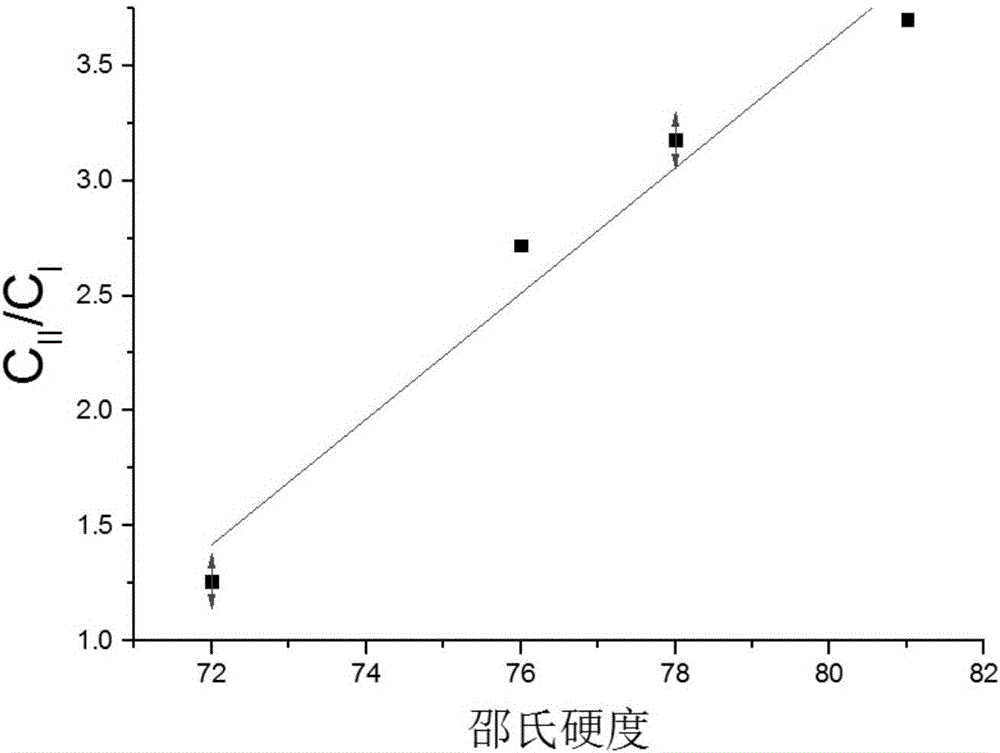
[0063] Sampling composite insulator sheds of 220kV transmission lines, the same manufacturer, and different operating regions, and measuring the Shore hardness x at specific locations i , carry out the laser-induced breakdown spectrum test at a distance of 5m for each specific position, select the ion line C II 588.977nm and the atomic line C I 247.8561nm of carbon element, and calculate their ratio y i , program in the software to calculate its y i with x i relationship such as figure 1 shown. Use LIBS test for other positions to be tested to obtain their spectral data, and use this functional relationship to calculate the hardness values of other positions to be tested.
the structure of the environmentally friendly knitted fabric provided by the present invention; figure 2 Flow chart of the yarn wrapping machine for environmentally friendly knitted fabrics and storage devices; image 3 Is the parameter map of the yarn covering machine
Login to View More PUM
 Login to View More
 Abstract
A method for testing the surface hardness of a composite insulating material comprises the following steps: S1, preparing a composite insulating material sample, of which the surface hardness is measured; S2, irradiating the surface of the composite insulating material sample by pulse laser beams and by a laser-induced breakdown spectroscopy (LIBS) method, and catching the laser-induced plasma spectroscopy of the surface; S3, establishing a functional relationship between a ratio of an ionic line to an atomic line of a selected element in the laser-induced plasma spectroscopy and the surface hardness value; S4, irradiating the surface of a to-be-tested composite insulating material by pulse laser beams and by the LIBS method, and catching the laser-induced plasma spectroscopy of the surface; and S5, determining the surface hardness of the to-be-tested composite insulating material according to the laser-induced plasma spectroscopy obtained in the step S4 and on the basis of the functional relationship between the ratio of the ionic line to the atomic line and the surface hardness value. By the method, the composite insulating material can be subjected to remote and electriferous on-site test, so that the accurate surface hardness of the composite insulating layer can be obtained quickly.
Description
technical field [0001] The invention relates to a method for testing the surface hardness of a composite insulating material. Background technique [0002] A good external insulation state of high-voltage transmission lines is an important guarantee for the safe operation of power systems. Since the 1990s, silicone rubber composite insulation materials have been widely used in the field of external insulation, and have been widely used in power systems, and the pollution flashover resistance of external insulation equipment has been significantly improved. The main equipment forms of silicone rubber composite insulation materials are composite insulators (synthetic insulators), climbing skirts, room temperature vulcanized silicone rubber coatings (RTV coatings), various casings made of liquid silicone rubber, etc. During the long-term operation of composite insulation materials, aging will occur due to the influence of electric field, temperature, humidity and other factors...
Claims
the structure of the environmentally friendly knitted fabric provided by the present invention; figure 2 Flow chart of the yarn wrapping machine for environmentally friendly knitted fabrics and storage devices; image 3 Is the parameter map of the yarn covering machine
Login to View More Application Information
Patent Timeline
 Login to View More
 IPC IPC(8): G01N21/71
CPCG01N21/718
Inventor王希林洪骁陈灿赵晨龙王晗叶蔚安贾志东
OwnerSHENZHEN GRADUATE SCHOOL TSINGHUA UNIV