Method for preparing C-3 oxo substituted imidazole heterocyclic compounds
What is AI technical title?
AI technical title is built by Patsnap AI team. It summarizes the technical point description of the patent document.
A technology of compounds and synthetic methods, applied in the fields of organic chemistry, drug combination, antibacterial drugs, etc., to achieve the effects of wide application prospect, high reaction yield and wide application range
Active Publication Date: 2017-07-14
杭州尚合生物医药科技有限公司 +1
View PDF7 Cites 3 Cited by
Summary
Abstract
Description
Claims
Application Information
AI Technical Summary
This helps you quickly interpret patents by identifying the three key elements:
Problems solved by technology
Method used
Benefits of technology
Problems solved by technology
No effective synthesis of 3-alkoxy or phenoxy substituted imidazole heterocycles has been reported
Method used
the structure of the environmentally friendly knitted fabric provided by the present invention; figure 2 Flow chart of the yarn wrapping machine for environmentally friendly knitted fabrics and storage devices; image 3 Is the parameter map of the yarn covering machine
View more
Image
Smart Image Click on the blue labels to locate them in the text.
Viewing Examples
Smart Image
Click on the blue label to locate the original text in one second.
Reading with bidirectional positioning of images and text.
Smart Image
Examples
Experimental program
Comparison scheme
Effect test
Embodiment 1
[0031] Example 1: Preparation of 3-phenoxy-2-phenylimidazo[1,2-a]pyridine
[0032]
[0033] Take a clean reaction bottle, add a small magnet, dry it, add 2-aminopyridine (56.5mg, 0.6mmol), 2-phenoxyacetophenone (42.5mg, 0.2mmol), cuprous iodide (0.01mmol) , 1,2-dichloroethane (1.0 mL), heated at 100° C. under oxygen for 16 hours, and the reaction solution was separated by direct column chromatography to obtain the target product (44.0 mg, yield 77%). White solid, m.p.:145-146℃. 1 H NMR (400MHz, CDCl 3 ): δ=8.07(d, J=7.6Hz, 2H), 7.75(d, J=6.8Hz, 1H), 7.66(d, J=9.2Hz, 1H), 7.41(t, J=7.2Hz, 2H ),7.28-7.35(m,3H),7.20(t,J=7.6Hz,1H),7.12(t,J=7.2Hz,1H),6.97(d,J=8.0Hz,2H),6.77(t ,J=6.8Hz,1H). 13 C NMR (100MHz, CDCl 3 ):δ=156.1,139.9,132.5,131.1,130.2,128.7,127.8,126.5,124.4,123.7,121.6,117.9,115.0,112.3.FTIR(NaCl,cm -1 ):3053.3,2985.8,1647.2,1495.6,1421.5,1390.1,1362.2,1265.3,1201.7,895.0,738.7,706.0.HR-MS(ESI):m / zcalculated for C 19 h 14 N 2 O[M+H]+: 287.1184; found 287.1...
Embodiment 2
[0034] Example 2: Preparation of 3-phenoxy-2-phenylimidazo[1,2-a]pyridine
[0035]
[0036] Take a clean reaction bottle, add a small magnet, dry it, add 2-aminopyridine (56.5mg, 0.6mmol), 2-phenoxyacetophenone (42.5mg, 0.2mmol), cuprous iodide (0.01 mmol) , 1,2-dichloroethane (1.0 mL), heated at 80° C. under oxygen for 16 hours, and the reaction solution was separated by direct column chromatography to obtain the target product (40.0 mg, yield 70%).
Embodiment 3
[0037] Example 3: Preparation of 3-phenoxy-2-phenylimidazo[1,2-a]pyridine
[0038]
[0039] Take a clean reaction bottle, add a small magnet, dry it, add 2-aminopyridine (56.5mg, 0.6mmol), 2-phenoxyacetophenone (42.5mg, 0.2mmol), cuprous iodide (0.01mmol) , 1,2-dichloroethane (1.0 mL), heated at 120° C. under oxygen for 16 hours, and the reaction solution was separated by direct column chromatography to obtain the target product (37.8 mg, yield 66%).
the structure of the environmentally friendly knitted fabric provided by the present invention; figure 2 Flow chart of the yarn wrapping machine for environmentally friendly knitted fabrics and storage devices; image 3 Is the parameter map of the yarn covering machine
Login to View More
PUM
Login to View More
Abstract
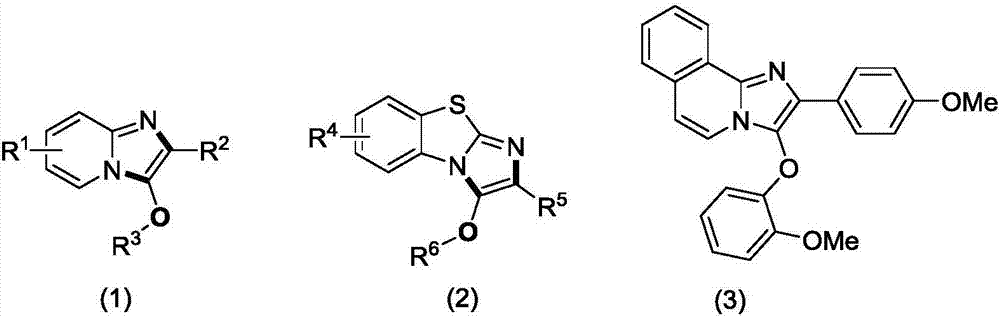
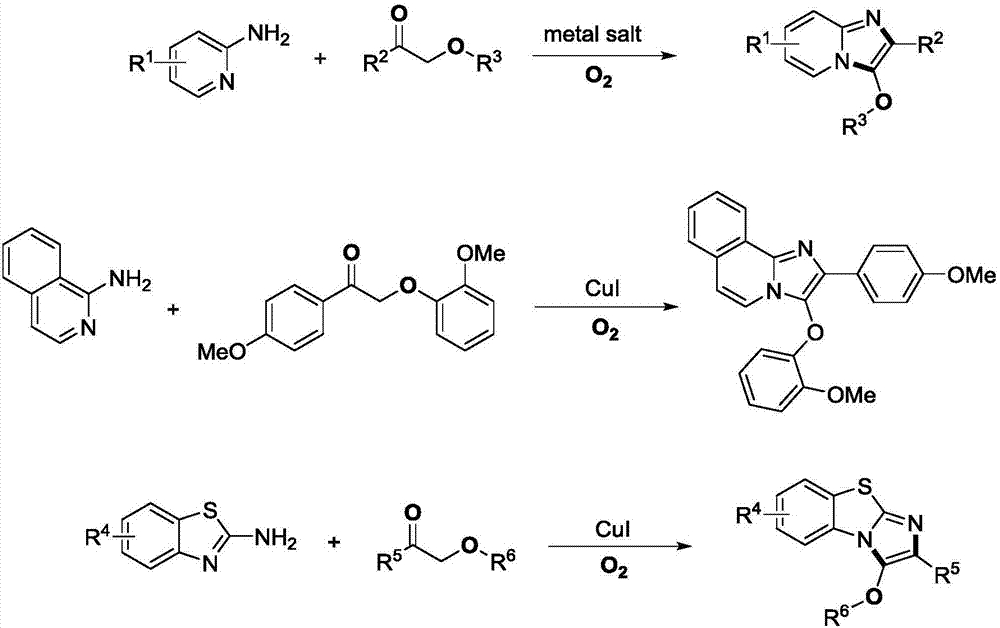
The invention relates to a method for synthesizing a compound represented by a formula (1) or a formula (2) or a formula (3) shown in the description. The method specifically comprises the steps of putting an o-amino nitrogenheterocyclic compound, a 2-oxo acetophenone derivative and a transition-metal salt catalyst into an organic solvent, carrying out a heated reaction in an oxygen-containing atmosphere, and subjecting the reaction solution to aftertreatment after the reaction ends, thereby obtaining the compound represented by the formula (1) or formula (2) or formula (3). 2-amino heterocyclic compounds are 2-aminopyridine compounds or 2-aminobenzo[d]thiazole compounds or 1-amino isoquinoline. According to the method disclosed by the invention, the operation is simple, the reaction conditions are mild, the byproduct is restricted to water, the reaction yield is high and reaches 97% to the maximum, and two kinds of heterocyclic compounds synthesized have pharmacological properties and can serve as important precursors of medicines.
Description
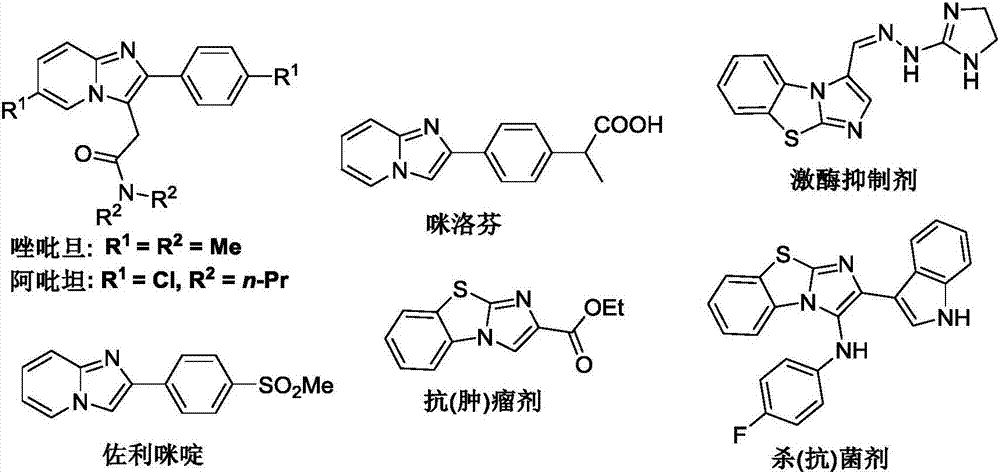
technical field [0001] The present invention relates to a preparation method of a C-3 oxygen substituted imidazoleheterocyclic compound, in particular to C-3 oxygen substituted imidazo[1,2-a]pyridine and benzo[d]imidazo[2, 1-b] Synthetic method of thiazole heterocyclic compounds. Background technique [0002] In recent years, imidazo[1,2-a]pyridine and benzo[d]imidazo[2,1-b]thiazole have attracted the attention of chemists due to their wide applications in different fields. Imidazo[1,2-a]pyridine is an important class of nitrogen-containing heterocyclic compounds. This structure is one of the most common nitrogen-containing heterocycles in natural products and bioactive drug molecules. Wide range of uses. Two main synthetic methods have been reported so far, one is cyclization with 2-aminopyridine via oxidative amination or cascade reaction. The second is based on the nucleophilicity of the C-3 position of imidazo[1,2-a]pyridine, using a transition metal catalyst to acti...
Claims
the structure of the environmentally friendly knitted fabric provided by the present invention; figure 2 Flow chart of the yarn wrapping machine for environmentally friendly knitted fabrics and storage devices; image 3 Is the parameter map of the yarn covering machine
Login to View More
Application Information
Patent Timeline
Application Date:The date an application was filed.
Publication Date:The date a patent or application was officially published.
First Publication Date:The earliest publication date of a patent with the same application number.
Issue Date:Publication date of the patent grant document.
PCT Entry Date:The Entry date of PCT National Phase.
Estimated Expiry Date:The statutory expiry date of a patent right according to the Patent Law, and it is the longest term of protection that the patent right can achieve without the termination of the patent right due to other reasons(Term extension factor has been taken into account ).
Invalid Date:Actual expiry date is based on effective date or publication date of legal transaction data of invalid patent.


 Login to View More
  Login to View More