
Robust adaptive clutter suppression method of sum and difference channel of missile-borne radar
An adaptive clutter and differential channel technology, applied in the field of radar, can solve the problems of target detection performance loss, etc., and achieve the effect of overcoming the loss of freedom, increasing the degree of freedom, and improving performance
- Summary
- Abstract
- Description
- Claims
- Application Information
AI Technical Summary
Problems solved by technology
Method used
Image

Examples
Embodiment 1
[0040] In the existing sum-difference STAP method, in the case of inaccurate estimation of the covariance matrix and target-steering vector and target contamination, the main lobe of the adaptive space-time response will be distorted, resulting in the suppression of the real target and loss of target detection performance.
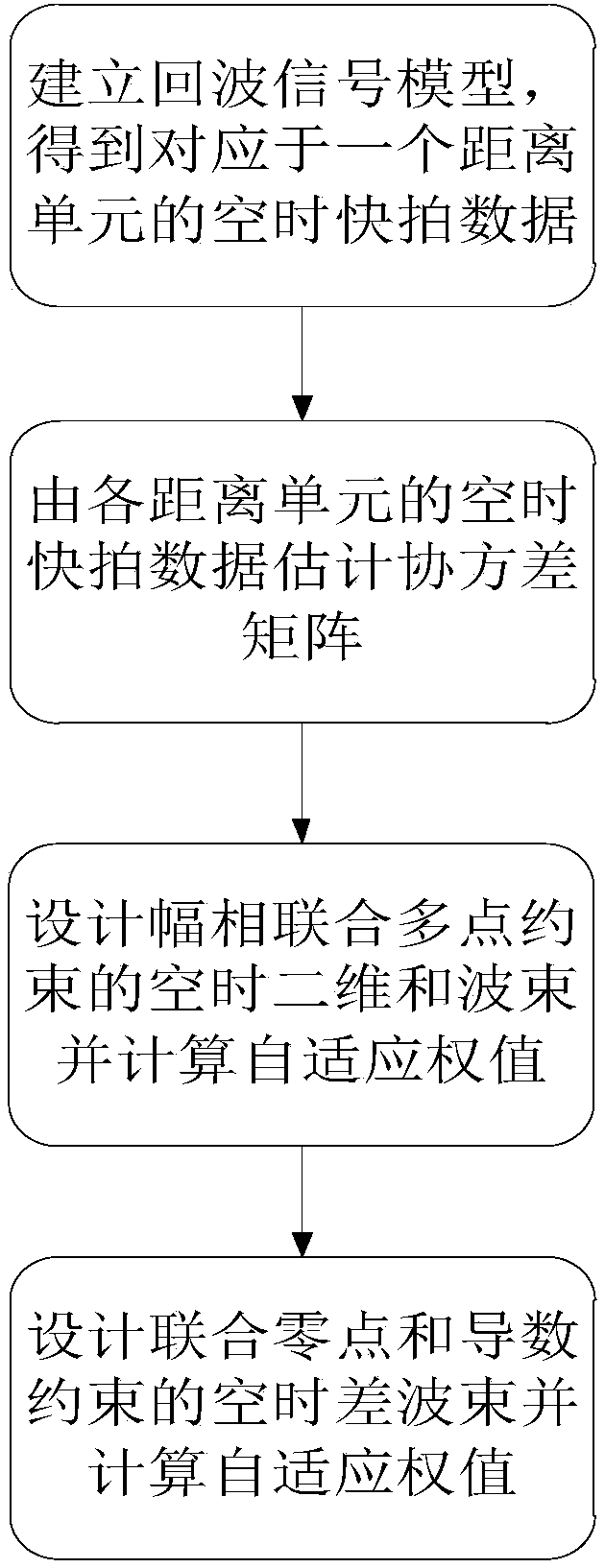
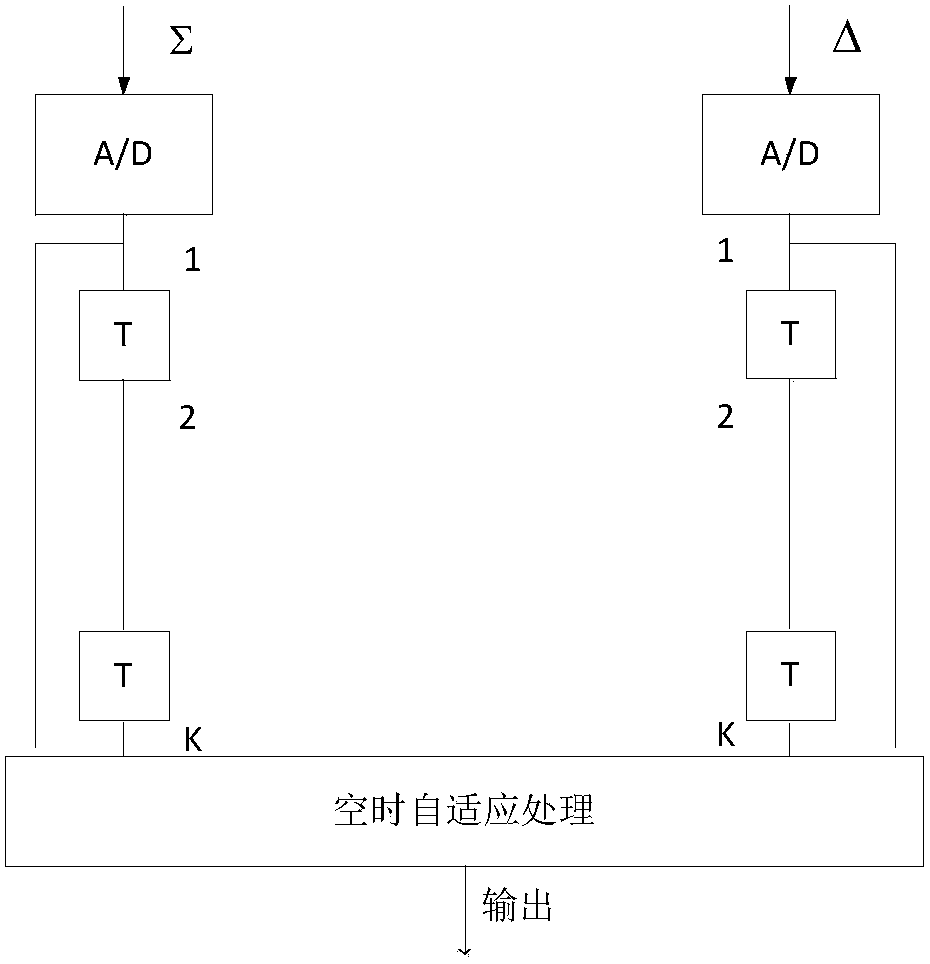
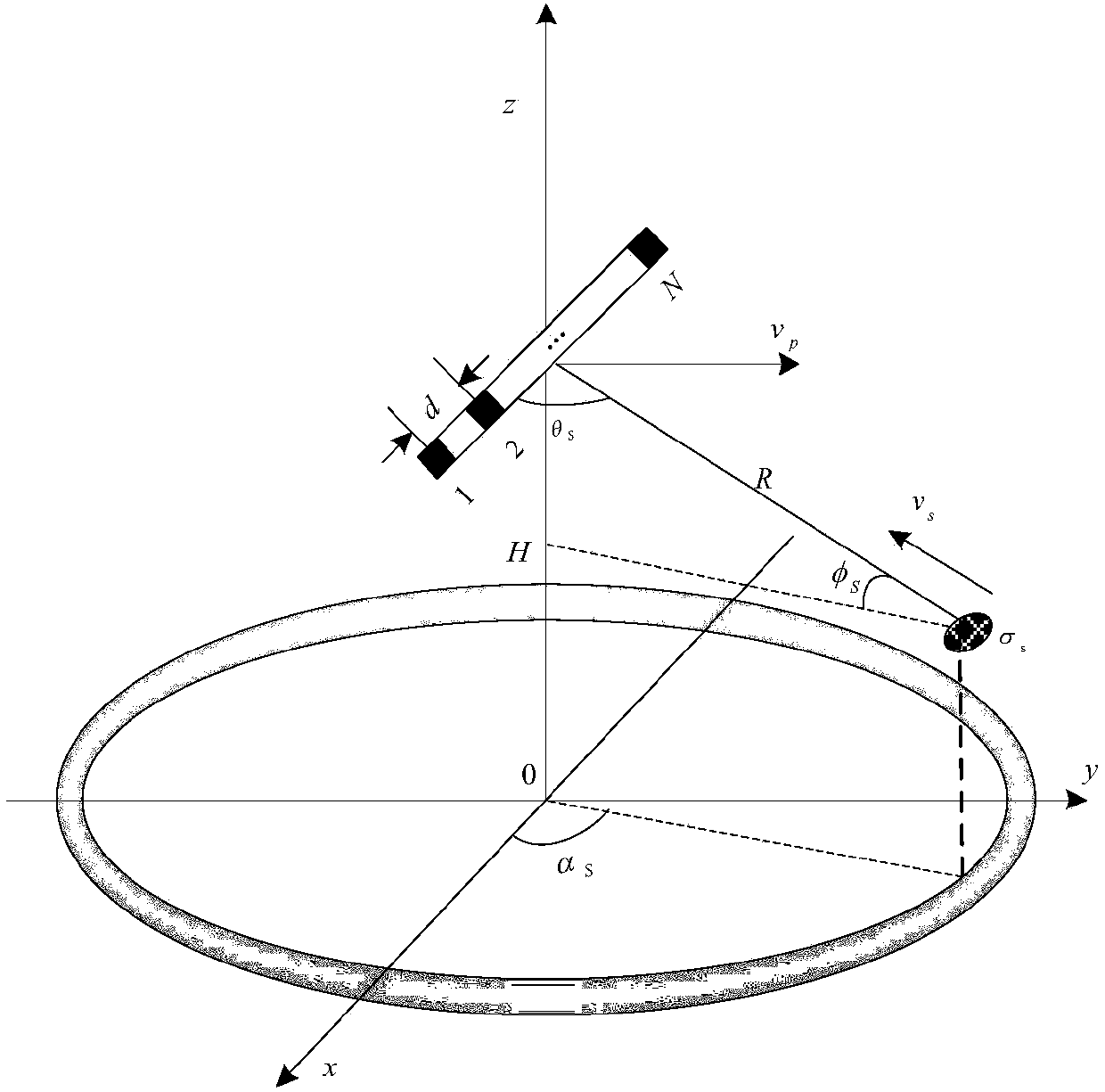
[0041] In response to this situation, the present invention has carried out research and innovation, and proposed a robust adaptive clutter suppression method for the sum-difference channel of the missile-borne radar. This invention is based on the sum-difference system, so it can use the existing sum-difference channel of the missile-borne radar The data is directly subjected to subsequent space-time processing, that is, combining airspace information and time domain information and using multiple constraints for clutter suppression and moving target detection. refer to figure 1 , the missile-borne radar and differential channel robust adaptive clutter su...
Embodiment 2
[0064] The robust adaptive clutter suppression method of the missile-borne radar and the difference channel is the same as that of Embodiment 1, and the direction matrix C in step 3.2 of the present invention Σ is the space-time steering vector S(θ i , f di ) as a column vector, expressed as:
[0065]
[0066] In the formula, the direction matrix C Σ The dimension is 2K*5,
[0067] refer to Figure 4 , Figure 4 Schematic diagram of the distribution of constrained points selected for the confinement target's approach angle and proximity Doppler in the main lobe area for the combined amplitude-phase multi-point confinement method. Constrain the target within the main lobe region Two constraint points are selected on the adjacent Doppler frequency of , where (θ 1 , f d1 ) see ① in the figure, (θ 2 , f d2 ) See ② in the figure, two constraint points are also selected on the adjacent angle, where (θ 3 , f d3 ) See ③ in the figure, (θ 4 , f d4 ) See ④ in the figur...
Embodiment 3
[0070] The robust adaptive clutter suppression method of the missile-borne radar and the difference channel is the same as that of embodiment 1-2, and the complex-valued response vector f matched with the static and beam amplitude phase response described in step 3.3 of the present invention Σ Expressed as:
[0071]
[0072] where the superscript T represents the transpose operation, α represents the magnitude of the complex-valued response vector element, and β represents the phase of the complex-valued response vector element:
[0073] alpha i =|s H (θ i , f di )s(θ 0 , f d0 )|=[a Σ H (θ i )a Σ (θ 0 )]*[b H (f di )b(f d0 )]+[a Δ H (θ i )a Δ (θ 0 )]*[b H (f di )b(f d0 )]
[0074] beta i =∠{s H (θ i , f di )s(θ 0 , f d0 )}
[0075] where α i is the magnitude of the complex-valued response vector element corresponding to the i-th constraint point, β i is the phase of the complex-valued response vector element corresponding to the i-th constrain...
PUM
 Login to View More
 Abstract
Description
Claims
Application Information
 Login to View More