This helps you quickly interpret patents by identifying the three key elements:
Problems solved by technology
Method used
Benefits of technology
Problems solved by technology
In the literature, for example, the charge transport properties of the NO-linked compound (compound 1 on page 63) are evaluated, but there is no description of the production method of materials other than the NO-linked compound. In addition, if the linked elements are different, Since the electronic state of the compound as a whole is different, the characteristics obtained from materials other than NO-linked compounds are still unknown.
Method used
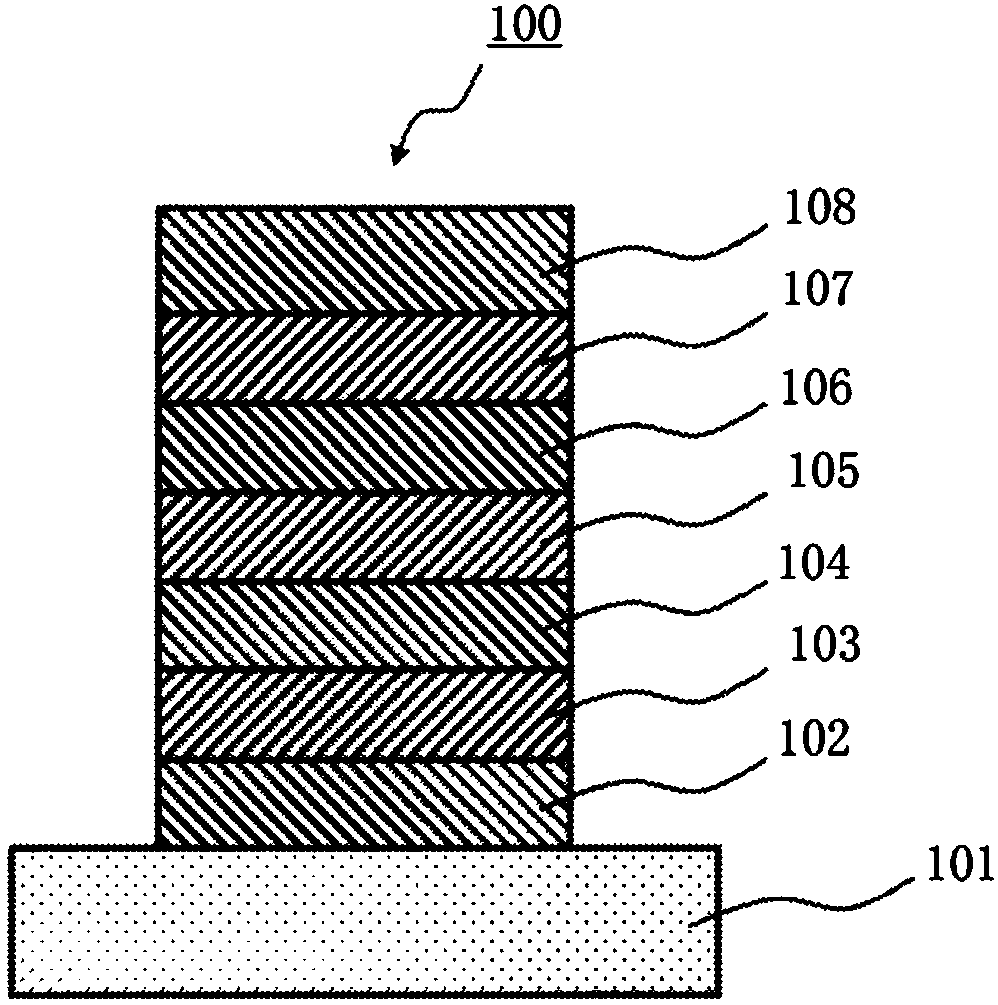
the structure of the environmentally friendly knitted fabric provided by the present invention; figure 2 Flow chart of the yarn wrapping machine for environmentally friendly knitted fabrics and storage devices; image 3 Is the parameter map of the yarn covering machine
View more
Image
Smart Image Click on the blue labels to locate them in the text.
Viewing Examples
Smart Image
Click on the blue label to locate the original text in one second.
Reading with bidirectional positioning of images and text.
Smart Image
Examples
Experimental program
Comparison scheme
Effect test
Embodiment
[0559] Hereinafter, the present invention will be explained more specifically with examples, but the present invention is not limited to these examples. First, the following describes synthesis examples of polycyclic aromatic compounds and their multimers.
Synthetic example (1
[0561] Compound (1-1152): 9-([1,1'-biphenyl]-4-yl)-5,12-diphenyl-5,9-dihydro-5,9-diaza-13b- Synthesis of Bora[3,2,1-de]anthracene
[0562] [化96]
[0563]
[0564] Under a nitrogen environment, and at 80°C, diphenylamine (37.5g), 1-bromo-2,3-dichlorobenzene (50.0g), Pd-132 (Johnson Matthey) will be added ) (0.8g), NaOtBu (32.0g), and xylene (500ml) flasks were heated and stirred for 4 hours, then heated to 120°C, and further heated and stirred for 3 hours. After the reaction liquid was cooled to room temperature, water and ethyl acetate were added for liquid separation. Then, it was purified by silica gelcolumn chromatography (developing solution: toluene / heptane = 1 / 20 (volume ratio)) to obtain 2,3-dichloro-N,N-diphenylaniline (63.0 g) .
[0565] [化97]
[0566]
[0567] In a nitrogen environment, 2,3-dichloro-N,N-diphenylaniline (16.2g), bis([1,1'-biphenyl]-4-yl)amine will be added at 120℃ (15.0g), Pd-132 (Johnson Matthey) (0.3g), NaOtBu (6.7g) and xylene (150ml) flasks were hea...
Synthetic example (2
[0576] Compound (1-422): 5,9,11,15-tetraphenyl-5,9,11,15-tetrahydro-5,9,11,15-tetraaza-19b,20b-diborin Synthesis of pentacene and [3,2,1-de:1',2',3'-jk]
[0577] [化100]
[0578]
[0579] In a nitrogen environment, 2,3-dichloro-N,N-diphenylaniline (36.0g), N 1 ,N 3 -A flask of diphenylbenzene-1,3-diamine (12.0g), Pd-132 (Johnson Matthey) (0.3g), NaOtBu (11.0g) and xylene (150ml) was heated and stirred for 3 hours. After cooling the reaction liquid to room temperature, water and ethyl acetate were added for liquid separation. Then, purification was performed by silica gelcolumn chromatography (developing solution: toluene / heptane mixed solvent). At this time, slowly increase the ratio of toluene in the developing solution to elute the target. Furthermore, it was purified by activated carboncolumn chromatography (developing solution: toluene) to obtain N 1 ,N 1' -(1,3-phenylene)bis(2-chloro-N 1 ,N 3 ,N 3 -Triphenylbenzene-1,3-diamine) (22.0 g).
[0580] [化101]
[0581]
[0582] In ...
the structure of the environmentally friendly knitted fabric provided by the present invention; figure 2 Flow chart of the yarn wrapping machine for environmentally friendly knitted fabrics and storage devices; image 3 Is the parameter map of the yarn covering machine
Login to View More
PUM
Property
Measurement
Unit
electron work function
aaaaa
aaaaa
wavelength
aaaaa
aaaaa
external quantum efficiency
aaaaa
aaaaa
Login to View More
Abstract
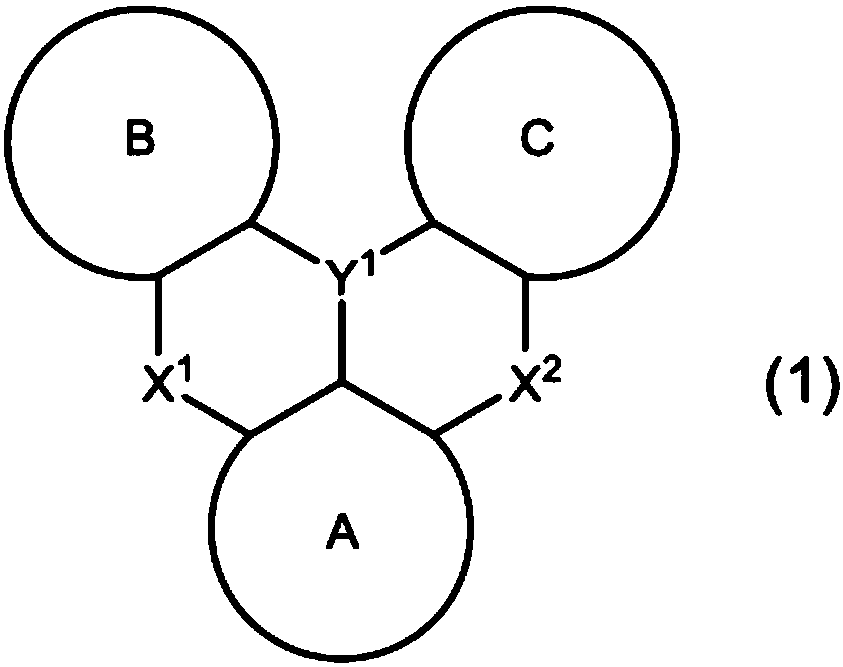
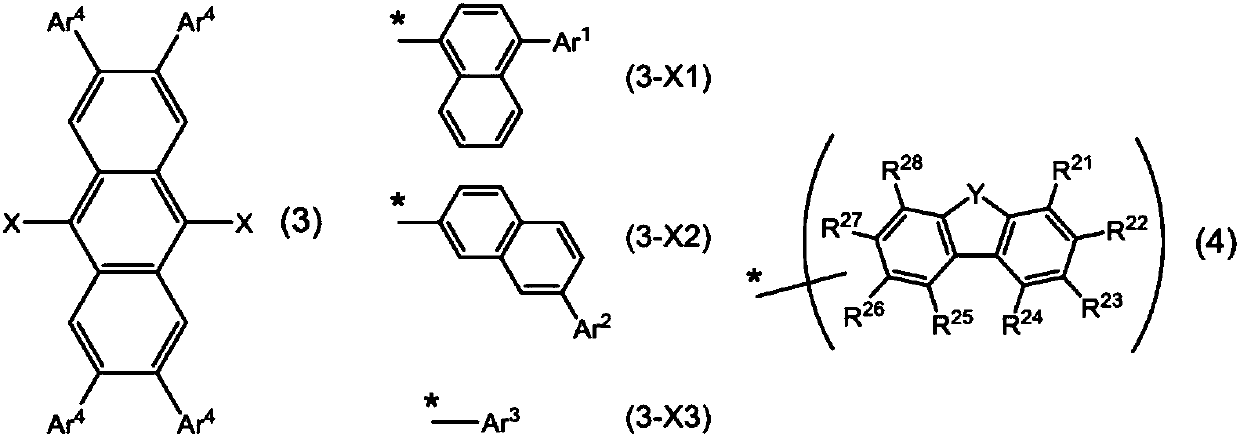
The present invention relates to a light-emission-layer material comprising: a novel polycyclic aromatic compound (1) in which a plurality of aromatic rings are linked by a boron atom and a nitrogen atom; and a specific anthracene-based compound (3) that achieves optimum light-emission characteristics in combination with said polycyclic aromatic compound. With this light-emission-layer material having optimum light-emission characteristics, it is possible to provide an excellent organic EL element. Ring A to ring C are an aryl ring or the like, X is a group represented by formula (3-X1), formula (3-X2), or formula (3-X3), and Ar1 to Ar4 are phenyl, a group represented by formula (4), or the like.
Description
Technical field [0001] The present invention relates to an organic electroluminescent element including a light-emitting layer containing a polycyclic aromatic compound or a polymer thereof as a dopant material, and a host material, and a display device and a lighting device using the same. The specific anthracene compounds. Background technique [0002] In the past, various researches have been conducted on display devices using light-emitting elements that perform electroluminescence because they can achieve power saving or thinning. Furthermore, organic electroluminescence elements containing organic materials (hereinafter, organic electroluminescence (EL) elements) ) It has been actively researched because it is easy to lighten or increase in size. In particular, with regard to the development of organic materials with luminescence characteristics such as blue, which is one of the three primary colors of light, and the combination of multiple materials that have the most sui...
Claims
the structure of the environmentally friendly knitted fabric provided by the present invention; figure 2 Flow chart of the yarn wrapping machine for environmentally friendly knitted fabrics and storage devices; image 3 Is the parameter map of the yarn covering machine
Login to View More
Application Information
Patent Timeline
Application Date:The date an application was filed.
Publication Date:The date a patent or application was officially published.
First Publication Date:The earliest publication date of a patent with the same application number.
Issue Date:Publication date of the patent grant document.
PCT Entry Date:The Entry date of PCT National Phase.
Estimated Expiry Date:The statutory expiry date of a patent right according to the Patent Law, and it is the longest term of protection that the patent right can achieve without the termination of the patent right due to other reasons(Term extension factor has been taken into account ).
Invalid Date:Actual expiry date is based on effective date or publication date of legal transaction data of invalid patent.



 Login to View More