

Molecular marker linked with drought-resistant rice gene qLRI9, and application thereof
A technology of rice and drought tolerance, applied in the field of agricultural biotechnology engineering, can solve the problem of greatly improving the level of drought tolerance of rice, and achieve the effect of overcoming long time period and strong reliability
- Summary
- Abstract
- Description
- Claims
- Application Information
AI Technical Summary
Problems solved by technology
Method used
Image



Examples
Embodiment 1
[0048] Example 1. Acquisition of Rice Drought Tolerance Gene qLRI9 and Its Closely Linked Molecular Markers
[0049] 1. Mapping of Drought Tolerance QTL and Acquisition of Rice Drought Tolerance Gene qLRI9
[0050] 1. Test materials
[0051]The F 10 The recombinant inbred line population (RIL) was used as the targeting population.
[0052] 2. Genotype identification
[0053] The test materials were planted in the Beijing Changping Experimental Base, and the young rice leaves were clipped, and the genome-wide DNA extraction was carried out according to Doyle and Dickson (1987) with a slightly improved method of cetyltriethylammonium bromide (CTAB). 178 pairs of SSR primers with good amplification effect, polymorphism between parents and uniform distribution in 12 linkage groups were screened out for genotype identification of the mapping population.
[0054] The PCR reaction system is as follows: 10×PCR buffer (containing Mg 2+ ) 1.0μl, 10mM dNTP Mixture 0.25μl, 10pM / μl pr...
Embodiment 2
[0085] Embodiment 2, rice drought tolerance identification method
[0086] The method for identifying the drought tolerance of rice to be tested provided by the invention is as follows:
[0087] 1. Extract the genomic DNA of the rice to be tested, use the genomic DNA as a template, and perform PCR amplification with the RM24598 molecular marker to obtain a PCR product;
[0088] The PCR reaction system is as follows: 10×PCR buffer (containing Mg 2+ ) 1.0μl, 10mM dNTP Mixture 0.25μl, 10pM / μl primer 0.25μl, 0.5U / μl Taq polymerase 0.25μl, 40ng / μl genomic DNA 1.0μl, ddH 2 O to make up to 10 μl.
[0089] The PCR reaction conditions were as follows: pre-denaturation at 94°C for 5 min; denaturation at 94°C for 30 s, annealing at 55°C for 30 s, extension at 72°C for 40 s, 36 cycles; extension at 72°C for 10 min.
[0090] 2. Identify the drought tolerance of the rice to be tested according to the size of the PCR product:
[0091] If the size of the PCR product is 110bp, the rice to ...
Embodiment 3
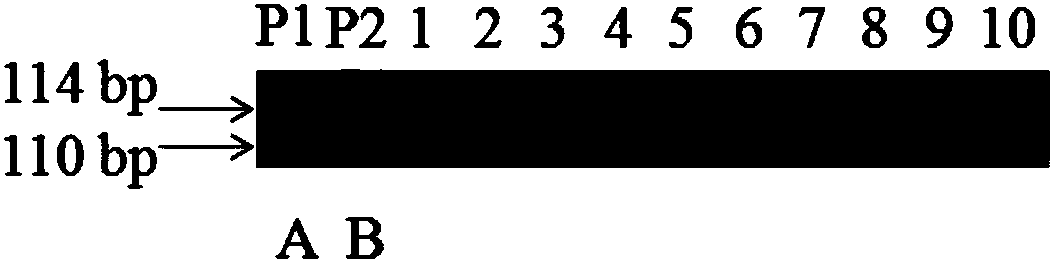
[0096] Example 3, Application of RM24598 Molecular Marker in the Identification of Rice Variety Drought Tolerance
[0097] 1. Test materials
[0098] The tested materials were Huakewagu, Dalisha, Yunchuanbai, Xiaomizao, Taipei 8, Huangbansuo, Heidagu, Jinxing 1, Guichao 2 and Manpixianghong glutinous rice.
[0099] 2. Identification of Drought Tolerance
[0100] According to the method in Step 3 of Example 1, the drought tolerance of the test materials in Step 1 was identified.
[0101]The results are shown in Table 4. It can be seen from the table that among the 10 rice varieties, Taipei No. 8 and Huangbansuo have a leaf curl degree of 7, both of which are rice varieties with weak drought tolerance, and Jinxing No. 1 has a leaf curl degree of 5, which indicates drought tolerance. Among the rice varieties, the remaining 7 rice varieties Huakewagu, Dalisha, Yunchuanbai, Xiaomizao, Heidagu, Guichao No. 2 and Manpixianghong glutinous rice are all drought-tolerant. Strong rice...
PUM
 Login to View More
 Abstract
Description
Claims
Application Information
 Login to View More