A Current Mode Array Spad Gain Uniformity Adaptive Control Circuit

An adaptive control, current-mode technology, applied in the field of single-photon detection, can solve problems such as circuit complexity, weakening, nonlinear SPAD detection sensitivity, etc., to simplify work, reduce power consumption and area overhead, and achieve gain consistency The effect of detection

CN108874020BActive Publication Date: 2020-01-03SOUTHEAST UNIV
5 Cites 0 Cited by

Patent Information

Authority / Receiving Office
CN · China
Patent Type
Patents(China)
Current Assignee / Owner
Publication Date
2020-01-03

Smart Images

  • Figure 1
    Figure 1
  • Figure 2
    Figure 2
  • Figure 3
    Figure 3
Patent Text Reader

Abstract

The invention discloses a current mode array SPAD gain uniformity self-adaptation control circuit. The current mode array SPAD gain uniformity self-adaptation control circuit comprises a public current bias module and a plurality of single-pixel circuits corresponding to the number of SPAD pixel units in the array SPAD, wherein each single-pixel circuit comprises a current monitoring module and anactive quenching module; the current monitoring modules are composed of operational amplifiers and current mirrors, the active quenching modules are composed of comparators and quenching pipes, and used for being triggered to work according to the output voltage signals of the current monitoring modules and controlling the quenching pipes to generate avalanche quenching signals; and the current monitoring modules are composed of the operational amplifiers OPi, the cascode current mirrors composed of PMOS pipe M4_i and PMOS pipe M5_i, and the current mirrors composed of NMOS pipe Mi_L and NMOSpipe Mi_R. A current mode method is adopted to self-adaptively control the reversed bias voltage of SPAD, the problem of gain uniformity of the array SPAD is inhibited, meanwhile the defect that a traditional voltage mode circuit is complex is overcome, and the area and power consumption are reduced.
Need to check novelty before this filing date? Find Prior Art

Description

technical field

[0001] The invention relates to a current mode array SPAD gain uniformity adaptive control circuit, which belongs to the technical field of single photon detection. Background technique

[0002] Avalanche photodiodes (APDs) have the advantages of small weight, low power consumption, high quantum efficiency, insensitivity to magnetic fields and radiation, and easy integration. Photon Avalanche Photodiode (SPAD). Therefore, the APD-based single-photon detection system has become an important research direction, which can be used in related fields such as lidar three-dimensional imaging, environmental detection, national defense security, and medical detection.

[0003] At present, single-photon detectors are developing in the direction of integration, miniaturization, and arraying. Especially with the continuous expansion of array detection applications, higher requirements are placed on the uniformity of detectors. For array SPADs, due to the influence of pr...

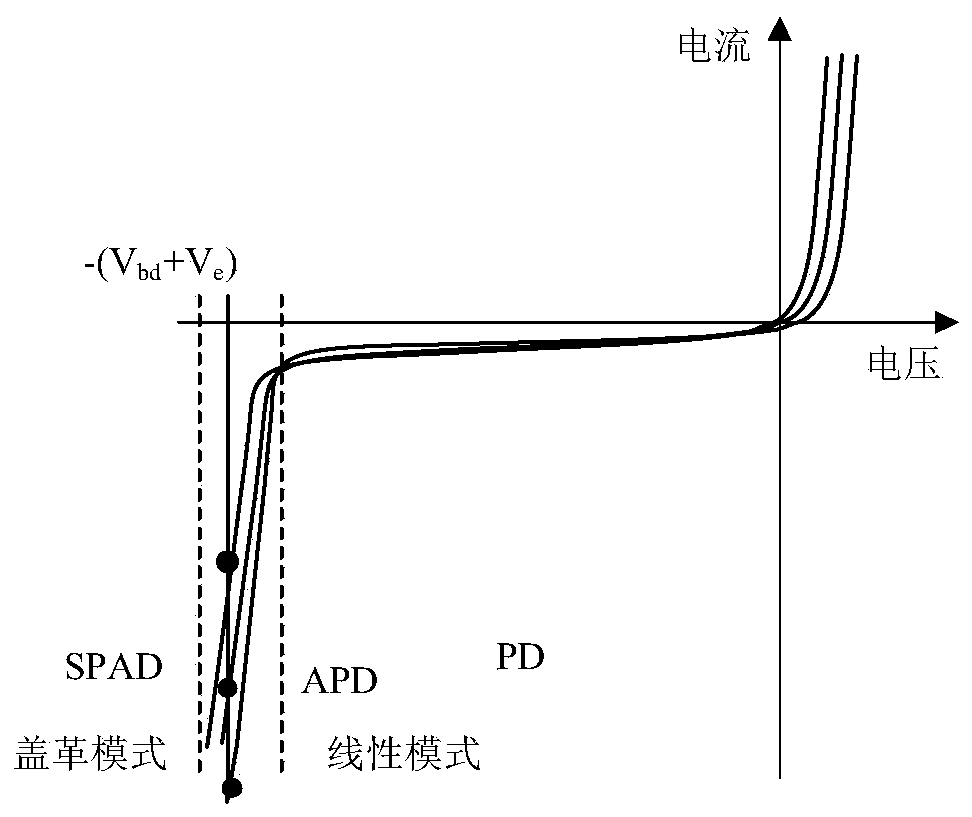
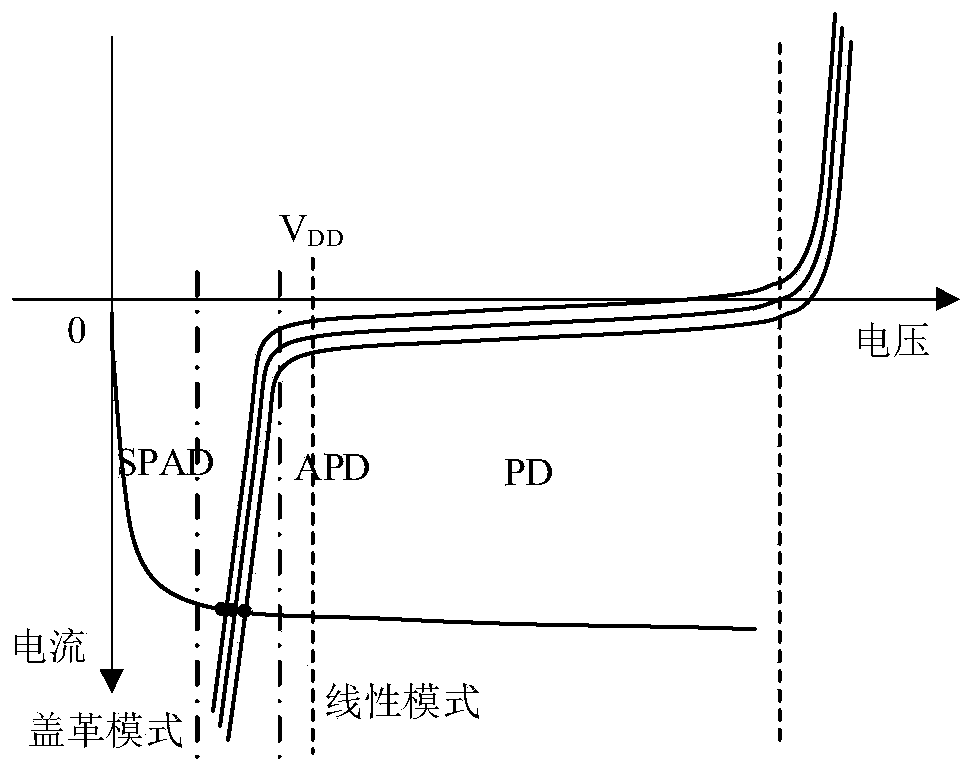
Examples

Embodiment Construction

[0026] Embodiments of the present invention will be described below in conjunction with the accompanying drawings.

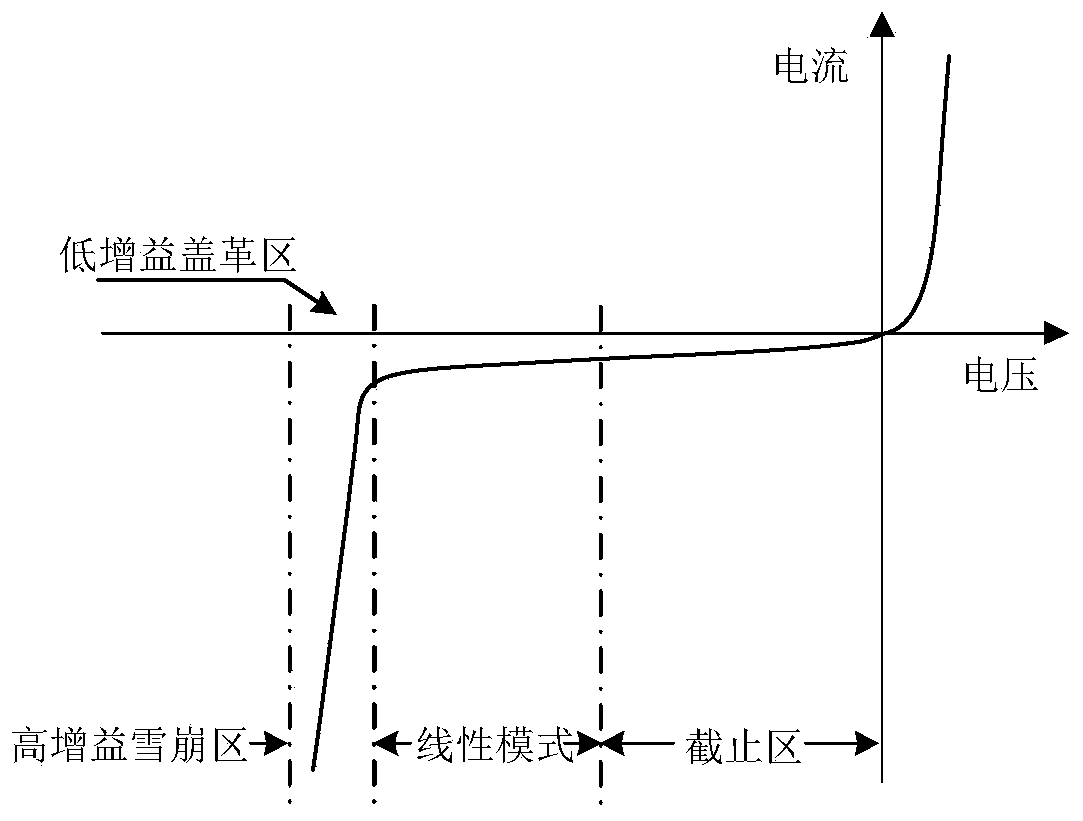
[0027] The V-I characteristic curve of an avalanche photodiode is as figure 1 As shown, its voltage and current have a nonlinear relationship, and the working region of the diode can be divided into a cut-off region, a linear region, a low-gain Geiger region and a high-gain avalanche region, and its gain characteristics are reflected by the current of the diode. In the present invention, based on The gain calibration circuit of the current mode realizes the adaptive control of the gain by detecting the current change of the SPAD detector.

[0028] The V-I characteristic curve of an avalanche photodiode is steep in Geiger mode, as figure 2 As shown, in this mode, when the reverse bias voltage changes slightly, the reverse bias current will change dramatically. Due to the discreteness of the process, if the SPAD array is simply operated under the same reverse b...