
A needle for mouse tail vein injection and its manufacturing method and experimental application
A technology of tail vein injection and needles, which is applied in syringes, veterinary instruments, infusion sets, etc., can solve problems such as unstable needles, easy twisting of mice, and increased experimental costs, so as to avoid unstable needles, Facilitate tail vein injection and shorten the time of needle insertion
- Summary
- Abstract
- Description
- Claims
- Application Information
AI Technical Summary
Problems solved by technology
Method used
Image


Examples
Embodiment 1
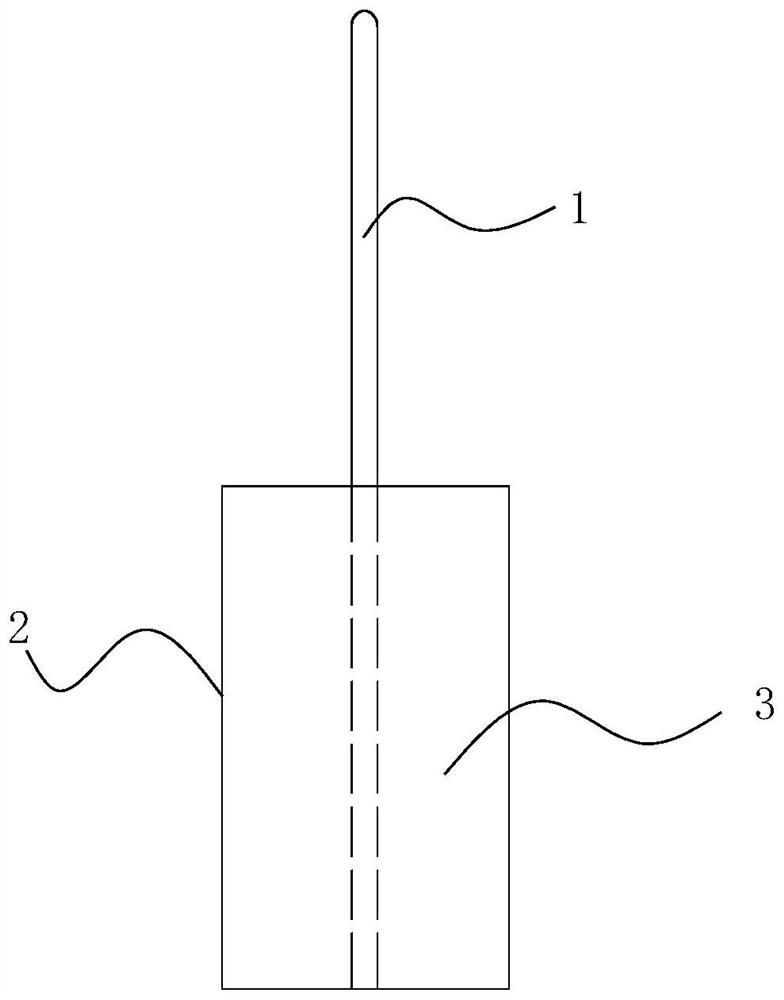
[0027] Such as figure 1 A mouse tail vein injection needle as shown comprises a needle body 1, and the needle body 1 is fixedly connected with a thin sheet 2, and the thin sheet 2 is folded and pressed and fixed on the needle body, and the needle body is formed on the needle body. The left and right symmetrical side wings 3 of the needle body, one end of the side wing 3 is located at the midpoint of the needle body 1 , and the other end is located at the bottom of the needle body 1 .
[0028] In this embodiment, the length of the side wings 3 is 50% of the length of the needle body, and according to actual needs, it is between 45% and 55%, preferably 50%. Within this ratio range, it can effectively ensure the smooth insertion of the needle .
[0029] In this embodiment, the width of the left and right ends of the wing 3 is 2mm, of course, it can fluctuate between 1.9-2.1mm according to actual needs, preferably 2mm.
[0030] In this embodiment, the sheet 2 is stainless steel ...
Embodiment 2
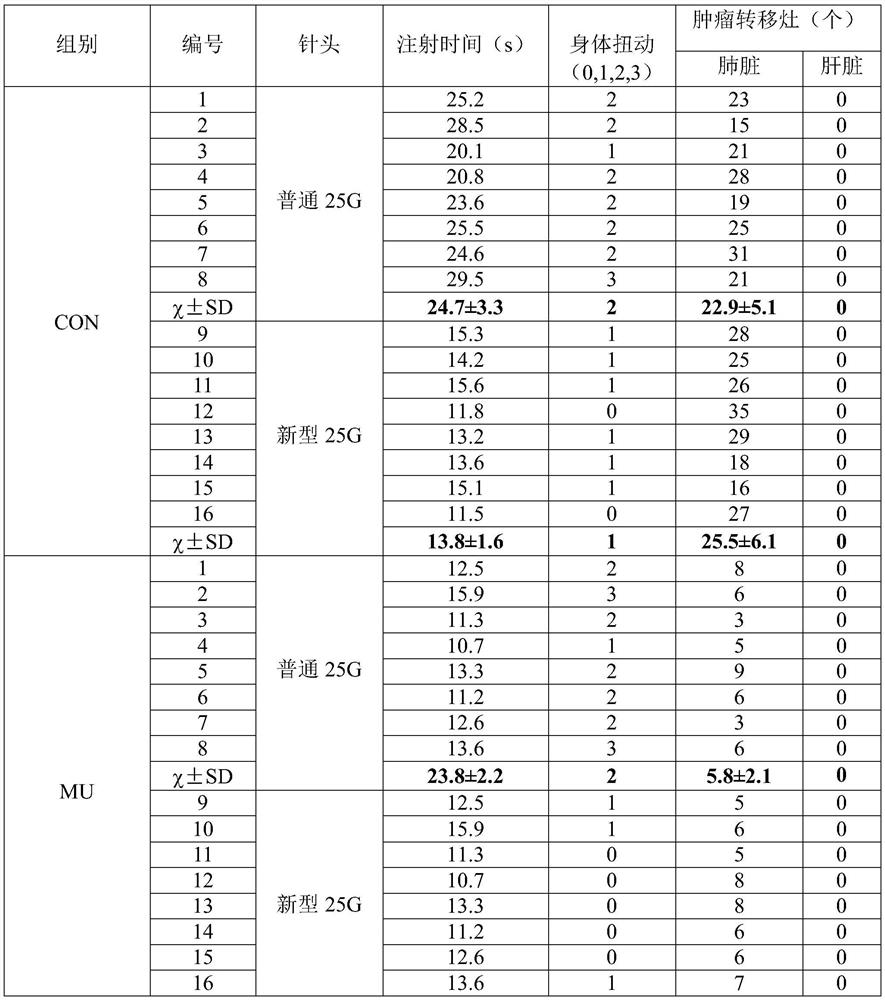
[0032] Using the mouse tail vein injection needle mentioned in Example 1 to carry out breast cancer cell metastasis experiment on mutant mice, the specific operation steps are as follows:
[0033] 1) Divide 32 female SPF Scid mice into two groups of CON and MU, 16 in each group, weighing 14-16g, and cut their ears respectively for marking.
[0034] 2) The human breast cancer cell line MDA-MB-231 and its mutant cell line MDA-MB-231MU were respectively configured as 5×10 6 / ml of cell suspension.
[0035] 3) Each CON group mouse was injected with 0.2ml of MDA-MB-231 cell suspension into the tail vein, among which, 8 mice were injected with a disposable 1ml syringe with a traditional medical 25G injection needle, and the other 8 mice were injected with a disposable 1ml syringe Inject with a new type of needle, record the injection time (unit: s) of each mouse, and compare the twisting range of the mouse body and the success rate of injection when the two needles are injected.
...
Embodiment 3
[0047] Using the mouse tail vein injection needle mentioned in Example 1 to carry out breast cancer cell metastasis experiment on mutant mice, the specific operation steps are as follows:
[0048]1) Divide 32 female nude mice of SPF grade into two groups of CON and MU, with 16 mice in each group, weighing 14-16g, and cut their ears respectively for marking.
[0049] 2) The human breast cancer cell line MCF-7 and its mutant cell line MCF-7MU were respectively configured as 8×10 6 / ml of cell suspension.
[0050] 3) Each mouse in the CON group was injected with 0.2ml of MCF-7 cell suspension into the tail vein, 8 of them were injected with a disposable 1ml syringe with a traditional medical 25G injection needle, and the other 8 were injected with a disposable 1ml syringe with a new For needle injection, the injection time (unit: s) of each mouse was recorded respectively, and the twisting range of the mouse body and the success rate of bolus injection were compared between the ...
PUM
 Login to View More
 Abstract
Description
Claims
Application Information
 Login to View More