
Method for producing acetification-grade dissolving pulp by using veneer
A technology for dissolving pulp and board skin, which is applied in the direction of pulping with organic compounds, pulping with inorganic alkalis, and cellulose treatment with microorganisms/enzymes, etc., to achieve the effect of cleaning the production process
- Summary
- Abstract
- Description
- Claims
- Application Information
AI Technical Summary
Problems solved by technology
Method used
Image

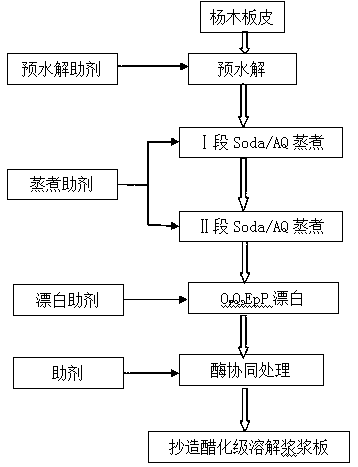
Examples
Embodiment 1
[0030] Prehydrolysis with Additives - Soda / AQ Staged Cooking with Additives - O P Q D EpP-enzyme synergistic process to treat poplar veneer raw material: Take 500g of poplar veneer slices from a certain factory, 10-30mm long, with a pentosan content of 24.3% and an α-cellulose content of 43.0%.
[0031] The pre-hydrolysis process conditions for controlling the addition of additives are: liquid ratio 1: 6, additives 0.4%, maximum temperature 160°C, holding time 60 minutes, the content of pentosan after hydrolysis is 8.6%, and the hydrolysis yield is 80%;
[0032]The process conditions of Soda / AQ cooking stage I are: the amount of alkali used is 5%, the liquid ratio is 1:4, magnesium hydroxide is 0.5%, sodium sulfite is 5.0%, the amount of AQ is 0.05%, Tmax=100℃±2℃, holding time 60 minutes;
[0033] The process conditions of Soda / AQ cooking stage II are: the amount of alkali used is 18%, magnesium hydroxide is 0.5%, sodium sulfite is 3.0%, the liquid ratio is 1:7, the amount o...
Embodiment 2
[0042] Prehydrolysis with Additives - Soda / AQ Staged Cooking with Additives - O P Q D EpP-enzyme synergistic process to treat the raw material of poplar veneer, the content of pentosan in the obtained poplar veneer is 22.3%, the content of α-cellulose is 45.0%, and the process conditions are the same as in Example 1. The α-cellulose content that obtains poplar bark vinegar grade dissolving pulp is 97%, polypentose is 2.2%, degree of polymerization 1280, whiteness 90%ISO, ash content 0.01%, DCM extract content 0.02%, vinegar Chemical reaction value (PV value) 820.
[0043] Poplar veneer vinegar-grade dissolving pulp has good detection indexes and can be used to produce high-grade cellulose acetate products.
Embodiment 3
[0045] Prehydrolysis with Additives - Soda / AQ Staged Cooking with Additives - O P Q D EpP-enzyme synergistic process to treat the poplar veneer raw material, the poplar veneer obtained is the same as that in Example 1. Only the pre-hydrolysis holding time was changed to 120 minutes, the content of pentosan after hydrolysis was 8.5%, and the hydrolysis yield was 79%, and other processes remained unchanged. The α-cellulose content of the finally obtained poplar veneer vinegar grade dissolving pulp is 97%, the polypentose is 2.2%, the degree of polymerization is 1200, the whiteness is 89%ISO, the ash content is 0.01%, and the DCM extract content is 0.02%. The esterification reaction value (PV value) is 780.
PUM
| Property | Measurement | Unit |
|---|---|---|
| aggregation | aaaaa | aaaaa |
| degree of polymerization | aaaaa | aaaaa |
| whiteness | aaaaa | aaaaa |
Abstract
Description
Claims
Application Information
 Login to View More