
Heat pump system achieving double-medium PVT coupling nocturnal radiation, control method and intelligent household electrical appliance
A control method and dual-medium technology, applied in the direction of machine operation, refrigerators, refrigeration components, etc., can solve the problems of being unable to meet the stable needs of users, reducing the use efficiency, and large fluctuations in the energy source of the PV/T system. Achieve the effects of improving equipment utilization and space utilization, reducing system energy consumption, and overcoming damage to pipelines and heat collectors
- Summary
- Abstract
- Description
- Claims
- Application Information
AI Technical Summary
Problems solved by technology
Method used
Image

Examples
Embodiment 1
[0020] Embodiment 1: A heat pump system with double-medium PVT coupled with nighttime radiation.
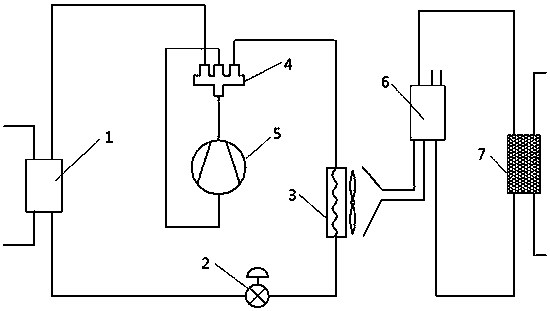
[0021] A dual-medium PVT coupled heat pump system for nighttime radiation, including a first heat exchanger, an electronic expansion valve, an air source heat exchanger, a four-way reversing valve, a compressor, a PVT assembly, and a heat storage tank. The heat exchanger is connected to the compressor through the four-way reversing valve, the air source heat exchanger is connected to the four-way reversing valve, and the air source heat exchanger is connected to the first heat exchanger , the electronic expansion valve is arranged on the connecting pipeline between the air source heat exchanger and the first heat exchanger, the PVT assembly is connected with the air source heat exchanger, and the PVT assembly is connected with the heat storage tank. PVT components include air channels and liquid channels, and the night radiation function is coupled to the PVT components. By combi...
Embodiment 2
[0022] Embodiment 2: A heat pump control method with double-medium PVT coupled with nighttime radiation.
[0023] A heat pump control method with double-medium PVT coupling nighttime radiation, the specific steps are as follows:
[0024] In the cooling mode, the daytime operation mode, the PVT assembly 6 is used for making hot water, and the air source heat exchanger 3 is used for cooling. The circulating water enters the heat storage tank 7 after absorbing heat in the PVT assembly 6, and stores the heat in the water tank for use by users. The refrigerant in the first heat exchanger 1 absorbs the heat of the room and enters the compressor 5 through the four-way reversing valve 4 for compression, and then enters the air source heat exchanger 3 to release heat, and then enters the first refrigerant through the electronic expansion valve 5 again after heat release. Heat exchanger 1 performs the next cycle.
[0025] The PVT module has separate air passages and liquid passages. ...
Embodiment 3
[0026] Embodiment 3: A heat pump control method with double-medium PVT coupled with nighttime radiation.
[0027] A heat pump control method with double-medium PVT coupling nighttime radiation, the specific steps are as follows:
[0028] In the cooling mode, the night operation mode, the PVT assembly 6 is used to produce cold air, and the air source heat exchanger 3 is used for refrigeration. The refrigerant in the first heat exchanger 1 absorbs the heat of the room and enters the compressor 5 through the four-way reversing valve 4 for compression, and then enters the air source heat exchanger 3 to release heat, and then enters the first air source heat exchanger 2 again through the electronic expansion valve 2 Heat exchanger 1 performs the next cycle. The cold air produced by the PVT assembly 6 leads to the air source heat exchanger 3 for exchanging heat with the refrigerant to reduce the fan energy consumption of the air source heat exchanger 3 .
[0029] When the PVT modu...
PUM
 Login to View More
 Abstract
Description
Claims
Application Information
 Login to View More