

Anti-CD123 nano antibody and application thereof
A nanobody and chimeric antigen receptor technology, applied in the field of biomedicine, can solve problems such as failure to achieve ideals, and achieve high affinity effects
- Summary
- Abstract
- Description
- Claims
- Application Information
AI Technical Summary
Problems solved by technology
Method used
Image

Examples
Embodiment 1
[0072] Example 1 Construction, panning and ELISA preliminary screening of phage nanobody library
[0073] (1) Construction of phage nanobody library
[0074] In this example, the Bactrian camel was first immunized with the extracellular region of the CD123 antigen, and after the titer was verified by ELISA, 200 mL of peripheral blood was extracted; lymphocytes were sorted from the peripheral blood, and peripheral blood mononuclear lymphocyte precipitates were obtained for RNA extraction;
[0075] Using the extracted RNA as a template, the Synthesize the first-strand cDNA with reverse transcriptase, and then use nested PCR to amplify the VHH gene; insert the amplified VHH gene into the pMECS phage display vector, electrotransform TG1 competent cells, take an appropriate amount of bacterial liquid for library identification, and the remaining Spread the culture evenly on the LB / AMPGLU plate;
[0076] After the bacteria grow, collect the lawn, add 1 / 3 volume of 50% glycerin, mix...
Embodiment 2
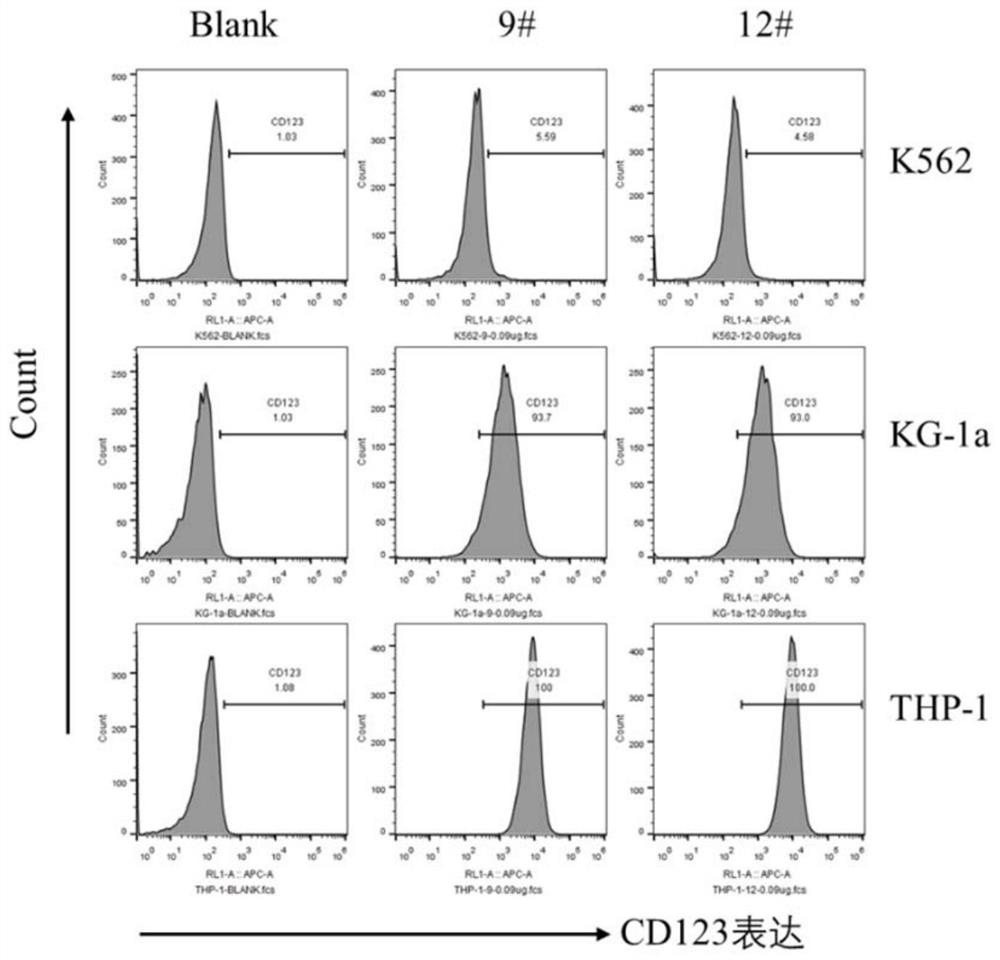
[0089] Example 2 FACS screening candidate clones
[0090] In this example, cell culture was carried out according to the standard cell culture protocol:
[0091] Use trypsin to digest the cells, prepare CD123-positive cells or CD123-negative cell suspensions, centrifuge at 300g for 5 minutes to remove the culture medium, and resuspend the cells with Flow Buffer to a cell concentration of 2×10 6 a / mL;
[0092] Add 2 × 10 to each well in a V-bottom 96-well plate 5 Centrifuge at 300g for 5 minutes to remove the supernatant, add VHH antibody crude extract to resuspend the cells, and incubate at 4°C for 1 hour;
[0093] Centrifuge at 300g for 5 minutes to remove the supernatant, resuspend the cells in Flow Buffer, add 100 μL of APC anti-his antibody (2 μg / mL) diluted in Flow Buffer, and incubate at 4°C for 1 hour;
[0094] After washing the cells 3 times with Flow Buffer, resuspend the cells in 200 μL Flow Buffer for flow cytometric detection.
Embodiment 3
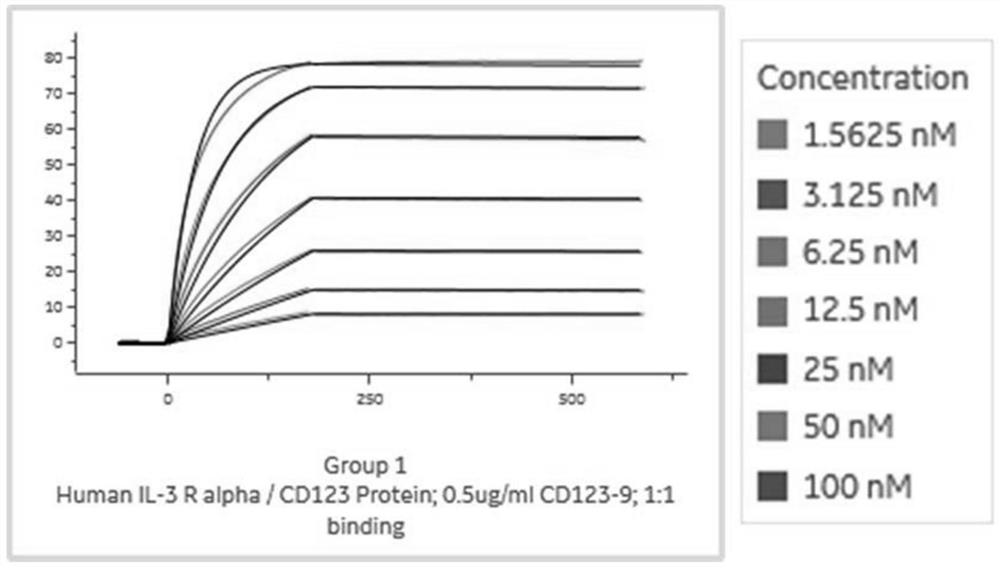
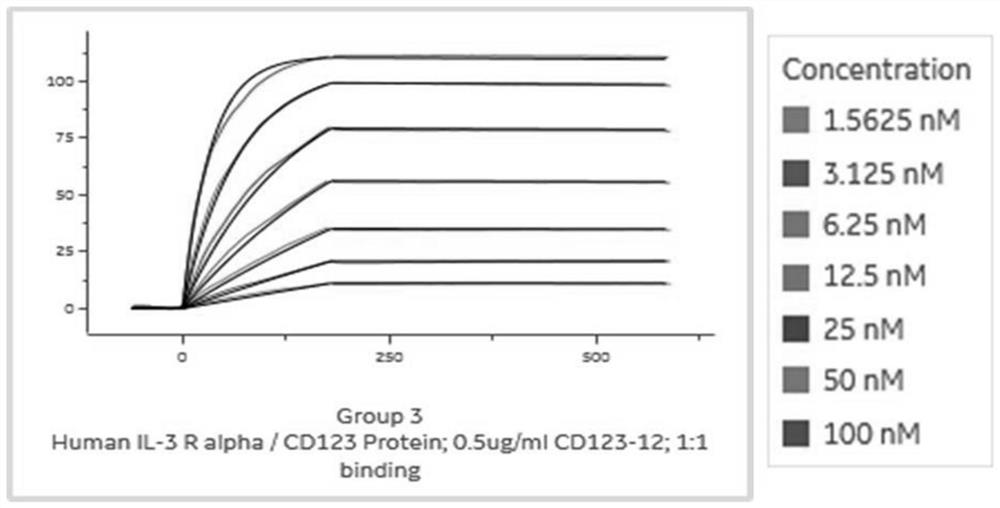
[0095] Example 3 Expression, purification and affinity determination of VHH-mIgG2a Fc nanobody
[0096] In order to further identify the screened antibodies, this example constructs the vector C-4pCP.Stuffer-mCg2a-FC expressing VHH (with mouse Fc tag), the steps are as follows:
[0097] PCR amplification anti-CD123 heavy chain variable region coding gene, wherein, the upstream primer of CD123-9 (SEQ ID NO:6) is HD-F, the downstream primer is HD-B12-R2, CD123-12 (SEQ ID NO:6) 7) The upstream primer is HD-F, the downstream primer is HD-CD-12-R, the sequence is shown in Table 2, the PCR reaction system is shown in Table 3, and the reaction conditions are pre-denaturation at 95°C for 1min and denaturation at 95°C for 10s , 55°C annealing 10s, 72°C extension 10s, 30 cycles, 72°C extension 5min, 4°C storage.
[0098] Table 2
[0099]
[0100] table 3
[0101]
[0102] The empty vector was digested at 37°C for 6 hours, the system is shown in Table 4, and the digested vector ...
PUM
 Login to View More
 Abstract
Description
Claims
Application Information
 Login to View More