Oligonucleotide chain random splicing method
An oligonucleotide and long-chain technology, applied in nucleotide libraries, protein nucleotide libraries, organic compound libraries, etc., can solve the problems of inapplicability and inapplicability of multi-fragment splicing, and achieve large storage capacity and guaranteed sequence The effect of polymorphism
- Summary
- Abstract
- Description
- Claims
- Application Information
AI Technical Summary
Problems solved by technology
Method used
Image

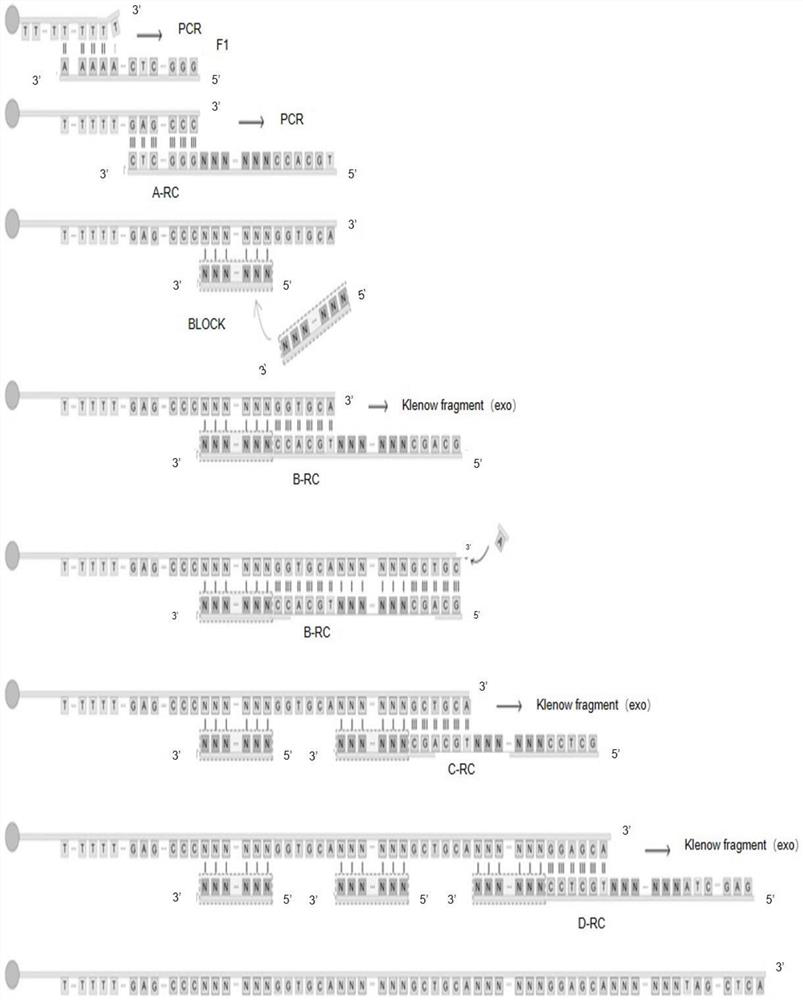


Examples
Embodiment 1
[0102] The splicing of embodiment 1 oligonucleotide chain
[0103] In this embodiment, six 12nt DNA fragments are used as oligonucleotide chains to be assembled, and any four oligonucleotide chains (named A, B, C, D) are randomly assembled. The basic process is: use magnetic beads as For the carrier, first connect Smart3_RC to the oligo-dT of the magnetic beads, then connect A, B, C, and D to the magnetic beads in different order, and finally use AdrecF primers and CDSIII_RC primers to combine the spliced long-chain oligonucleotides acid for amplification. The structure of the assembled long-chain oligonucleotide is: oligonucleotide chain A-the first linker-oligonucleotide chain B-the second linker-oligonucleotide chain C-the third linker-oligonucleotide For the nucleotide chain D, the sequences (5'-3') of the first linker, the second linker and the third linker used are GGTGCA, GCTGCA, and GGAGCA, respectively.
[0104] The specific random stitching method is as follows, ...
experiment example
[0182] The random oligonucleotide chain library constructed in the above-mentioned examples and comparative examples was tested for splicing efficiency, storage capacity and polymorphism. The specific process is as follows:
[0183] 1. Library concentration detection
[0184] The spliced final products obtained by PCR amplification cycles of 20 and 33 cycles in Step 9 in Example 1 and Comparative Example 1 were detected by agarose gel electrophoresis. The result is as image 3 As shown, when there is no linker in Comparative Example 1, there is still no clear product band after 33 cycles of amplification, indicating that the product of successful splicing cannot be obtained without a linker, and the splicing efficiency is 0, so subsequent cloning and sequencing detection are not performed ; while embodiment 1 amplified 20 cycles and 33 cycles of the spliced final product obtained clear bands can be seen, indicating that the content of the final product is about 100ng.
...
PUM
 Login to View More
 Abstract
Description
Claims
Application Information
 Login to View More
 - R&D
- Intellectual Property
- Life Sciences
- Materials
- Tech Scout
- Unparalleled Data Quality
- Higher Quality Content
- 60% Fewer Hallucinations
Browse by: Latest US Patents, China's latest patents, Technical Efficacy Thesaurus, Application Domain, Technology Topic, Popular Technical Reports.
© 2025 PatSnap. All rights reserved.Legal|Privacy policy|Modern Slavery Act Transparency Statement|Sitemap|About US| Contact US: help@patsnap.com