Specimen having capability of separating solid component
A test piece and solid technology, applied in the field of chemical analysis of biological materials, can solve the problems of deviation, difficulty and complexity of the concentration distribution of the tested substance
- Summary
- Abstract
- Description
- Claims
- Application Information
AI Technical Summary
Problems solved by technology
Method used
Image

Examples
Embodiment 1
[0092] First, the bottom layer will be described. In Examples of the present invention, Milli-Q water obtained by treating distilled water in Milli-Q Labo (manufactured by Nippon Millipore Co., Ltd.) was used. The distilled water was produced by using a pure water producing apparatus Autostill WG 220 type (manufactured by Yamato Scientific Co., Ltd.).
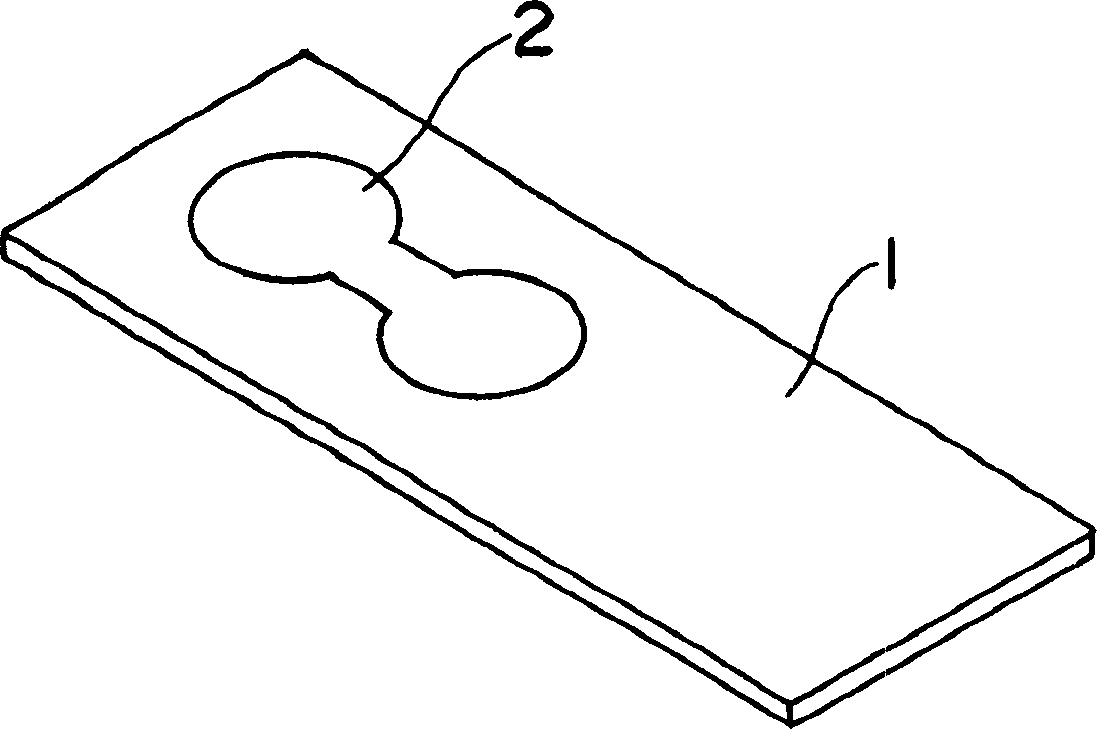
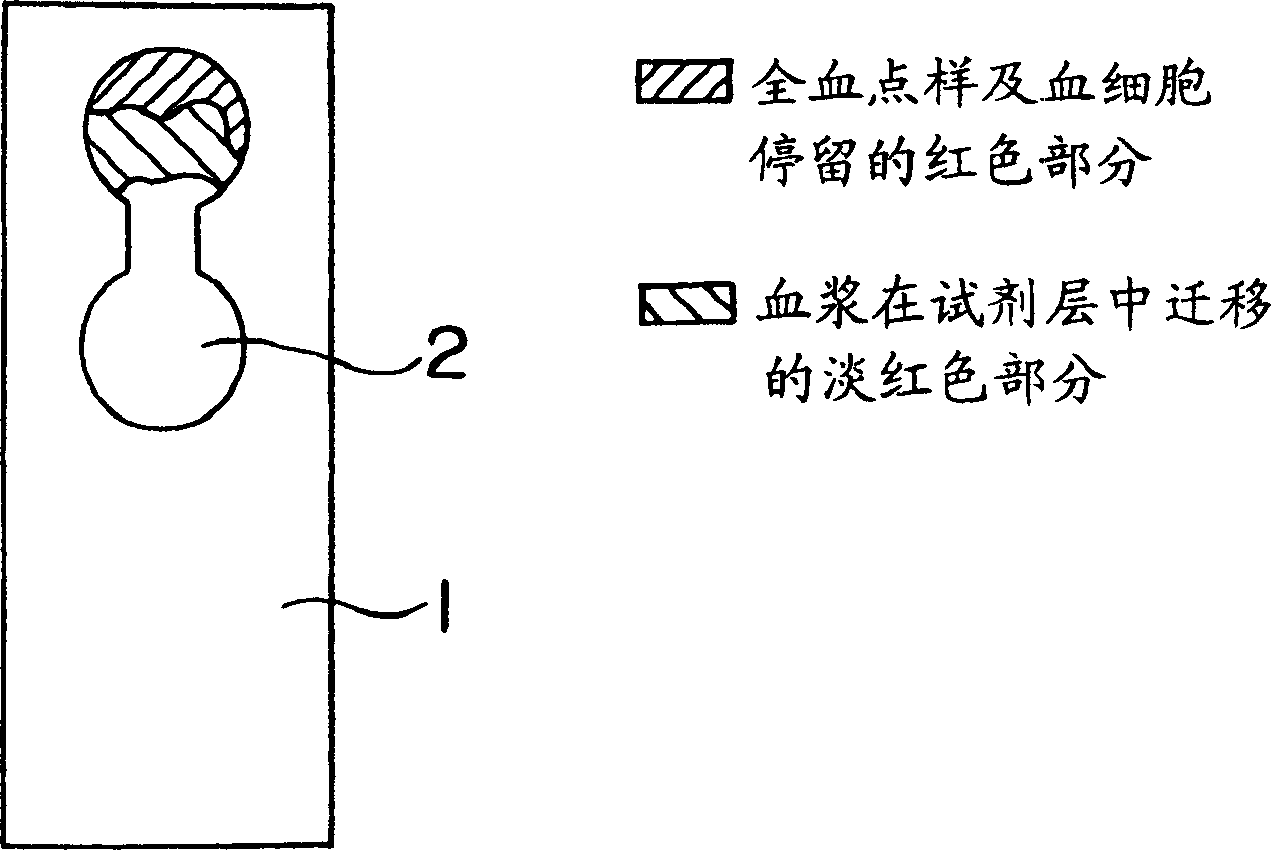
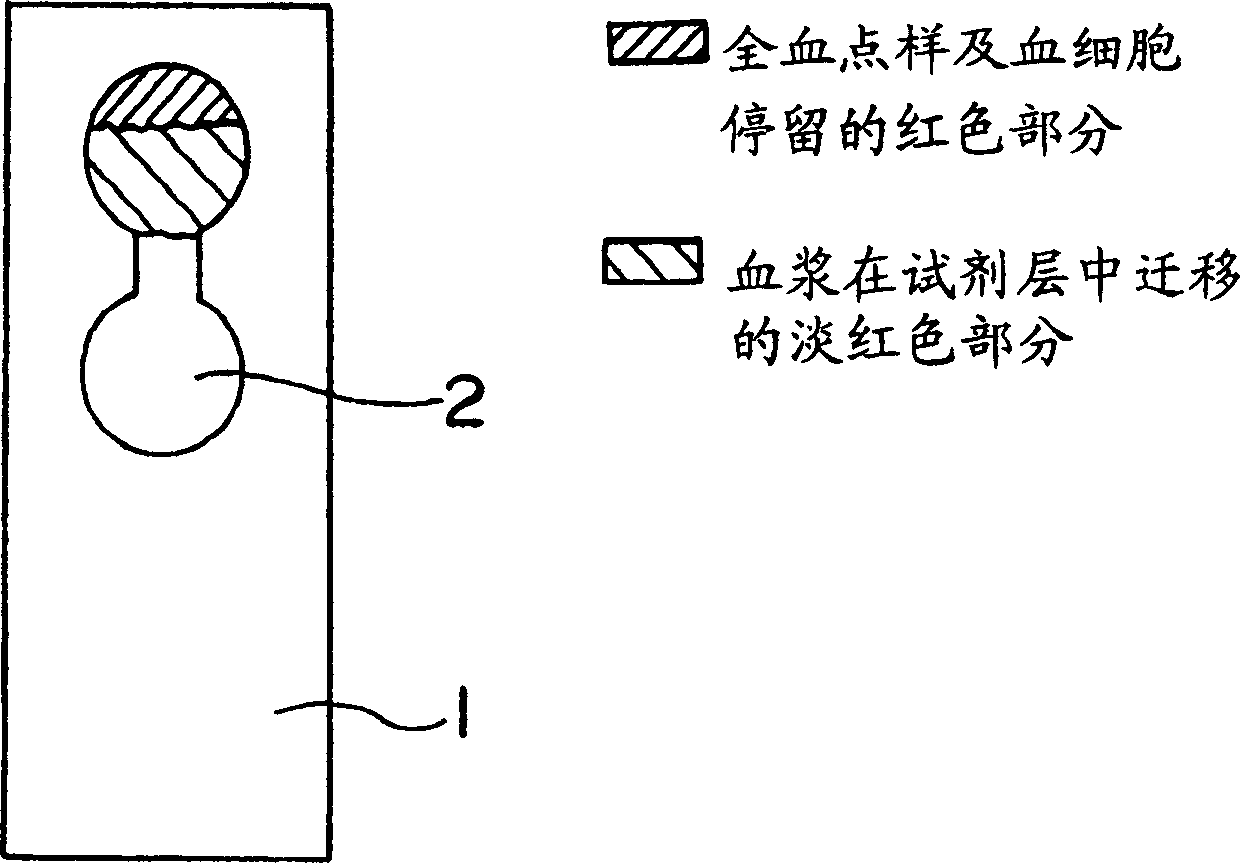
[0093] First, after cleaning the transparent polystyrene plate with ethanol-Milli-Q water and drying it, it was irradiated with ultraviolet rays for 1 - 30 minutes (preferably 3 minutes), and then make the surface of the above-mentioned transparent polystyrene plate undergo hydrophilic treatment to make the bottom layer 1 . The shape of the hydrophilic region of the bottom layer 1 was made into a gourd shape formed by joining two circles with a diameter of 5 mm.
[0094] Next, the manufacture of the reagent layer will be described.
[0095] Inorganic gelling agent Laponite XLG, Bis-Tris buffer solution (pH6.5), POD (peroxida...
Embodiment 2
[0105] Next, except that the amount of raponite XLG and other reagents was fixed, and the amount of particles used was changed according to the following Table 2, test pieces with different reagent layer thicknesses were manufactured in the same manner as in Example 1, and the expected reagent layer thickness was measured . The expected thickness is the film thickness (μm) obtained by observing the cross-section of the reagent layer on the SEM and calculating it.
[0106] Whole blood was spotted on each test piece with different reagent layer thicknesses, and the migration distance of plasma was measured. The migration distance is the migration distance (mm) of the separated plasma from the spotting position to the top within 5 seconds of spotting the whole blood.
[0107] Reagent formula
[0108] As can be seen from Table 2, the thickness of the reagent layer varies according to the amount of particles used, and the migration distance of plasma is greater in the re...
Embodiment 3
[0110] Next, a test piece was manufactured in the same manner as in Example 1 except that each reagent was used at the final concentration described in Table 3 below. In the same manner as in Example 2 above, the expected thickness of the reagent layer in each test piece was measured, and whole blood was spotted on the reagent layer, followed by measuring the migration distance of plasma in this case. Table 3 shows the reagent formulations for each test piece, and Table 4 shows the expected migration distance and measurement results of thickness.
[0111] Reagent
[0112] Reagent formula
[0113] From Tables 3 and 4, it can be seen that if the pH remains constant, the migration distance of plasma depends on the amount of particles used, that is, the thickness of the reagent layer, even if the amount of reagent used becomes larger or smaller.
PUM
| Property | Measurement | Unit |
|---|---|---|
| particle diameter | aaaaa | aaaaa |
| particle diameter | aaaaa | aaaaa |
Abstract
Description
Claims
Application Information
 Login to View More
 - R&D
- Intellectual Property
- Life Sciences
- Materials
- Tech Scout
- Unparalleled Data Quality
- Higher Quality Content
- 60% Fewer Hallucinations
Browse by: Latest US Patents, China's latest patents, Technical Efficacy Thesaurus, Application Domain, Technology Topic, Popular Technical Reports.
© 2025 PatSnap. All rights reserved.Legal|Privacy policy|Modern Slavery Act Transparency Statement|Sitemap|About US| Contact US: help@patsnap.com