Unlock instant, AI-driven research and patent intelligence for your innovation.

Method and apparatus for analyzing and for removing a defect of an EUV photomask

a technology of euv mask and defect analysis, applied in the field of analyzing and removing defects of euv mask, can solve the problems of structural element imaging errors, euv wavelength range presents enormous challenges to the precision of optical elements, and the wafer illumination of euv masks is not suitable for euv illumination

Active Publication Date: 2018-08-28
CARL ZEISS SMT GMBH
View PDF41 Cites 3 Cited by
  • Summary
  • Abstract
  • Description
  • Claims
  • Application Information

AI Technical Summary

Benefits of technology

This approach provides comprehensive defect analysis and effective compensation by combining data from different measurement principles, ensuring accurate repair of buried defects and improving imaging quality in EUV lithography.

Problems solved by technology

The EUV wavelength range presents enormous challenges to the precision of optical elements in the optical path of future lithography systems.
As a consequence of the extremely small wavelength already smallest unevenness of the multi-layer structure and minimal deviations of the absorber structure from the predetermined placement and / or of the predetermined target size of the structure elements of the absorber layer result in imaging errors of the wafers illuminated with the EUV mask.
Moreover, defects in or on the substrate and / or in the multi-layer structure of the EUV mirror or the EUV mask also result in imaging errors of the structural elements which are imaged by the EUV mask on a wafer which cannot be tolerated.
However, this process cannot be performed due to the multitude of layers of the multi-layer structure and their low thickness of approximately 3 nm for the molybdenum (Mo) layers as well as of approximately 4 nm for the silicon (Si) layers and the high demands on the planarity of the layers or their surfaces.

Method used

the structure of the environmentally friendly knitted fabric provided by the present invention; figure 2 Flow chart of the yarn wrapping machine for environmentally friendly knitted fabrics and storage devices; image 3 Is the parameter map of the yarn covering machine
View more

Image

Smart Image Click on the blue labels to locate them in the text.
Viewing Examples
Smart Image
  • Method and apparatus for analyzing and for removing a defect of an EUV photomask
  • Method and apparatus for analyzing and for removing a defect of an EUV photomask
  • Method and apparatus for analyzing and for removing a defect of an EUV photomask

Examples

Experimental program
Comparison scheme
Effect test

Embodiment Construction

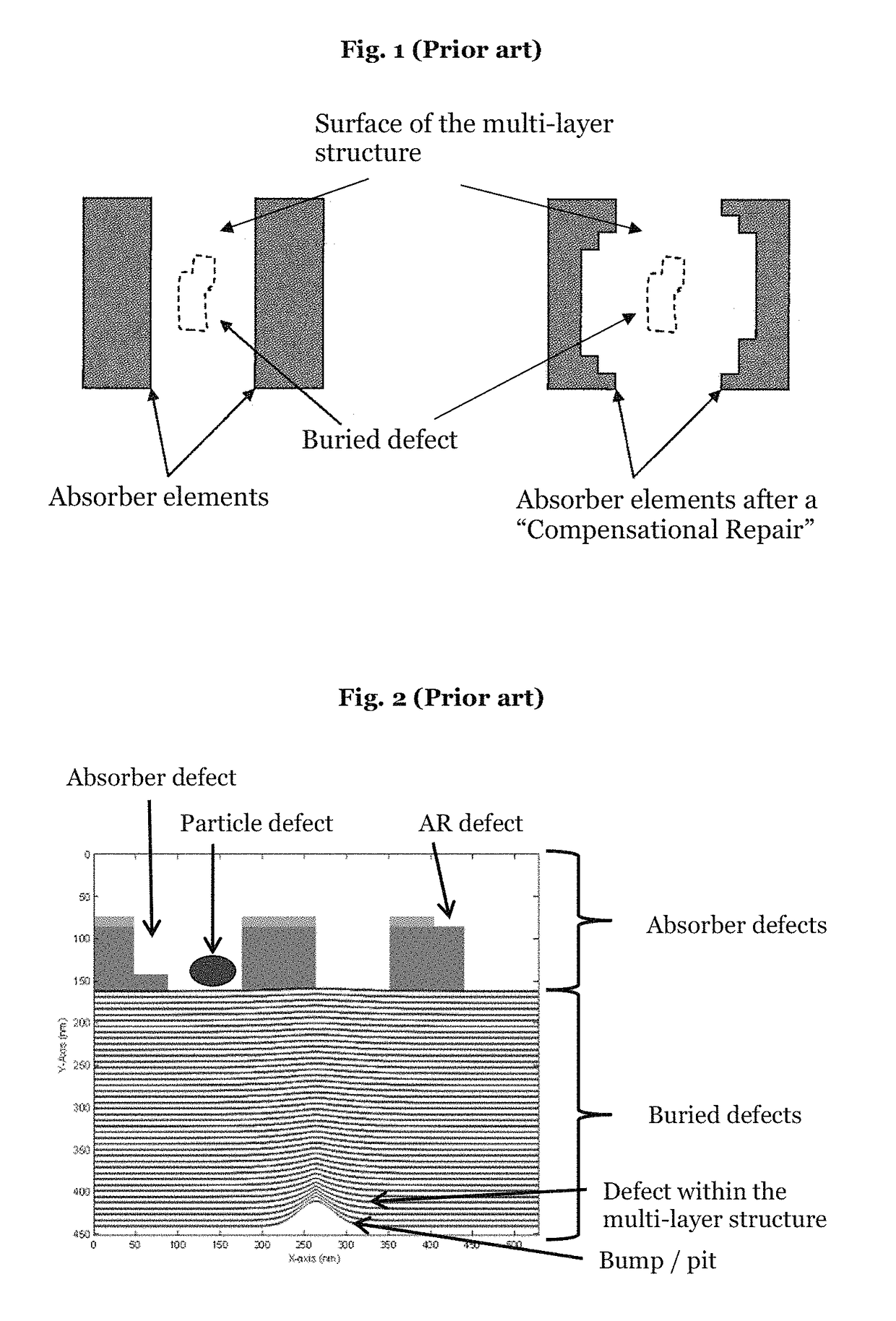
[0094]FIG. 2 gives an overview of the essential defect types of EUV masks. Absorber defects occur if absorber material is available at positions which have to be free from elements of the absorber structure. The inverse situation can also occur, i.e. the absorber material is completely or partially missing at positions which have to be covered with absorber elements. Moreover defects of the anti-reflection (AR) layer which is deposited on the absorber structure and / or dust or dirt particles on the surface of the multi-layer structure can also lead to absorber defects.

[0095]An absorber defect essentially causes an amplitude error in the reflected radiation. Typically, it can be visualized by scanning the EUV mask with a scanning electron microscope (SEM) and can be repaired with a mask repairing system, as for example a MeRiT™ system of the company Carl Zeiss. In this process missing absorber material is deposited by a local deposition process and excessive absorber material is remov...

the structure of the environmentally friendly knitted fabric provided by the present invention; figure 2 Flow chart of the yarn wrapping machine for environmentally friendly knitted fabrics and storage devices; image 3 Is the parameter map of the yarn covering machine
Login to View More

PUM

No PUM Login to View More

Abstract

The invention refers to a method for analyzing a defect of an optical element for the extreme ultra-violet wavelength range comprising at least one substrate and at least one multi-layer structure, the method comprising the steps: (a) determining first data by exposing the defect to ultra-violet radiation, (b) determining second data by scanning the defect with a scanning probe microscope, (c) determining third data by scanning the defect with a scanning particle microscope, and (d) com-bining the first, the second and the third data.

Description

CROSS-REFERENCE TO RELATED APPLICATIONS[0001]The present application is a continuation of, and claims benefit under 35 USC 120 to, international application PCT / EP2012 / 063881, filed Jul. 16, 2012, which claims benefit under 35 USC 119 of German Application No. 10 2011 079 382.8, filed Jul. 19, 2011. International application PCT / EP2012 / 063881 also claims priority under 35 USC 119(e) to U.S. Provisional Application No. 61 / 509,206, filed Jul. 19, 2011. The entire disclosure of international application PCT / EP2012 / 063881 is incorporated by reference herein.1. TECHNICAL FIELD[0002]The present invention relates to the field of analyzing and removing a defect of an EUV photomask.2. BACKGROUND OF THE INVENTION[0003]As a result of the constantly increasing integration density in the semiconductor industry, photolithographic masks have to project smaller and smaller structures on wafers. In order to fulfill this demand, the exposure wavelength of lithography systems has been shifted to small...

Claims

the structure of the environmentally friendly knitted fabric provided by the present invention; figure 2 Flow chart of the yarn wrapping machine for environmentally friendly knitted fabrics and storage devices; image 3 Is the parameter map of the yarn covering machine
Login to View More

Application Information

Patent Timeline
no application Login to View More
Patent Type & Authority Patents(United States)
IPC IPC(8): G01Q30/02B82Y40/00G03F1/84G03F1/86B82Y10/00G03F1/22
CPCG01Q30/02B82Y10/00G03F1/86G03F1/22G03F1/84B82Y40/00G03F1/24
Inventor BUDACH, MICHAELBRET, TRISTANEDINGER, KLAUSHOFMANN, THORSTEN
Owner CARL ZEISS SMT GMBH