
Allele selective gene editing and uses thereof
a gene editing and allele technology, applied in the field of allele selective gene editing, can solve the problems of ineffective guides that otherwise follow the structural scheme, limited effectiveness of guide molecules for targeting polynucleotides, and unpredictable specificity and activity of guide molecules, so as to increase the efficiency of gene engineering, and high the effect of targeted mutagenesis
- Summary
- Abstract
- Description
- Claims
- Application Information
AI Technical Summary
Benefits of technology
Problems solved by technology
Method used
Image

Examples
example 1
Allele Selective Editing of a TTR Genomic Site with a U-Guide Molecule for CRISPR / Cas9
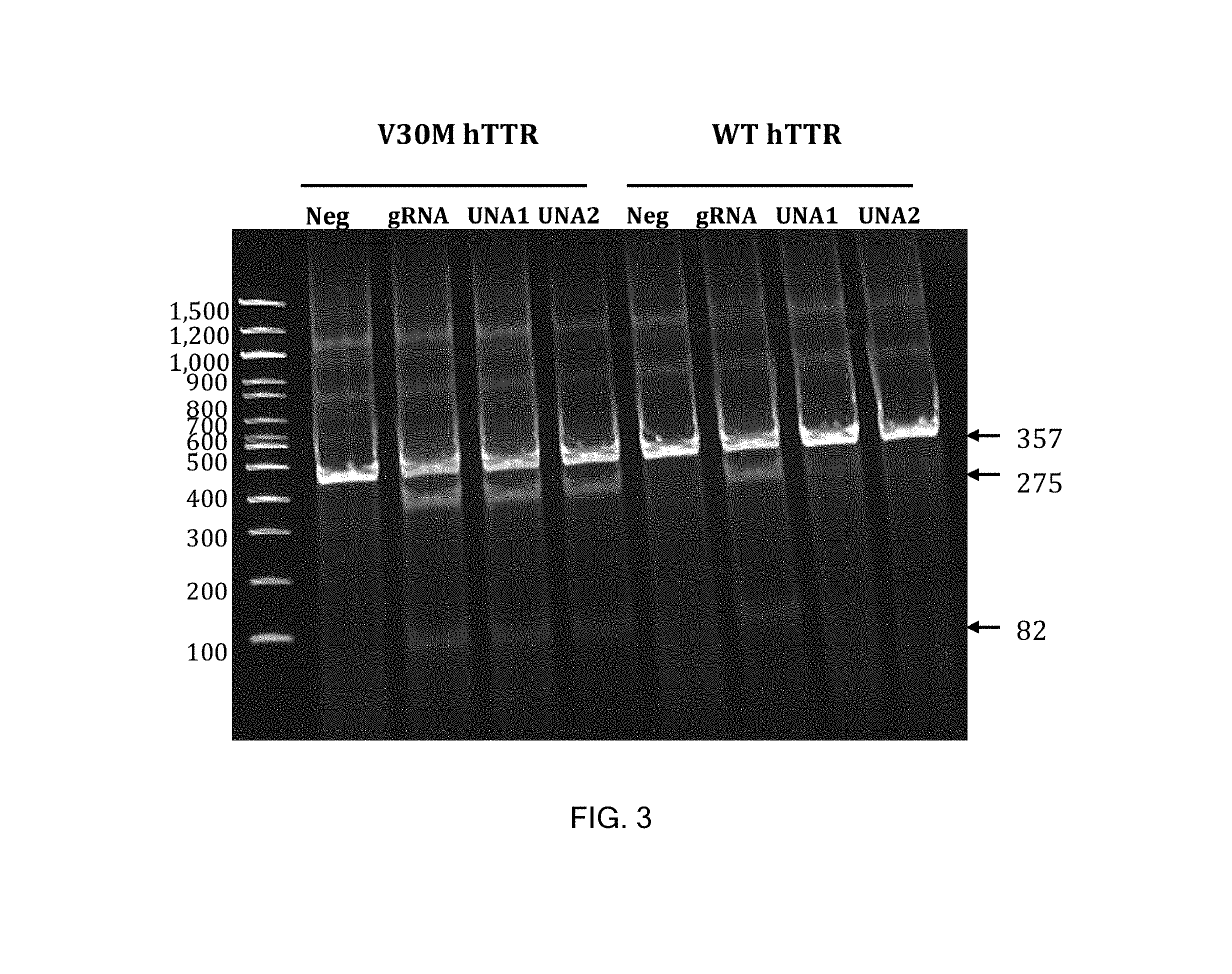
[0328]For this experiment, a 357-bp PCR product was generated from human TTR genomic DNA, accession number NC _000018.10, using the primers:[0329]SEQ ID NO. 11[0330]Forward (intron 1): 5′-tgtcttctctacacccagggcac-3′[0331]SEQ ID NO. 12[0332]Reverse (exon 2): 5′-gcaaaccacagctagaggagagga-3′.
[0333]Guide sequences of 20-mer length were identified that targeted regions 269-288 and 269-286, respectively, of the human TTR coding region.
[0334]A 20-mer guide sequence for V30M hTTR is shown in Table 6.
[0335]
TABLE 620-mer guide sequence for V30M hTTRSEQIDNO.SEQUENCE133′-CGGUAGUUACACCGGUACGU-5′ (TARGET GUIDE)145′-CCT-GCCATCAATGTGGCCATGCA-3′(V30M TTR GENE)153′-GGA-CGGTAGTTACACCGGTACGT-5′(V30M TTR GENE)
[0336]In Table 6, the underlined positions show the V30M mutation. In Table 6, SEQ ID NO:13 can also be written in the 5′ to 3′ direction, and appears in the U-Guide molecules of Table 7 written in the 5′ to 3′ dire...
example 2
Allele Selective Editing of a TTR Genomic Site with a U-Guide Molecule for CRISPR / Cas9
[0357]A 20-mer guide sequence for V30M hTTR is shown in Table 8.
[0358]
TABLE 820-mer guide sequence for V30M hTTRSEQSEQUENCEIDNO.403′-AGUUACACCGGUACGUACAC-5′ (TARGET GUIDE)415′-CCA-TCAATGTGGCCATGCATGTG-3′(V30M TTR GENE)423′-GGT-AGTTACACCGGTACGTACAC-5′(V30M TTR GENE)
[0359]In Table 8, SEQ ID NO:40 can also be written in the 5′ to 3′ direction, and appears in the U-Guide molecules of Table 9 written in the 5′ to 3′ direction.
[0360]As used herein, the term “1 or 5′ to 3′” refers to U-Guides having either a UNA monomer on the leftmost end (1 to 3′, for example SEQ ID NO:43) or a nucleotide on the leftmost end (5′ to 3′, for example SEQ ID NO:44).
[0361]A U-Guide molecule was synthesized, wherein the molecule contained the 20-mer guide sequence for V30M and a CRISPR sequence of S. pyogenes.
[0362]Examples of 20-mer target length U-Guide molecules for the V30M region of hTTR are shown in Table 9.
[0363]
TABLE...
example 3
Editing a BIRC5 Genomic Site with a U-Guide Molecule for CRISPR / Cas9
[0372]Survivin (baculoviral inhibitor of apoptosis repeat-containing 5, human BIRC5, NG_029069.1) can be expressed in tumor cells, especially in breast and lung cancer, and is generally not present in normal cells. Survivin may be an oncogene, and its overexpression in cancer cells may lead to resistance to apoptosis, and increased survival.
[0373]Guide sequences of 20-mer length were identified that targeted certain regions of human BIRC5. The EntreZ Gene ID for these sequences is 332.
[0374]20-mer guide sequences for BIRC5 are shown in Table 10.
[0375]
TABLE 1020-mer guide sequences for BIRC5SEQIDNO.TARGET SEQUENCE 5′ -> 3′67GAUGCGGUGGUCCUUGAGAA68CAAGAACUGGCCCUUCUUGG69GCAGGCGCAGCCCUCCAAGA70UUCUGCUUCAAGGAGCUGGA71CCAGUUUCAAAAAUUCACCA72CAAUAAGAAGAAAGAAUUUG
[0376]A U-Guide molecule is synthesized, wherein the molecule contains the 20-mer target sequence and a CRISPR sequence of S. pyogenes.
[0377]Examples of 20-mer target ...
PUM
| Property | Measurement | Unit |
|---|---|---|
| temperature | aaaaa | aaaaa |
| size | aaaaa | aaaaa |
| length | aaaaa | aaaaa |
Abstract
Description
Claims
Application Information
 Login to View More