Unlock instant, AI-driven research and patent intelligence for your innovation.

AMPK activators

a technology of ampk activators and activators, applied in the field of ampk activators, can solve the problems of direct ampk activator, unsuitable to address the problem, and treatment with known ampk activators

Active Publication Date: 2022-03-22
KALLYOPE INC
View PDF349 Cites 1 Cited by
  • Summary
  • Abstract
  • Description
  • Claims
  • Application Information

AI Technical Summary

Benefits of technology

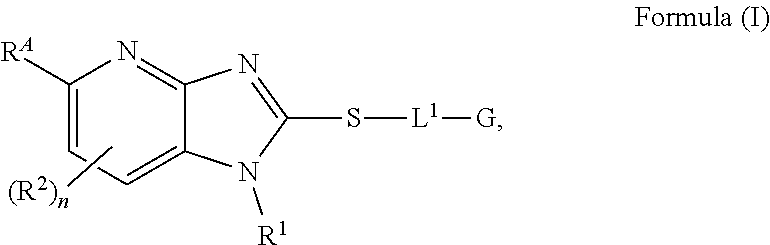
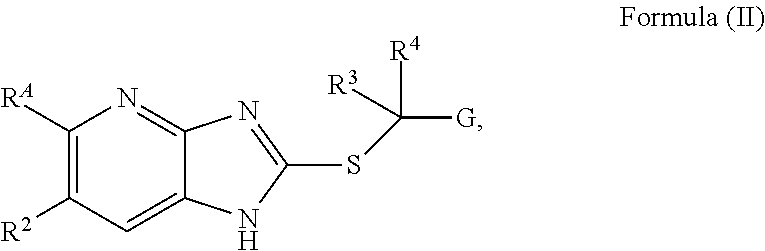
The patent describes a group of compounds that can activate a protein called adenosine 5′-monophosphate-activated protein kinase (AMPK), which is involved in a variety of conditions related to the gut-brain axis. These conditions include central nervous system disorders, metabolic conditions, inflammatory disorders, and autoimmune diseases. The compounds can be used as gut-restricted or selective activators of AMPK, which can help treat these disorders.

Problems solved by technology

However, there are safety concerns with sustained direct AMPK activation, particularly in the heart.
Due to this risk of cardiac hypertrophy, treatment with known AMPK activators, which are systemic in nature, is unsuitable to address the problem of treating IBD, colitis, and other diseases with a leaky gut barrier with a direct AMPK activator.
However, metformin does not optimally activate AMPK, metformin has other activities, and this approach requires specific formulation development.
Thus it is not an optimal solution to the problem.

Method used

the structure of the environmentally friendly knitted fabric provided by the present invention; figure 2 Flow chart of the yarn wrapping machine for environmentally friendly knitted fabrics and storage devices; image 3 Is the parameter map of the yarn covering machine
View more

Image

Smart Image Click on the blue labels to locate them in the text.
Viewing Examples
Smart Image
  • AMPK activators
  • AMPK activators
  • AMPK activators

Examples

Experimental program
Comparison scheme
Effect test

example 1

on of 2-((6-chloro-5-(2′-hydroxy-[1,1′-biphenyl]-4-yl)-1H-imidazo[4,5-b]pyridin-2-yl)thio)acetic Acid (Compound 1)

[0393]

Step 1: 5,6-dichloro-3-nitropyridin-2-amine (1-1)

[0394]To a solution of 6-chloro-3-nitro-pyridin-2-amine (50 g, 0.29 mol, 1 eq) in AcOH (250 mL) was added NCS (46 g, 0.35 mmol, 1.2 eq). The mixture was stirred at 100° C. for 3 hours. The mixture was cooled to room temperature, then filtered. The filter residue was washed with ethanol (100 mL), then dried in vacuo to give 1-1 (48 g, crude) as a yellow solid. LCMS: (ES+) m / z (M+H)+=207.9.

Step 2: 5-chloro-6-iodo-3-nitropyridin-2-amine (1-2)

[0395]To a solution of 1-1 (48 g, 0.23 mol, 1 eq) in AcOH (250 mL) was added NaI (73 g, 0.48 mol, 2.1 eq). The mixture was stirred at 90° C. for 12 hours. The mixture was poured into water (500 mL), then filtered. The filter residue was washed with water (200 mL), then dried in vacuo to give 1-2 (60 g, crude) as a yellow solid. LCMS: (ES+) m / z (M+H)+=299.8.

Step 3: 5-chloro-6-iodopyr...

example 2

on of (((6-chloro-5-(2′-hydroxy-[1,1′-biphenyl]-4-yl)-1H-imidazo[4,5-b]pyridin-2-yl)thio)methyl)(methyl)phosphinic Acid (Compound 2 FA Salt)

[0402]

Step 1: ethyl (((6-chloro-5-iodo-1H-imidazo[4,5-b]pyridin-2-yl)thio)methyl)(methyl)phosphinate (2-1)

[0403]To a solution of 1-4 (0.50 g, 1.6 mmol) in DMF (10 mL) was added Cs2CO3 (1.1 g, 3.2 mmol) and ethyl (chloromethyl)(methyl)phosphinate (0.20 g, 1.3 mmol). The mixture was stirred at 25° C. for 12 hours. The mixture was poured into water (40 mL), pH was adjusted to ˜6 with 1 N aqueous HCl, and then extracted with ethyl acetate (30 mL×2). The combined organic layers were washed with saturated brine (20 mL×2) and concentrated in vacuo to give 2-1 (0.80 g, crude) as a black brown oil, which was used without further purification. LCMS: (ES+) m / z (M+H)+=431.7.

Step 2: ethyl (((6-chloro-5-iodo-1-((2-(trimethylsilyl)ethoxy)methyl)-1H-imidazo[4,5-b]pyridin-2-yl)thio)methyl)(methyl)phosphinate (2-2)

[0404]To a solution of 2-1 (0.80 g, 1.9 mmol) in ...

example 3

on of ethyl hydrogen (((6-chloro-5-(2′-hydroxy-[1,1′-biphenyl]-4-yl)-1H-imidazo[4,5-b]pyridin-2-yl)thio)methyl)phosphonate (Compound 3 FA Salt)

[0407]

Step 1: diethyl (((6-chloro-5-iodo-1H-imidazo[4,5-b]pyridin-2-yl)thio)methyl)phosphonate (3-1)

[0408]To a solution of 1-4 (1.0 g, 3.2 mmol) in DMF (20 mL) was added Cs2CO3 (2.1 g, 6.4 mmol) and diethyl (bromomethyl)phosphonate (0.59 g, 2.6 mmol) under N2. The mixture was stirred at 25° C. for 2 hours. The mixture was poured into water (50 mL), adjusted to pH ˜6 with 1 N aqueous HCl, and then extracted with ethyl acetate (100 mL×2). The combined organic layers were washed with saturated brine (30 mL×2), concentrated in vacuo to give 3-1 (1.6 g, crude) as a yellow solid which was used without further purification. LCMS: (ES+) m / z (M+H)+=461.9.

Step 2: diethyl (((6-chloro-5-iodo-1-((2-(trimethylsilyl)ethoxy)methyl)-1H-imidazo[4,5-b]pyridin-2-yl)thio)methyl)phosphonate (3-2)

[0409]To a solution of 3-1 (1.6 g, 3.5 mmol) and TEA (0.53 g, 5.2 mmo...

the structure of the environmentally friendly knitted fabric provided by the present invention; figure 2 Flow chart of the yarn wrapping machine for environmentally friendly knitted fabrics and storage devices; image 3 Is the parameter map of the yarn covering machine
Login to View More

PUM

No PUM Login to View More

Abstract

This disclosure is directed, at least in part, to AMPK activators useful for the treatment of conditions or disorders associated with AMPK. In some embodiments, the condition or disorder is associated with the gut-brain axis. In some embodiments, condition or disorder is associated with systemic infection and inflammation from having a leaky gut barrier. In some embodiments, the AMPK activators are gut-restricted compounds. In some embodiments, the AMPK activators are agonists or partial agonists.

Description

CROSS-REFERENCE TO RELATED APPLICATIONS[0001]This application is a continuation of International Application Serial No. PCT / US2021 / 032933, filed May 18, 2021, which claims the benefit of U.S. Provisional Application No. 63 / 027,231 filed on May 19, 2020, U.S. Provisional Application No. 63 / 111,837 filed on Nov. 10, 2020, and U.S. Provisional Application No. 63 / 141,169 filed on Jan. 25, 2021, each of which is incorporated herein by reference in its entirety.BACKGROUND OF THE INVENTION[0002]Adenosine 5′-monophosphate-activated protein kinase (AMPK) is a serine / threonine kinase and is evolutionarily conserved from yeast to mammals. AMPK acts as an energy sensor and is activated by upstream enzymes when the cellular ratio of adenosine 5′-monophosphate (AMP) to adenosine triphosphate (ATP) is elevated due to nutrient deprivation. Activated AMPK phosphorylates downstream substrates to promote catabolism and impede anabolism, leading to ATP production and energy restoration. AMPK activity c...

Claims

the structure of the environmentally friendly knitted fabric provided by the present invention; figure 2 Flow chart of the yarn wrapping machine for environmentally friendly knitted fabrics and storage devices; image 3 Is the parameter map of the yarn covering machine
Login to View More

Application Information

Patent Timeline
no application Login to View More
Patent Type & Authority Patents(United States)
IPC IPC(8): C07D471/04A61P1/12A61P1/04
CPCC07D471/04A61P1/04A61P1/12A61K31/437A61P3/00A61P1/00A61P29/00A61P31/00C07F9/6561A61K31/662A61K31/675
Inventor SEBHAT, IYASSUHE, SHUWEN
Owner KALLYOPE INC