
Thermal imaging measurement of lateral diffusivity and non-invasive material defect detection
a technology of lateral diffusivity and thermal imaging, which is applied in the direction of material heat development, optical radiation measurement, instruments, etc., can solve the problems of time-consuming ultrasonic techniques for detecting this type of defect in large material samples, and achieve the effect of automatic and accurate methods
- Summary
- Abstract
- Description
- Claims
- Application Information
AI Technical Summary
Benefits of technology
Problems solved by technology
Method used
Image

Examples
Embodiment Construction
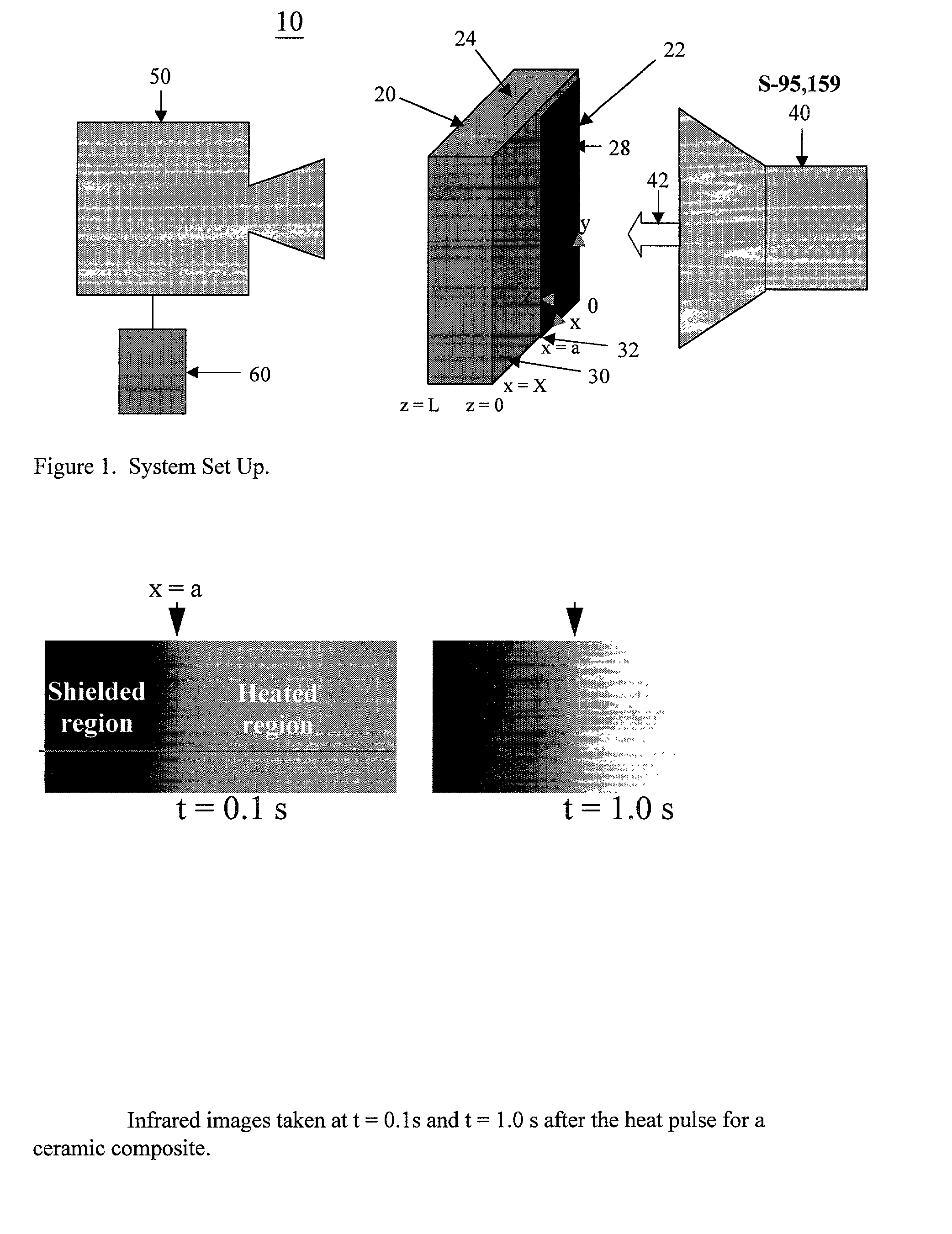
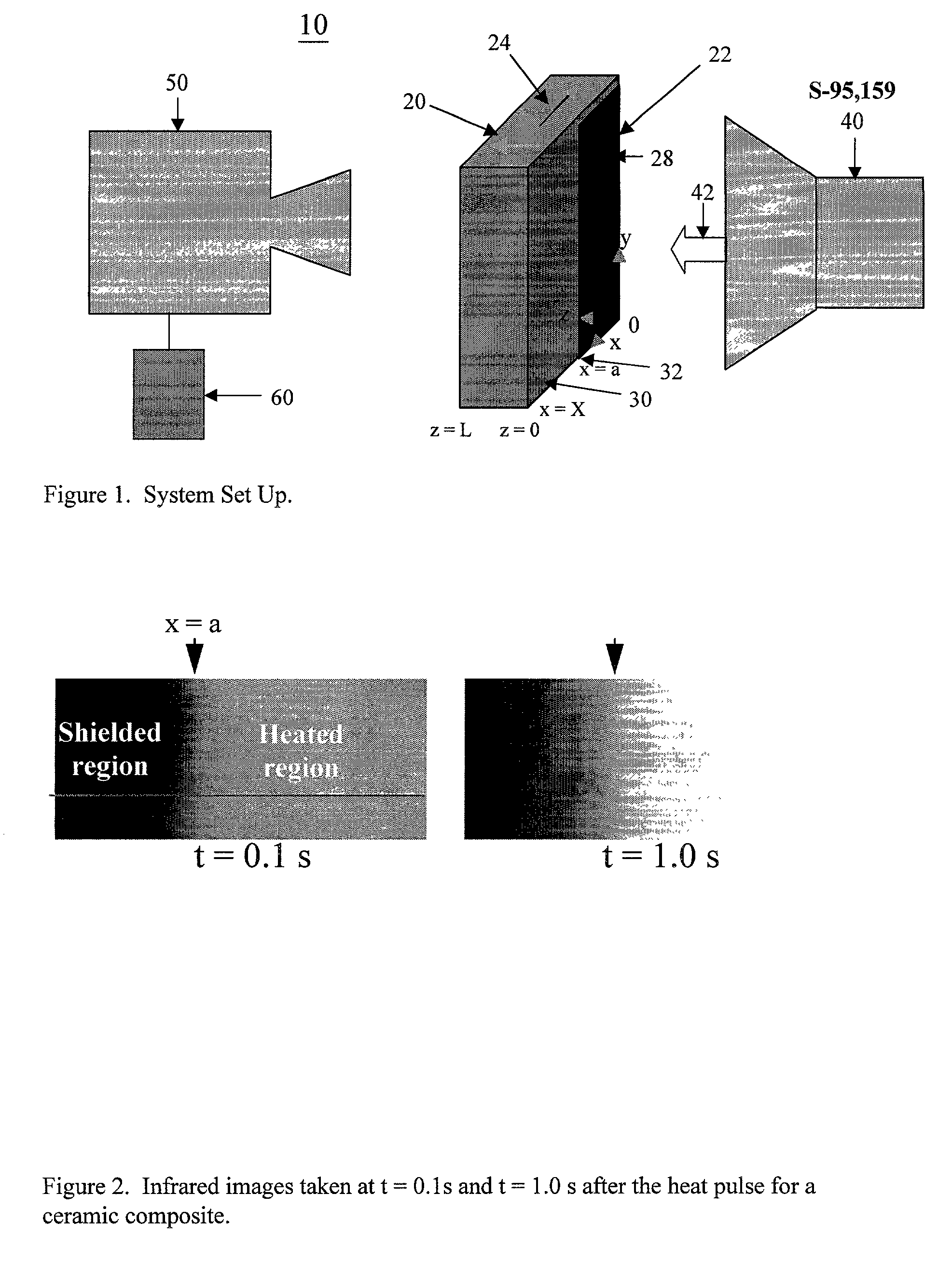
[0023] FIG. 1 depicts the system set up 10. A material sample 20 is placed between a heat source 40, that has an average direction of heat flow 42 when the heat source 40 is activated, and an infrared camera 50 that has infrared receptors directed toward the sample 20. The sample 20 is oriented within an orthogonal coordinate system having x, y, and z-axes. The x-y plane of the coordinate system is perpendicular to the average direction of heat flow 42 while the z-axis is essentially parallel to the average direction of heat flow 42. A shield 22 on the back side (the side facing the heat source 40) of the sample 20 insulates the portion of the sample 20 that is covered by the shield 22 from receiving heat from the heat source 40 when the heat source 40 is activated. An edge of the shield 22 creates an interface 32 between the shielded portion of the sample 28 and the unshielded portion of the sample 30. The interface 32 is essentially equidistant from the y-axis. The infrared camera...
PUM
| Property | Measurement | Unit |
|---|---|---|
| surface temperature | aaaaa | aaaaa |
| surface temperature | aaaaa | aaaaa |
| thermal diffusivity | aaaaa | aaaaa |
Abstract
Description
Claims
Application Information
 Login to View More