Methods for using JNK inhibitors for treating or preventing disease-related wasting

US20040034084A1Inactive Publication Date: 2004-02-19CELGENE CORP
17 Cites 25 Cited by

Patent Information

Authority / Receiving Office
US · United States
Current Assignee / Owner
Publication Date
2004-02-19
Estimated Expiration
Not applicable · inactive patent

Smart Images

  • Figure 1
    Figure 1
  • Figure 2
    Figure 2
  • Figure 3
    Figure 3
Patent Text Reader

Abstract

The present invention relates to methods useful for the treatment or prevention of disease-related wasting. The methods of the invention comprise the administration of an effective amount of a JNK Inhibitor. In one embodiment, the disease is HIV, AIDS, cancer, end-stage renal disease, kidney failure, chronic heart disease, obstructive pulmonary disease or tuberculosis. The methods can further comprise the administration of a therapeutic or prophylactic agent useful for the treatment or prevention of HIV, AIDS, cancer, end-stage renal disease, kidney failure, chronic heart disease, obstructive pulmonary disease, chronic infectious diseases (e.g., osteoarthritis and bacterial endocarditis), chronic inflammatory diseases (e.g., scleroderma and mixed connective tissue disease) or tuberculosis.
Need to check novelty before this filing date? Find Prior Art

Description

[0001] This application claims the benefit of U.S. provisional application No. 60 / 383,202, filed May 24, 2003, the contents of which are incorporated by reference herein in their entirety.1. FIELD OF INVENTION

[0002] The present invention relates to methods useful for treating or preventing disease-related wasting in a patient, comprising administering an effective amount of a JNK Inhibitor to a patient in need thereof.2. BACKGROUND OF THE INVENTION

[0003] 2.1 Jun N-Terminal Kinase (JNK)

[0004] The Jun N-terminal kinase (JNK) pathway is activated by exposure of cells to environmental stress or by treatment of cells with pro-inflammatory cytokines. Targets of the JNK pathway include the transcription factors c-jun and ATF2 (Whitmarsh A. J., and Davis R. J. J. Mol. Med. 74:589-607, 1996). These transcription factors are members of the basic leucine zipper (bZIP) group that bind as homo- and hetero-dimeric complexes to AP-1 and AP-1-like sites in the promoters of many genes (Karin M., Liu...

Examples

Embodiment Construction

[0108] 4.1 Illustrative JNK Inhibitors

[0109] As mentioned above, the present invention is directed to methods useful for treating or preventing disease-related wasting in a patient, comprising administering an effective amount of a JNK Inhibitor. Illustrative JNK Inhibitors are set forth below.

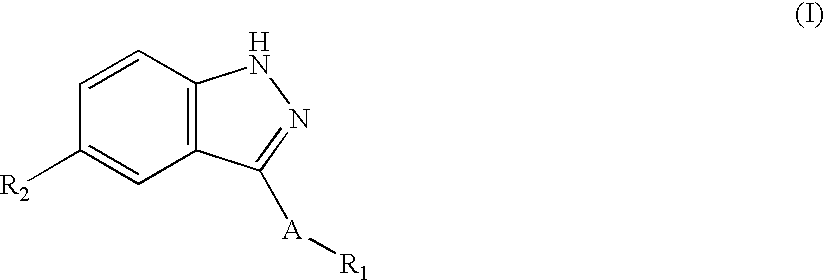
[0110] In one embodiment, the JNK Inhibitor has the following structure (I): 1

[0111] wherein:

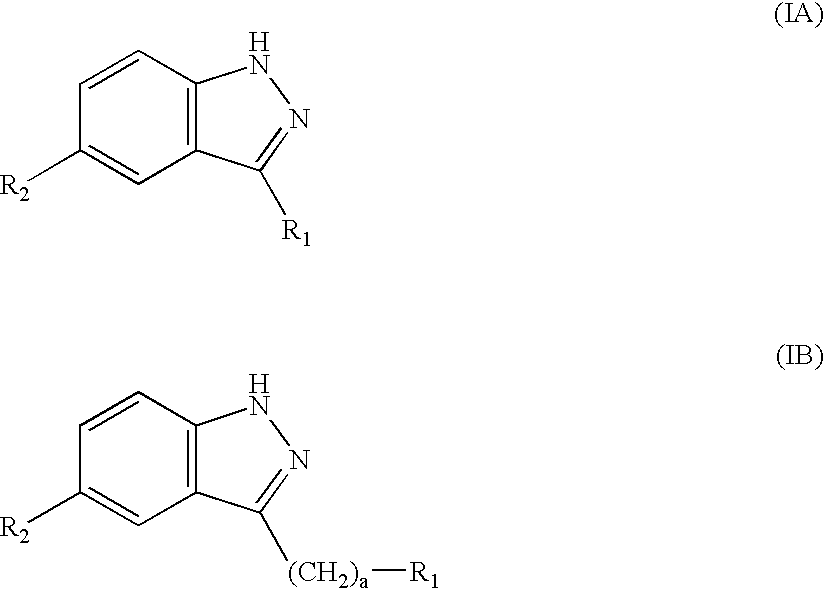
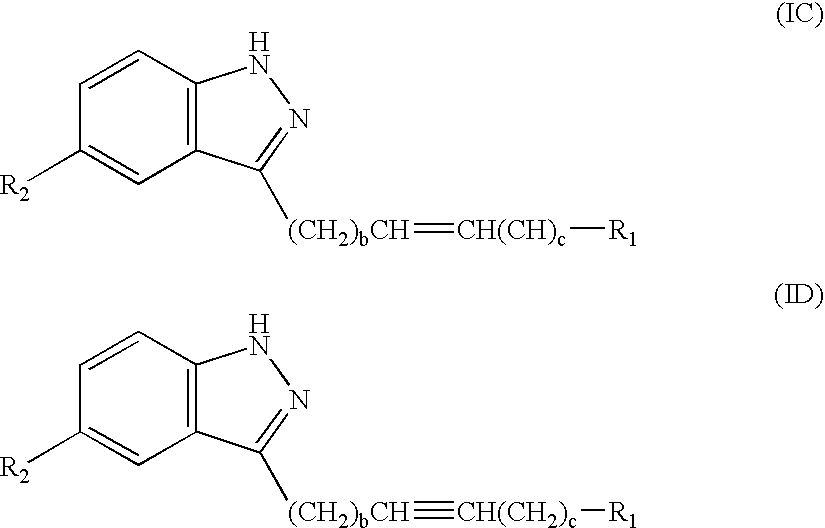
[0112] A is a direct bond, --(CH.sub.2).sub.a--, --(CH.sub.2).sub.bCH.dbd.-CH(CH.sub.2).sub.c--, or --(CH.sub.2).sub.bC.ident.C(CH.sub.2).sub.c--;

[0113] R.sub.1 is aryl, heteroaryl or heterocycle fused to phenyl, each being optionally substituted with one to four substituents independently selected from R.sub.3;

[0114] R.sub.2 is --R.sub.3, --R.sub.4, --(CH.sub.2).sub.bC(.dbd.O)R.sub.5-, --(CH.sub.2).sub.bC(.dbd.O)OR.sub.5, --(CH.sub.2).sub.bC(.dbd.O)NR.sub.5-R.sub.6, --(CH.sub.2).sub.bC(.dbd.O)NR.sub.5(CH.sub.2)CC(.dbd.O)R.sub.6, --(CH.sub.2).sub.bNR.sub.5C(.dbd.O)R.sub.6, --(CH.sub.2).sub.bNR.sub.5C(....