
Novel amino acid derivative and sweetening agent
a technology of amino acid derivatives and sweeteners, applied in the field of new amino acid derivatives, can solve the problems of increased problems, excessive sugar ingestion, and study of the relationship between chemical structure and structure, and achieve excellent stability and safety
- Summary
- Abstract
- Description
- Claims
- Application Information
AI Technical Summary
Benefits of technology
Problems solved by technology
Method used
Image

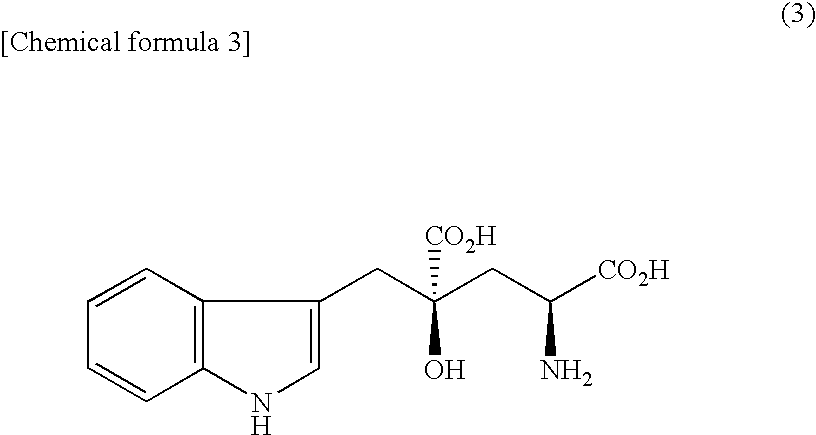
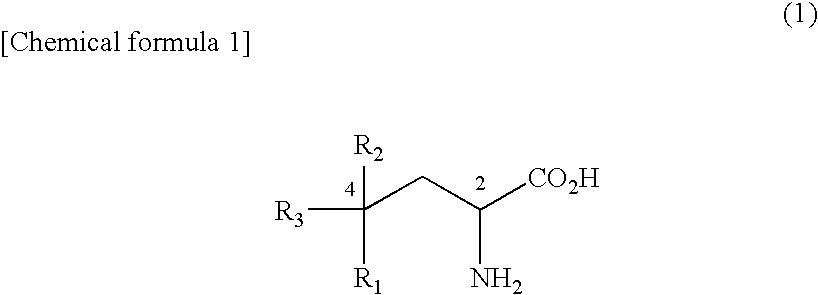
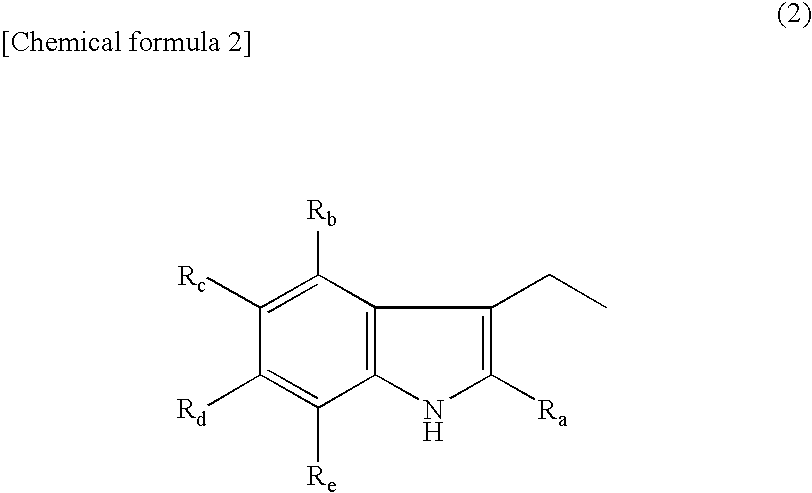
Examples
example 1
Synthesis of (2R,4S)-2-Amino-4-(3-indolyl)methyl Pentandioic Acid 1
[0071]
[0072] In an atmosphere of argon, 457 mg of (D)-N-t-butoxycarbonylpyroglutamic acid methyl ester (1.88 mmol) was dissolved in 5 ml of anhydrous tetrahydrofuran (THF). The reaction solution was maintained at a temperature of −78° C., and 1.1 ml of a 1 mol solution (29%, solution in THF) of lithium hexamethyldisilazide (LHMDS) was added thereto. One hour later, 5 ml of a solution of 700 mg of N-t-butoxycarbonyl-3-bromomethylindole (2.26 mmol) in THF was added thereto, and stirred at −78° C. for 2 hrs. To the reaction solution a saturated aqueous ammonium chloride solution was added, followed by extraction with 50 ml of ethyl acetate (twice). The resulting organic layer was washed with a saturated salt solution, and dried over anhydrous magnesium sulfate. The magnesium sulfate was removed by filtration, and the resulting filtrate was concentrated. The residue was purified on a preparative thin layer chromatography...
example 2
Synthesis of 4-Hydroxy-4-(6-methylindole-3-ylmethyl)glutamic Acid 2
[0083]
[0084] 6-Methylindole-3-pyruvic acid in an amount of 3.40 g (15.65 mmol) and oxalacetic acid in an amount of 12.4 g (93.9 mmol) were suspended in 40 ml of water, and maintained at a temperature of 0° C. A solution of 12.3 g of potassium hydroxide (219.1 mmol) dissolved in 20 ml of water was added to the suspension. After stirring the reaction solution overnight at room temperature, 4.35 g of hydroxylammonium chloride (62.6 mmol) was added thereto followed by additional stirring at room temperature for one day. Concentrated hydrochloric acid was added to the reaction solution to adjust the pH of 2 to 3, followed by extraction with 100 ml of ethyl acetate (three times). The organic layer was washed with 100 ml of water and 100 ml of a saturated salt solution, and dried over anhydrous magnesium sulfate. The magnesium sulfate was removed by filtration, and the filtrate was vacuum concentrated. The residue was disso...
example 3
Synthesis of (2S,4S)- and (2R,4R)-2-Amino-4,5-dihydroxy-4-(3-indolylmethyl)pentanoic Acid Mixture 3
[0094]
[0095] A mixture of (2S,4S)- and (2R,4R)-2-benzyloxycarbonylamino-4-carboxy-4-(3-indolylmethyl)-γ-butyrolactone in an amount of 408 mg (1.0 mmol), which was obtained by benzyloxycarbonylation and lactonization of a mixture of (2S,4R)- and (2R,4R)-monatin, was dissolved in 3 ml of THF, and 0.21 ml of triethylamine (1.5 mmol) was added thereto. The reaction solution was cooled to −18° C., and 0.20 ml of isobutyl chloroformate (1.5 mmol) was added. After stirring at −18° C. for 30 min, a solution of 113 mg of sodium borohydride (3.0 mmol) dissolved in 1.5 ml of water was added, and stirred at −18° C. for 20 min. After adding 2.0 ml of a 2 N hydrochloric acid solution, the reaction solution was vacuum concentrated. To the residue 30 ml of water was added and an extraction manipulation with 50 ml of ethyl acetate was repeated twice. The resulting organic layer was washed with 50 ml of...
PUM
| Property | Measurement | Unit |
|---|---|---|
| half life | aaaaa | aaaaa |
| half life | aaaaa | aaaaa |
| temperature | aaaaa | aaaaa |
Abstract
Description
Claims
Application Information
 Login to View More