Check patentability & draft patents in minutes with Patsnap Eureka AI!

Delivery vectors for short interfering RNA, micro-RNA and antisense RNA

Inactive Publication Date: 2005-09-15
KATAHDIN BIOSCI
View PDF1 Cites 31 Cited by
  • Summary
  • Abstract
  • Description
  • Claims
  • Application Information

AI Technical Summary

Benefits of technology

[0019] The use of a naturally-occurring (genome-encoded) intron-containing tRNA gene makes it possible to deliver, express and release three independent RNAi molecules (siRNA, microRNA or asRNA) in one construct. These can either be used to target three independent genes for silencing or to increase the gene silencing effect by targeting the same gene with two or three RNAi molecules that bind to different sequence motifs.

Problems solved by technology

However, design (sequence choice), synthesis of the RNA molecules, delivery and regulation, prevented asRNA to being used significantly beyond in vitro studies.
While this use of siRNA for basic research is a growing field, its postulated utility, being useful as a therapeutic, has so far been less successful.
This is not due to a lack of specificity but to the problem of targeted delivery of the active nucleic acid—the RNA molecule itself—into an organism.
Thus the same reasons that prevented antisense RNA from being widely used as therapeutic, ie., expensive synthesis and purification, lack of sufficient stability in the cell and thus efficacy, are also the main obstacles for the application of siRNA and microRNA beyond research tools in functional genomics.
The use of asRNA, i.e. ribo-oligonucleotides, is impractical, as the stability of these short RNA molecules could not be guaranteed once they are introduced (transfected) into a cell's cytoplasm.
One problem so far prevents the use of DNA vectors as a tool for using siRNA or microRNA as a therapeutic in organisms.
Thus, it is virtually impossible to deliver siRNA encoded in a larger construct to a multicellular organism such as a mammal without inducing an unwanted adverse event.
Of these, the hydrodynamic delivery produces better results but would have no clinical significance as delivery of the RNA or DNA in question cannot be targeted towards a specific tissue and the method is used for isolated cells only.
However, this method still demands accessibility of the tissues / cells to be transformed with a gene construct or naked RNAi molecule.
However, as stated above, delivering such constructs directly is costly due to the expense of synthesis and purification of the required large concentrations of ribo-oligonucleotides.
Furthermore, such constructs lack adequate stability in cellular environments and cannot be sufficiently controlled as to their timely activation and expression in the target tissue.

Method used

the structure of the environmentally friendly knitted fabric provided by the present invention; figure 2 Flow chart of the yarn wrapping machine for environmentally friendly knitted fabrics and storage devices; image 3 Is the parameter map of the yarn covering machine
View more

Image

Smart Image Click on the blue labels to locate them in the text.
Viewing Examples
Smart Image
  • Delivery vectors for short interfering RNA, micro-RNA and antisense RNA
  • Delivery vectors for short interfering RNA, micro-RNA and antisense RNA
  • Delivery vectors for short interfering RNA, micro-RNA and antisense RNA

Examples

Experimental program
Comparison scheme
Effect test

example one

Cloning and Gene Construction

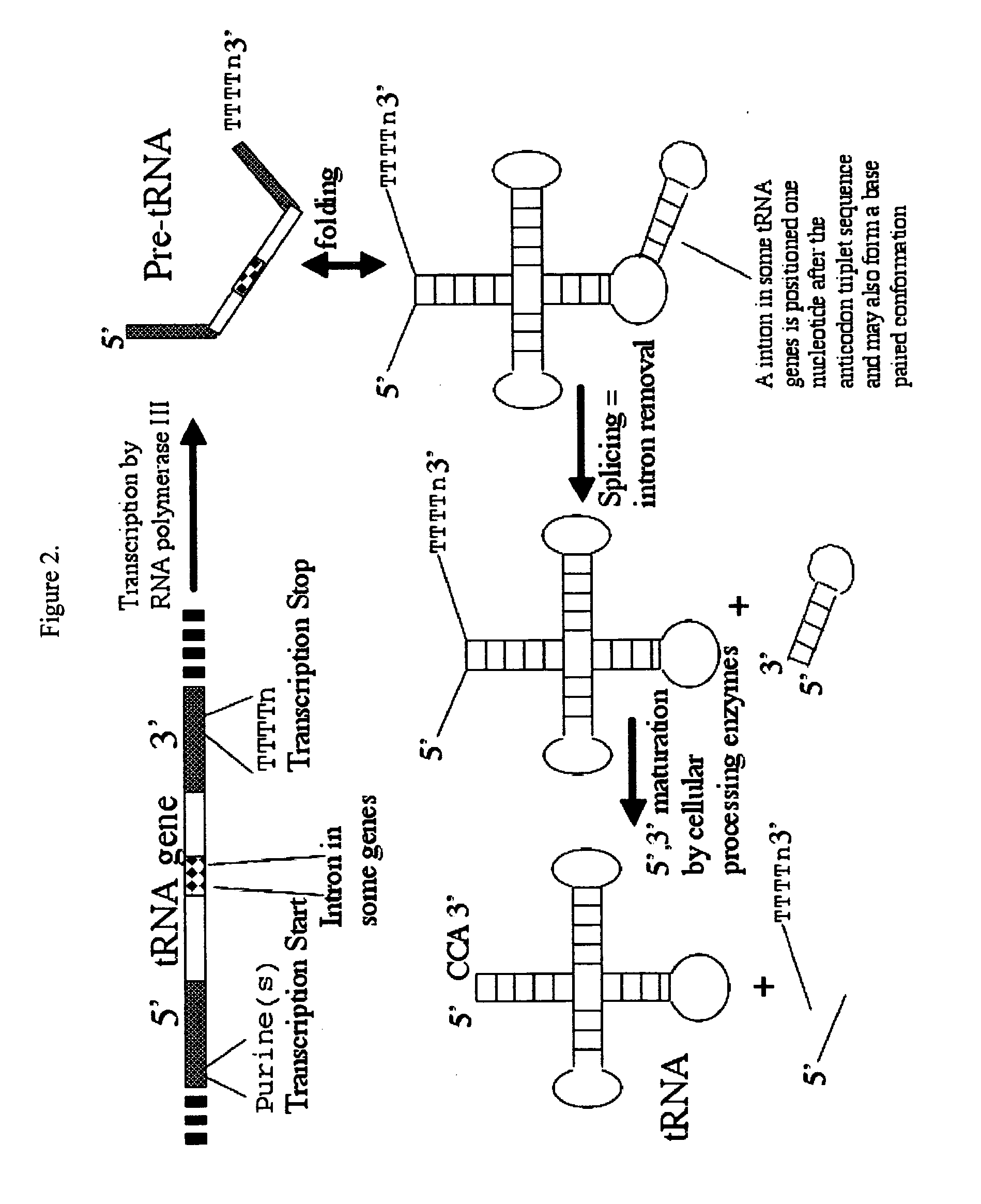
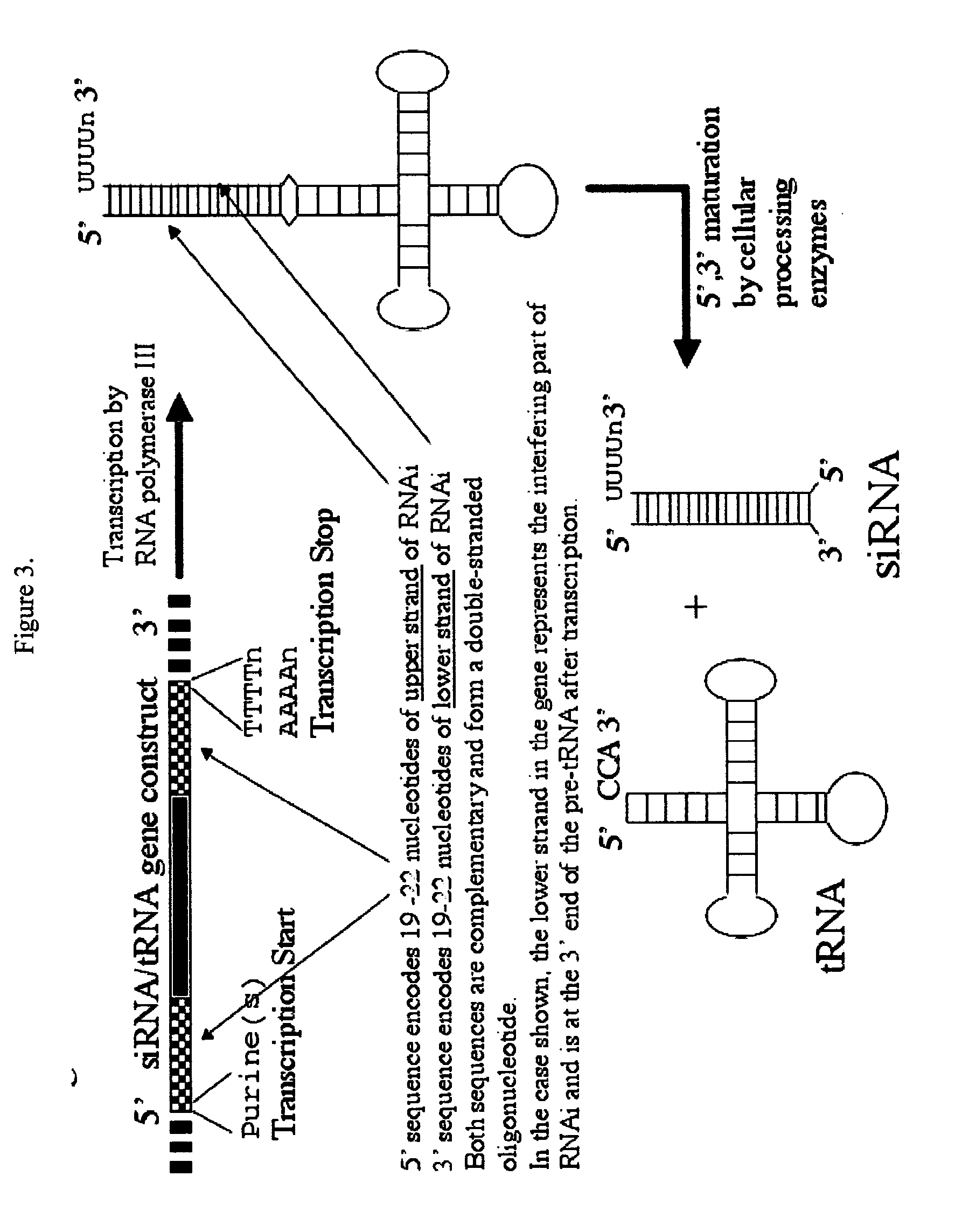
[0061] Commercially available components such as primers are used to isolate or PCR-amplify a human tRNA gene starting from genomic DNA. The primers are chimeric so that they add a 5′ and 3′ complementary overhang sequence that encodes a 19-21 nt long double stranded siRNA (see FIGS. 2 and 3). The siRNA sequence can be as long as 30 bp; however, longer sequences can invoke an antiviral response in the organism. The siRNA sequence is designed to partially encode the sequence of a known target gene and maybe selected from commercially available siRNA suppliers. The construct is cloned into a shuttle vector allowing amplification in bacterial systems and also stable transient expression in a mammalian cell or animal model. Injection or transformation of mice through tail vein injection is done as described by Gratsch et al. (2003 Genesis 37:12-7) or Giladi et al. (2003 Mol Ther 8:769-76). Kim et al. (2004 Nature Biotechnol 22:321-325) show that an interfer...

the structure of the environmentally friendly knitted fabric provided by the present invention; figure 2 Flow chart of the yarn wrapping machine for environmentally friendly knitted fabrics and storage devices; image 3 Is the parameter map of the yarn covering machine
Login to View More

PUM

PropertyMeasurementUnit
Efficiencyaaaaaaaaaa
Antisenseaaaaaaaaaa
Login to View More

Abstract

This invention relates to compositions and methods for transcription and expression of nucleic acids into organisms. In particular, the invention comprises a tRNA vector system to deliver and express short interfering nucleic acid, small interfering (siRNA) and micro RNA (miRNA) and antisense (asRNA) into an organism with high efficiency. The compositions further provide expression of nucleic acids to perform as therapeutic compounds in organisms.

Description

RELATED APPLICATION(S) [0001] This application claims the benefit of U.S. Provisional Application Ser. No. 60 / 551,921, filed Mar. 10, 2004, the contents of which are hereby incorporated in their entirety by reference herein.REFERENCE TO SEQUENCE LISTING [0002] Incorporated herein by reference in its entirety is a sequence listing, comprising SEQ ID NO:1 to SEQ ID NO:16, contained on a CD-R, filed as three identical copies of an ASCII referenced as “020-0501 US.ST25”, created on Mar. 9, 2005, in MS Windows 98 format and 4.21 KB in size. FIELD OF THE INVENTION [0003] This invention relates generally to the field of genetics, genomics and molecular biology. The invention relates to methods and materials used to modulate gene expression in a variety of applications, including use in therapeutic, diagnostic, target validation, and genomic discovery applications thereof. This invention also relates to small nucleic acid molecules, such as short interfering nucleic acid, short interfering ...

Claims

the structure of the environmentally friendly knitted fabric provided by the present invention; figure 2 Flow chart of the yarn wrapping machine for environmentally friendly knitted fabrics and storage devices; image 3 Is the parameter map of the yarn covering machine
Login to View More

Application Information

Patent Timeline
no application Login to View More
IPC IPC(8): A61K48/00C07H21/02C12N15/85C12Q1/68
CPCC12N2320/32C12N15/111
Inventor THOMANN, ULRICHSTANGE-THOMANN, NICOLE
Owner KATAHDIN BIOSCI
Features
  • R&D
  • Intellectual Property
  • Life Sciences
  • Materials
  • Tech Scout
Why Patsnap Eureka
  • Unparalleled Data Quality
  • Higher Quality Content
  • 60% Fewer Hallucinations
Social media
Patsnap Eureka Blog
Learn More